Approval Secrets: Financing a Vehicle on AISH or Disability in Alberta
Table of Contents
- Key Takeaways
- Introduction: Navigating the Alberta Disability Car Loan Landscape
- Why Lenders Treat Disability Income Differently
- The 'Non-Garnishable' Factor: Understanding Lender Risk
- Fixed Income vs. Variable Expenses: How Banks Calculate Your Debt-to-Income (DTI) Ratio
- The Stability Advantage: Why Disability Income Can Be More Attractive Than Seasonal Work
- AISH Regulations and Vehicle Ownership: What You Need to Know
- Asset Limits in Alberta: Ensuring Your Vehicle Doesn't Disqualify Your Benefits
- Primary vs. Secondary Vehicles: How AISH Views Car Equity
- Modifications and Accessibility: Potential Grants for Vehicle Adaptations
- The 5 'Approval Secrets' for AISH Recipients
- Secret #1: The Magic of the 'Micro' Down Payment
- Secret #2: Leveraging Provincial Tax Credits as Proof of Affordability
- Secret #3: Targeting Lenders Who Specialize in 'Non-Traditional' Income
- Secret #4: The 'Older Car, Shorter Term' Strategy
- Secret #5: Utilizing a Co-borrower vs. a Co-signer
- Preparing Your Application: The Documentation Checklist
- Choosing the Right Vehicle for Long-Term Success
- Factoring in 'Hidden' Costs: Alberta's Winterizing Needs
- Where to Apply: Banks vs. Specialized Disability Lenders in Alberta
- Big Five Banks: Why They Often Say 'No'
- Alberta Credit Unions: The Community-Based Advantage
- Specialized Auto Finance Companies
- Avoiding 'Predatory' Lenders
- Step-by-Step Guide to the Application Process
- Step 1: Check Your Credit Score
- Step 2: Calculate Your 'True' Budget
- Step 3: Get Pre-Approved
- Step 4: The Test Drive and Inspection
- Step 5: Finalizing the Paperwork
- Maintaining Your Loan and Building Your Credit
- The 'Credit Rebuilder' Effect
- Setting up 'Fail-Safe' Payments
- What to Do if You Miss a Payment
- Frequently Asked Questions (FAQs)
- Can I get a car loan if I have zero credit history and am on AISH?
- Does the age of the car matter when applying for a disability car loan in Alberta?
- How does a co-signer help if they don't live in Alberta?
- Will my AISH payments be reduced if I own a car worth more than $5,000?
- What is the maximum interest rate I should accept on a disability car loan?
- Can I use my disability back-pay as a down payment?
- Conclusion: Your Path to Mobility
Key Takeaways
- AISH is Valid Income: Being on the Assured Income for the Severely Handicapped (AISH) or other disability benefits does not disqualify you from car ownership.
- Garnishment Protection: Lenders are cautious because disability income cannot be garnished, but this risk can be offset with the right documentation.
- Asset Limits: In Alberta, your primary vehicle is generally exempt from AISH asset limits, but secondary vehicles or extreme luxury may trigger reviews.
- The Power of the Down Payment: Even a small amount upfront significantly lowers the lender's perceived risk and improves interest rates.
- Strategic Applications: Applying for a car loan with disability allowance in Alberta requires targeting lenders who understand non-traditional income streams.
Introduction: Navigating the Alberta Disability Car Loan Landscape
Living in Alberta without a reliable vehicle isn't just an inconvenience; for many, it’s a barrier to healthcare, community, and independence. Whether you are navigating the snowy streets of Edmonton or the sprawling outskirts of Calgary, a car is a necessity. However, when your primary source of income is the Assured Income for the Severely Handicapped (AISH) or a federal disability benefit, the path to the driver's seat can feel blocked by a wall of "no."
You might have been told that your income isn't "high enough" or that it "doesn't count" because it isn't from a traditional 9-to-5 job. These are common misconceptions. The reality is that disability income is some of the most stable income a person can have. Unlike a retail job that can be cut during a recession, disability payments are consistent. The secret to getting approved isn't about hiding your status; it's about framing your financial profile in a way that makes sense to a lender's risk model.
This guide is designed to pull back the curtain on the Alberta lending market. We are going to look at why banks hesitate, how AISH regulations impact your choices, and the specific steps you can take to apply for car loan with disability allowance alberta and actually get the keys in your hand.
Why Lenders Treat Disability Income Differently
The 'Non-Garnishable' Factor: Understanding Lender Risk
To understand how to get approved, you have to understand why you might have been denied in the past. In Alberta, most disability benefits, including AISH, are legally protected from garnishment. This means if a borrower stops paying their loan, a bank cannot take a portion of their disability cheque to cover the debt. For a traditional bank, this represents a "security gap." If things go wrong, they have fewer ways to recover their money compared to a borrower with a standard salary.
Fixed Income vs. Variable Expenses: How Banks Calculate Your Debt-to-Income (DTI) Ratio
Lenders use a formula called the Debt-to-Income (DTI) ratio to decide if you can afford a car. They look at your total monthly income and subtract your rent, utilities, and existing debts. Because AISH is a fixed amount, lenders often worry about "income shocks"—like a sudden rise in grocery prices or an unexpected medical bill. When you apply, the goal is to prove that your fixed income is more than enough to cover a modest car payment alongside your living expenses.
The Stability Advantage: Why Disability Income Can Be More Attractive Than Seasonal Work
While the non-garnishable nature is a hurdle, the consistency is a major plus. Alberta’s economy is often tied to oil and gas, leading to many "boom and bust" employment cycles. A lender looking at a seasonal oil field worker sees high risk. A lender looking at an AISH recipient sees someone whose income is guaranteed every single month. By highlighting this stability, you shift the conversation from "low income" to "guaranteed income."
AISH Regulations and Vehicle Ownership: What You Need to Know
Asset Limits in Alberta: Ensuring Your Vehicle Doesn't Disqualify Your Benefits
One of the biggest fears for Albertans on disability is that owning an asset like a car will result in their benefits being cut. Under current AISH regulations, your primary vehicle—the one you use for daily transportation—is considered an "exempt asset." This means its value does not count toward the $100,000 personal asset limit. You can own a reliable, modern car without fearing for your monthly cheque.
Primary vs. Secondary Vehicles: How AISH Views Car Equity
Where things get tricky is when you own more than one vehicle. A second car is typically considered a non-exempt asset. If you have a primary car and then finance a second "weekend" vehicle, the equity in that second car could potentially push you over your asset limit. If you are financing your first and only vehicle, you are generally in the clear, regardless of the loan amount.
Modifications and Accessibility: Potential Grants for Vehicle Adaptations
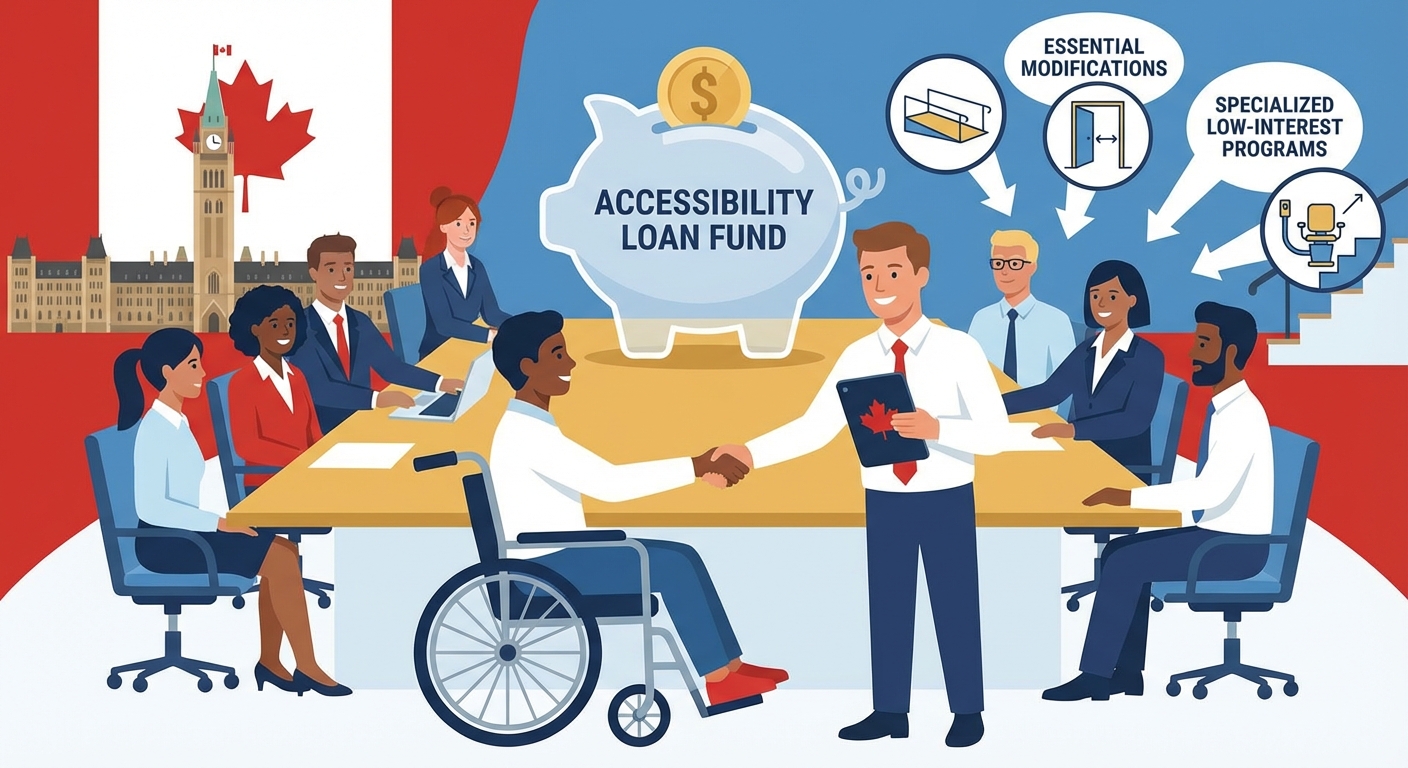
If your disability requires specific vehicle modifications (like hand controls or a ramp), these costs can often be financed into the loan, or you can seek provincial grants. Alberta has programs designed to help with the "extra" costs of accessibility. When talking to a lender, make sure they understand that a portion of the loan might be for these essential modifications, which can sometimes qualify for specialized low-interest disability programs.
The 5 'Approval Secrets' for AISH Recipients
Secret #1: The Magic of the 'Micro' Down Payment
Many people believe they need thousands of dollars down. In reality, even a $500 or $1,000 down payment can change the lender's internal "scorecard." It shows that you have the discipline to save and, more importantly, it gives you immediate equity in the vehicle. This reduces the "Loan-to-Value" (LTV) ratio, which is a fancy way of saying the bank is taking less of a gamble on you.
Secret #2: Leveraging Provincial Tax Credits as Proof of Affordability
When you apply, don't just show your AISH stub. Include your GST credit notices, the Alberta Child and Family Benefit (if applicable), and your Carbon Tax rebate (CAI). While these aren't "earned income," they represent additional cash flow that helps you cover fuel and insurance, making your car payment look much more manageable to a credit officer.
Secret #3: Targeting Lenders Who Specialize in 'Non-Traditional' Income
The "Big Five" banks (like RBC or TD) often use automated systems that automatically decline any application where the income source is listed as "Government Benefits." You want to look for specialized auto finance companies or local Alberta credit unions. These institutions often have "manual underwriting" processes where a real human looks at your story rather than a computer program.
Secret #4: The 'Older Car, Shorter Term' Strategy
It’s tempting to want a 7-year (84-month) loan to keep payments low. However, lenders see a long-term loan for someone on a fixed income as a high risk. If you choose a slightly older, reliable vehicle (like a 5-year-old Toyota or Honda) and a shorter 36 or 48-month term, you are much more likely to get an approval. The bank sees a clear, short path to being paid back.
Secret #5: Utilizing a Co-borrower vs. a Co-signer
There is a legal distinction here that matters. A co-signer just guarantees the loan if you fail. A co-borrower (like a spouse or family member) is equally responsible from day one. In Alberta, having a co-borrower with a traditional job can "bridge the gap" of the non-garnishable AISH income, allowing the lender to feel secure while you build the credit in your own name.
Preparing Your Application: The Documentation Checklist
When you apply for car loan with disability allowance alberta, your paperwork is your "secret weapon." Coming prepared makes you look professional and financially literate, which builds trust with the finance manager.
- Alberta ID: A valid driver's license is mandatory. If you have a restricted license, ensure you have the paperwork explaining the conditions.
- AISH/Disability Statements: Provide the last three months of benefit statements.
- Bank Records: Print out 90 days of full bank statements. Lenders are looking for "NSF" (Non-Sufficient Funds) fees. If your account is clean, you are a gold-star candidate.
- Proof of Residency: A utility bill or lease agreement in your name. Lenders want to know you aren't going to disappear.
- Notice of Assessment (NOA): Your most recent tax return from the CRA. This confirms your total annual income and proves you are up to date with the government.
Choosing the Right Vehicle for Long-Term Success
Getting approved is only half the battle; staying "approved" means being able to afford the car for the next few years. In Alberta, the cost of the car is only a portion of the monthly expense.
| Expense Category | Used Sedan (Example) | Used Small SUV (Example) |
|---|---|---|
| Monthly Loan Payment | $250 | $375 |
| Insurance (Alberta Average) | $150 | $180 |
| Fuel (1,200 km/month) | $140 | $210 |
| Total Monthly Commitment | $540 | $765 |
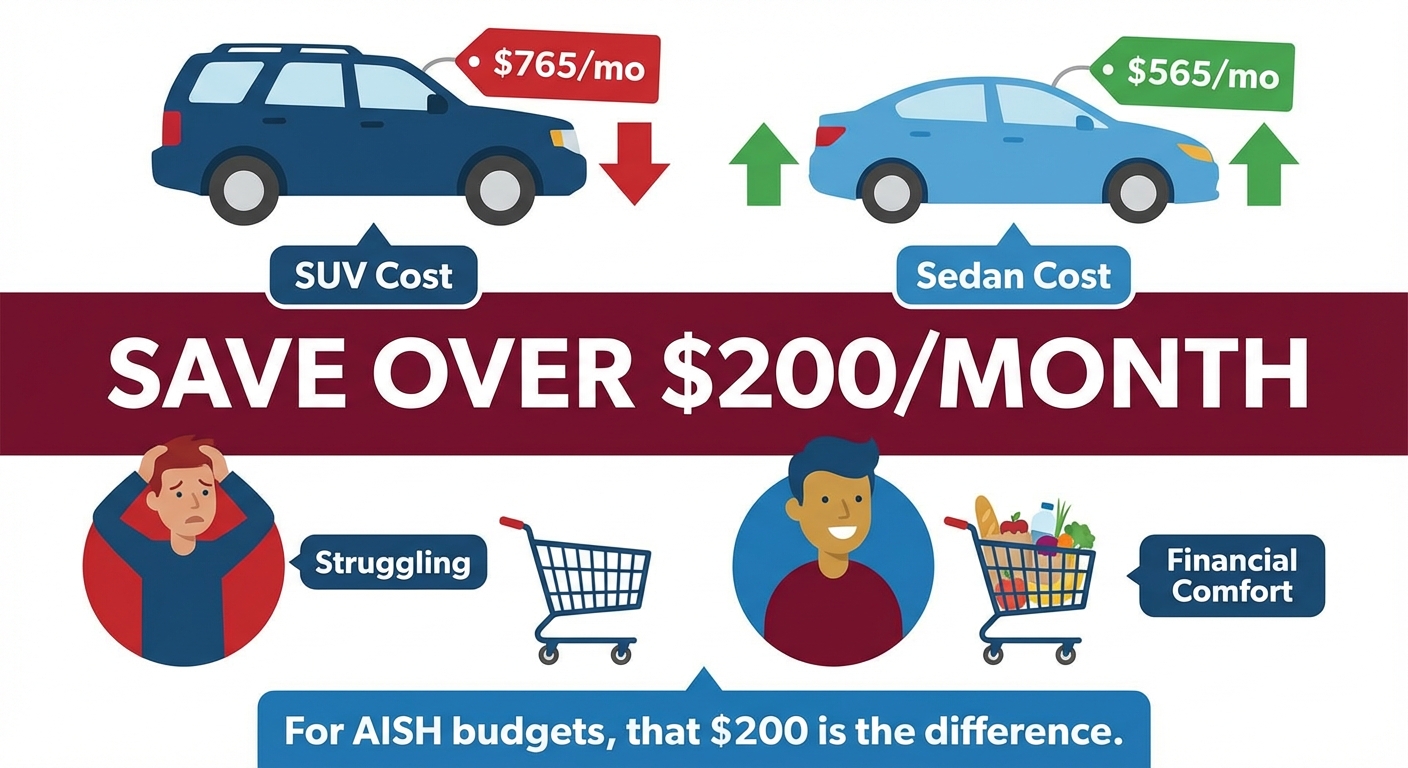
As you can see from the table, choosing a fuel-efficient sedan over an SUV can save you over $200 a month. For someone on a fixed AISH budget, that $200 is the difference between financial comfort and struggling to buy groceries.
Factoring in 'Hidden' Costs: Alberta's Winterizing Needs
Don't forget that in Alberta, you need winter tires. When negotiating your loan, ask if the dealership can include a set of winter tires in the financing package. It might add $15 a month to your payment, but it prevents a $1,000 "emergency" expense when the first snow falls in October.
Where to Apply: Banks vs. Specialized Disability Lenders in Alberta
Big Five Banks: Why They Often Say 'No'
The major banks are built for the "average" Canadian. Their risk algorithms are rigid. If you don't fit into a specific box, the computer spits out a denial. Unless you have a long-standing relationship with a personal banker who can override the system, the Big Five are usually the hardest place for AISH recipients to get a fair shake.
Alberta Credit Unions: The Community-Based Advantage
Credit unions like Servus or ConnectFirst operate differently. They are owned by their members and often have more flexibility to look at the "whole person." They understand the Alberta economy and the importance of AISH. If you have a clean banking history with a credit union, they are often your best bet for a lower interest rate.
Specialized Auto Finance Companies
This is where most people on disability find success. These lenders specialize in "subprime" or "non-prime" loans. They are comfortable with non-garnishable income because they have different recovery models. The trade-off is often a higher interest rate, but for many, this is a necessary step to building credit and gaining mobility.
Avoiding 'Predatory' Lenders
Be careful of "Buy Here, Pay Here" lots that don't report your payments to the credit bureau (Equifax or TransUnion). If they don't report your payments, you are paying high interest without the benefit of improving your credit score. Always ensure the lender is a reputable institution that will help you build your financial future.
Step-by-Step Guide to the Application Process
Step 1: Check Your Credit Score
Before you talk to a dealer, know your score. You can check this for free through services like Borrowell or Credit Karma. Look for errors. If there is a "late payment" listed that you actually paid on time, dispute it immediately. A 30-point jump in your score can save you thousands in interest.
Step 2: Calculate Your 'True' Budget
Financial experts recommend the "15% Rule." Your total car costs (payment, insurance, fuel) should not exceed 15% to 20% of your monthly income. If you receive $1,787 from AISH, your total car-related expenses should ideally stay around $350-$450. This is tight, which is why a used, fuel-efficient vehicle is almost always the smarter choice.
Step 3: Get Pre-Approved
Don't just walk onto a lot and fall in love with a car. Apply for a pre-approval first. This tells you exactly how much a lender is willing to give you and at what rate. It puts the power back in your hands during negotiations.
Step 4: The Test Drive and Inspection
For used vehicles, an inspection is non-negotiable. If you are on a fixed income, a $2,000 transmission failure six months after purchase is a disaster. Spend the $150 to have an independent mechanic look at the car before you sign the loan papers.
Step 5: Finalizing the Paperwork
Read the "Fine Print." Ensure there are no "pre-payment penalties." You want the ability to pay the loan off early if you receive a back-payment or an inheritance without being charged a fee.
Maintaining Your Loan and Building Your Credit
The 'Credit Rebuilder' Effect
A car loan is one of the fastest ways to improve a credit score. By making every payment on time, you are proving to the entire Canadian financial system that you are responsible. After 12 to 18 months of perfect payments, you may even be able to "refinance" your loan at a much lower interest rate.
Setting up 'Fail-Safe' Payments
Align your loan due date with your AISH payment date. If AISH arrives on the 1st, set your car payment for the 2nd. This ensures the money is always there before you have a chance to spend it on other necessities. Most lenders allow you to pick your payment date—use this to your advantage.
What to Do if You Miss a Payment
Life happens. If you know you are going to be short one month, call the lender *before* the payment is due. Most lenders have "skip-a-payment" programs or can move the due date by a few days. Being proactive prevents a "missed payment" strike on your credit report.
Frequently Asked Questions (FAQs)
Can I get a car loan if I have zero credit history and am on AISH?
Yes. While it is more challenging, many specialized lenders look at your "capacity to pay" (your income vs. expenses) rather than just your credit history. You may require a small down payment or a co-signer to get the initial approval, but it is entirely possible.
Does the age of the car matter when applying for a disability car loan in Alberta?
Absolutely. Most lenders prefer vehicles that are less than 7-10 years old and have under 150,000 kilometres. Older cars are harder to finance because the bank worries they will break down, leaving you with a repair bill *and* a loan payment you can no longer afford.
How does a co-signer help if they don't live in Alberta?
A co-signer can live anywhere in Canada, as long as they are a Canadian citizen or permanent resident with a stable income. Their location doesn't matter as much as their credit score and their willingness to be legally responsible for the debt if you cannot pay.
Will my AISH payments be reduced if I own a car worth more than $5,000?
Generally, no. In Alberta, your primary vehicle is an exempt asset. Whether it is worth $5,000 or $35,000, it usually does not impact your AISH eligibility. However, it is always wise to double-check with your AISH caseworker if you are planning to purchase a high-value luxury vehicle.
What is the maximum interest rate I should accept on a disability car loan?
Interest rates for "subprime" loans in Alberta typically range from 10% to 25%. While 25% is very high, it is sometimes the only starting point for those with poor credit. The goal should be to accept the loan, pay it perfectly for a year, and then refinance at a rate closer to 8-10%.
Can I use my disability back-pay as a down payment?
Yes, and this is a brilliant strategy. Using a large lump sum from a back-payment as a down payment can drastically reduce your monthly costs and ensure you get approved for a more reliable, newer vehicle.
Conclusion: Your Path to Mobility
Securing a vehicle while on disability in Alberta is not just about "getting a loan"—it's about gaining the freedom to move, work, and live on your own terms. The system can feel like it's designed to keep you stationary, but by understanding the "secrets" of the lending world, you can navigate the hurdles effectively.
Remember: your income is stable, your primary vehicle is an exempt asset, and there are lenders in Alberta who want your business. Don't let a "no" from a big bank stop you. Prepare your documents, save what you can for a down payment, and approach the process with the confidence of someone who knows their value. Your path to mobility starts with a single, well-prepared application.