Self-Employed? Your Bank Account *Is* Your Proof. Get Approved.
Table of Contents
- Key Takeaways: Your Fast Track to Self-Employed Car Loan Approval
- The Self-Employed Paradox: Why Your Freedom Doesn't Have to Mean Financing Hurdles
- The Old Myth vs. The New Reality: Dispelling 'No Pay Stub, No Loan'
- Understanding the Lender's Hesitation: What Makes Self-Employment 'Different'?
- Empowering Your Application: How to Turn Your Business Acumen into Loan Approval
- Your Bank Account: The Undeniable Ledger of Your Income and Stability
- Deep Dive: How Bank Statements Become Your Primary Income Verification
- Navigating Income Fluctuations: Showcasing Stability Amidst Variability
- Beyond the Deposits: What Else Lenders Glean from Your Banking Activity
- The 'Magic Number': How Many Months of Bank Statements Do You Really Need?
- Demystifying the Lender's Playbook: What They *Really* Look For in a Self-Employed Borrower
- Beyond the Pay Stub: The 'Five Cs' of Credit for the Entrepreneur
- The Debt-to-Income (DTI) Ratio: Your Self-Employed Calculation and Optimization
- Your Credit Score: The Unsung Hero for Self-Employed Loan Approval
- Business vs. Personal Finances: The Critical Distinction for Lenders
- Building Your Bulletproof Application: Beyond Bank Statements for Ultimate Credibility
- The Essential Document Checklist: What Each Paper Reveals About Your Business
- Crafting a Compelling 'Letter of Explanation': Your Narrative of Financial Strength
- Navigating the Lender Landscape: Who's Your Best Bet for Self-Employed Car Loans?
- Traditional Banks vs. Credit Unions: Familiarity and Flexibility
- Dealership Financing (The 'Indirect' Route): Convenience vs. Control
Self-Employed? Your Bank Account *Is* Your Proof. Get Approved for the Car Loan You Deserve.
Key Takeaways: Your Fast Track to Self-Employed Car Loan Approval
- ✓ Your bank statements are often the most powerful proof of income for self-employed individuals, showcasing consistent cash flow.
- ✓ Lenders prioritize stability, so demonstrate consistent deposits and responsible financial management, even with fluctuating income.
- ✓ Prepare a comprehensive 'financial narrative' beyond just bank statements, including tax returns, invoices, and a letter of explanation.
- ✓ Explore various lender types – traditional banks, credit unions, dealership financing, and specialized online lenders – to find the best fit for your unique situation.
- ✓ A strong credit score and a significant down payment can dramatically improve your approval odds and secure better rates.
You've embraced the entrepreneurial spirit, charting your own course, setting your own hours, and building something unique. That's a huge accomplishment! But when it comes to big purchases like a car, many self-employed Canadians hit a familiar roadblock: lenders who just don't seem to 'get' your income structure. Forget the traditional pay stub; your financial life is a dynamic tapestry of invoices, deposits, and strategic write-offs. The good news? Your bank account, meticulously managed and consistently active, is often the most compelling proof of your financial health. It’s not just a record; it's your story, told in transactions. At SkipCarDealer.com, we understand this reality and are here to guide you through the process of turning your financial narrative into car loan approval.
The Self-Employed Paradox: Why Your Freedom Doesn't Have to Mean Financing Hurdles
The Old Myth vs. The New Reality: Dispelling 'No Pay Stub, No Loan'
For decades, the standard for proving income to a lender was straightforward: a bi-weekly or monthly pay stub from a consistent employer, perhaps a T4 slip at tax time. This provided a clear, predictable snapshot of your earnings, making risk assessment relatively simple for financial institutions. For the self-employed, however, this traditional model felt like a brick wall. The common myth was, "No pay stub, no loan." Many entrepreneurs were (and still are) met with skepticism, often being told their income was too 'unstable' or 'unverifiable.' This outdated notion created unnecessary stress and limited access to essential financing for a growing segment of the Canadian workforce.
But the Canadian economy has evolved dramatically. The gig economy, independent contracting, and small business ownership are no longer niche sectors; they are mainstream. Lenders are slowly but surely adapting. They're realizing that a well-managed self-employment income can be just as, if not more, robust than a traditional salary. The new reality is that while the proof might look different, the underlying financial stability is what truly matters. Your financial records, particularly your bank statements, are now recognized as powerful, undeniable evidence of your capacity to manage and repay a loan.
Understanding the Lender's Hesitation: What Makes Self-Employment 'Different'?
It's helpful to step into a lender's shoes to understand their perspective. Their primary goal is to assess risk and ensure repayment. For self-employed individuals, several factors can make this assessment seem more complex than for a traditionally employed person:
- Income Volatility: Self-employed income can fluctuate. Some months are boom times, others are slower. This variability, while normal for business, can appear unpredictable to a lender accustomed to fixed salaries.
- Expense Write-offs Affecting Taxable Income: Entrepreneurs wisely utilize legitimate business expenses to reduce their taxable income. While smart for tax purposes, this can make your reported net income on tax returns appear lower than your actual gross cash flow, which is what you live on and use to service debt.
- Lack of a Clear Employer: There's no HR department to call for employment verification, no corporate structure to guarantee continued employment. Lenders need to understand the source and consistency of your income streams.
- Commingled Finances: For some sole proprietors, personal and business finances can become intertwined, making it harder for lenders to clearly differentiate between business revenue and personal disposable income.
Understanding these concerns isn't about accepting defeat; it's about knowing how to proactively address them in your application. It’s about presenting your financial information in a way that minimizes perceived risk and highlights your inherent stability.
Empowering Your Application: How to Turn Your Business Acumen into Loan Approval
Instead of viewing your self-employed status as a hurdle, consider it an opportunity to showcase your financial savviness. As an entrepreneur, you're already adept at managing budgets, forecasting revenue, and navigating financial complexities. These are precisely the skills lenders appreciate. Your application becomes a chance to tell a compelling story of financial strength and responsible management, even if it doesn't fit the traditional mold.
The key lies in comprehensive documentation and clear communication. While your income might be different, it can often be even more robustly documented, provided you know exactly what lenders are looking for. By understanding their criteria and preparing your records accordingly, you can transform your self-employment into a powerful asset in your loan application, demonstrating not just income, but also resilience and financial discipline.
Pro Tip: Start thinking of your financial history as a compelling story. Every bank deposit, every invoice paid, contributes to the narrative of your business's health and your capacity to repay.
Your Bank Account: The Undeniable Ledger of Your Income and Stability
Deep Dive: How Bank Statements Become Your Primary Income Verification
For self-employed individuals, bank statements are not just records; they are your financial resumé. Lenders scrutinize these documents for a clear, consistent pattern of income. They're looking for proof of regular deposits from clients, sales, or contract work that directly reflect your business activity. Here’s what they meticulously analyze:
- Consistency of Deposits: Are deposits happening regularly (weekly, bi-weekly, monthly)? Even if the amounts vary, a consistent frequency signals ongoing business operations.
- Deposit Sources: Lenders want to see where the money is coming from. Deposits labelled "Client Payment," "Contract Work," or "Sales Revenue" are ideal. Avoid large, unexplained cash deposits that can raise red flags.
- Average Monthly Income: They will typically average your total deposits over several months (often 6-12) to determine a consistent monthly income figure. This helps them account for natural fluctuations.
- Gross vs. What's Available for Loan Payments: While they look at gross deposits, they also consider your expenses. However, the consistent inflow of gross revenue demonstrates the scale of your business operations and your potential capacity to service debt, even if some of it is earmarked for business costs.
- Transaction History: Beyond just deposits, they assess the overall activity. A healthy account shows regular transactions, indicating an active business and responsible management.
Your bank statements offer an unbiased, third-party verification of your income. They cut through the complexities of varying pay structures and provide a tangible, numerical representation of your earnings over time.
Navigating Income Fluctuations: Showcasing Stability Amidst Variability
It's a reality for many self-employed Canadians: income isn't always a steady, predictable stream. Some months are incredibly busy and profitable, while others might see a dip due to project cycles, seasonal demand, or investment in new ventures. The key is not to hide these fluctuations but to explain them effectively and demonstrate overall stability.
Strategies for presenting fluctuating income:
- Average Over Time: Lenders often calculate an average monthly income over 6-12 months (sometimes up to 24 months for highly seasonal businesses). Highlight this average as your true earning potential.
- Explain Seasonal Peaks and Troughs: If your business is seasonal (e.g., landscaping in summer, tax preparation in spring), provide a brief explanation. Lenders understand these patterns, especially if your long-term averages are strong.
- Show Resilience: If you had a period of lower income, explain the reason (e.g., a planned sabbatical, a major client project concluding, or an investment in new equipment). Show how you recovered or diversified your income streams.
- Projections (with backing): While not primary proof, if you have new contracts or projects starting, you can mention these in a letter of explanation, backed by signed agreements or invoices.
The goal is to paint a picture of a resilient business with a solid, albeit sometimes variable, income stream that can comfortably support car loan payments.
Pro Tip: Maintain separate business and personal bank accounts. This clarity makes it significantly easier for lenders to assess your business income without sifting through personal transactions, streamlining the approval process.
Beyond the Deposits: What Else Lenders Glean from Your Banking Activity
Lenders don't just look at how much money comes in; they also analyze your spending habits and overall cash flow management. Your banking activity provides a holistic view of your financial responsibility:
- Spending Habits: While they won't micromanage your expenses, they'll look for patterns. Are you consistently spending more than you earn? Are there frequent large, discretionary purchases that might indicate poor budgeting?
- Cash Flow Management: Do you typically have a healthy balance in your account, or are you frequently close to zero? Good cash flow management shows you have a buffer for unexpected expenses and can handle regular payments.
- Overdrafts and NSFs: Frequent overdrafts or Non-Sufficient Funds (NSF) charges are major red flags. They indicate financial instability and a potential inability to manage your money, making you a higher risk.
- Savings Patterns: Evidence of regular savings, even small amounts, demonstrates financial prudence and foresight, which can be a positive indicator for lenders.
Every transaction, every balance, tells a part of your financial story. Presenting clean, well-managed bank accounts reinforces your image as a responsible borrower.
The 'Magic Number': How Many Months of Bank Statements Do You Really Need?
One of the most common questions from self-employed individuals is about the required length of banking history. While there's no single 'magic number' that applies to every lender, most prefer to see:
- 6-12 Months: This is the standard minimum. Six months provides a reasonable snapshot of recent activity, while twelve months offers a full year's cycle, which is excellent for demonstrating consistency and handling seasonal variations.
- 24 Months (for significant fluctuations): If your income is highly seasonal or has experienced significant, but explainable, fluctuations, some lenders might request up to 24 months of statements. This longer period helps them identify underlying stability despite short-term variability.
The duration is crucial because it allows lenders to establish a reliable pattern of income, assess your cash flow management over time, and gain confidence in your ability to sustain loan payments. The more history you can provide that shows consistent income and responsible banking, the stronger your application will be.
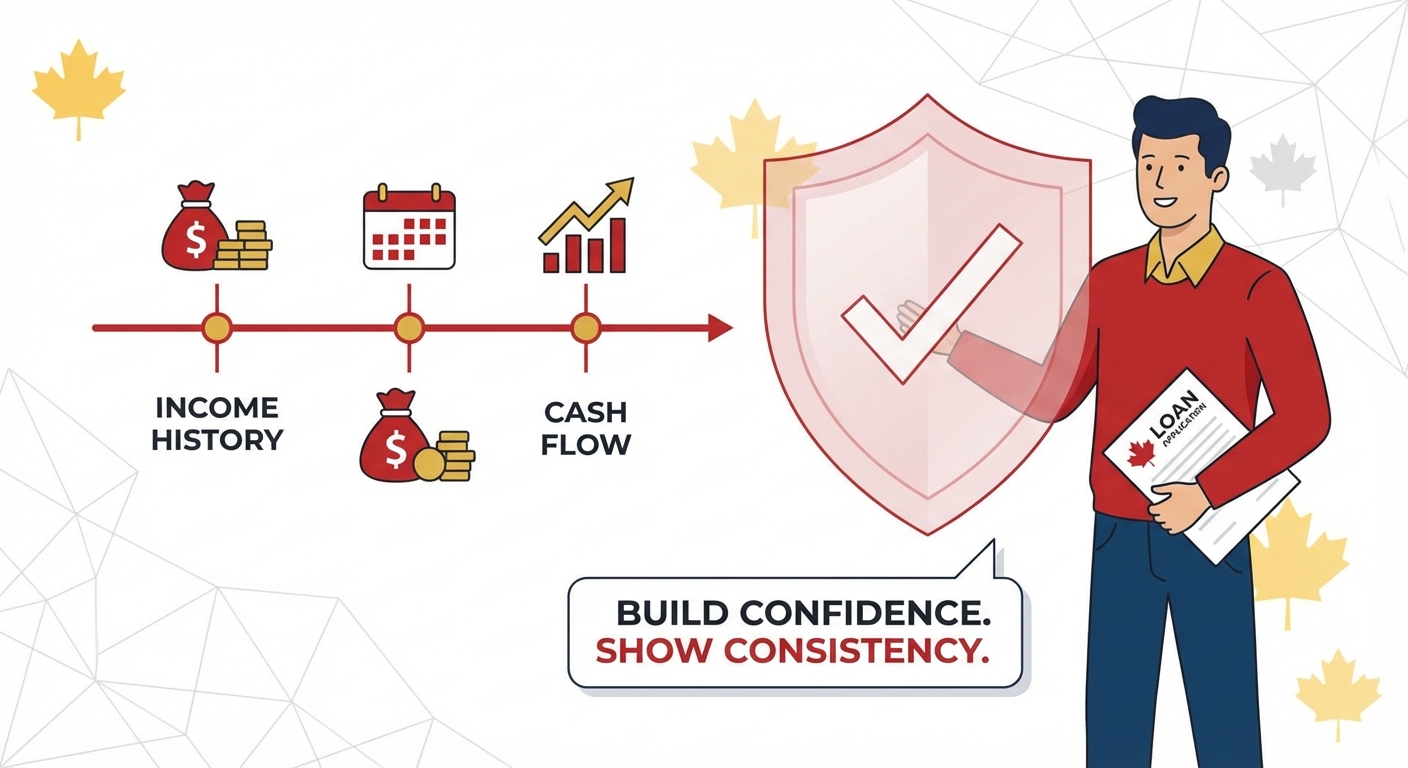
Demystifying the Lender's Playbook: What They *Really* Look For in a Self-Employed Borrower
Beyond the Pay Stub: The 'Five Cs' of Credit for the Entrepreneur
Lenders evaluate loan applications based on fundamental principles, often summarized as the 'Five Cs' of Credit. For the self-employed, these principles are just as relevant, though interpreted through a different lens:
- Character: This refers to your willingness to repay debt. For the self-employed, Character is primarily built through your personal credit history. A strong track record of on-time payments on credit cards, lines of credit, and past loans demonstrates reliability and trustworthiness.
- Capacity: Your ability to repay the loan. For self-employed individuals, this is where bank statements, tax returns, and profit & loss statements come into play. Lenders assess your consistent cash flow and calculate your Debt-to-Income (DTI) ratio based on your verifiable income.
- Capital: The money you've invested in your business or are putting towards the car purchase. A significant down payment on the vehicle (your capital contribution) reduces the loan amount and the lender's risk, making you a more attractive borrower.
- Collateral: The asset being financed, which serves as security for the loan. For a car loan, the vehicle itself is the collateral. Lenders assess its market value, age, and condition to ensure it provides adequate security if you were unable to repay.
- Conditions: The economic environment and the specific terms of the loan. This includes interest rates, loan term, and broader market trends. For self-employed individuals, the stability of their industry or client base can also fall under conditions.
By understanding how lenders apply these Cs to your unique situation, you can strategically strengthen each aspect of your application.
The Debt-to-Income (DTI) Ratio: Your Self-Employed Calculation and Optimization
Your Debt-to-Income (DTI) ratio is a crucial metric that lenders use to assess your capacity to take on new debt. It's the percentage of your gross monthly income that goes towards servicing your monthly debt payments. For the self-employed, calculating DTI requires a bit more nuance:
Calculation: Lenders will typically use your average verifiable monthly income (often from bank statements or tax returns, after business expenses) as your gross income. They then sum up all your minimum monthly debt payments (credit cards, existing loans, mortgage/rent, etc.) and divide that by your average monthly income. For example, if your average monthly income is $5,000 and your total monthly debt payments are $1,500, your DTI is 30% ($1,500 / $5,000).
Optimization: Lenders generally prefer a DTI of 36% or lower, though some may go higher depending on other factors. Here’s how to optimize yours:
- Reduce Existing Debts: Pay down credit card balances or small personal loans before applying for a car loan. This directly lowers your monthly debt obligations.
- Increase Verifiable Income: Ensure all your business income is flowing through your bank accounts and is clearly documented.
- Accurate Income Reporting: Work with your accountant to understand how your business write-offs affect your reported income for lending purposes, and be prepared to explain the difference between gross cash flow and net taxable income.
A lower DTI signals to lenders that you have ample disposable income to comfortably make your car loan payments.
Your Credit Score: The Unsung Hero for Self-Employed Loan Approval
While your bank statements prove income, your credit score is the single most important indicator of your financial reliability and your willingness to repay debt. For self-employed individuals, a strong personal credit score is even more paramount because it compensates for the perceived 'risk' of non-traditional income. It's your financial reputation in a three-digit number.
Lenders use your credit score to gauge your payment history, how much credit you use (utilization), the length of your credit history, and the types of credit you have. A higher score (generally 650+ in Canada for prime rates, though lower scores can still get approved) indicates a lower risk of default.
Steps to boost your credit score:
- Pay Bills On Time, Every Time: Payment history is the biggest factor. Set up automatic payments for all your bills.
- Reduce Credit Card Balances: Keep your credit utilization low (ideally below 30% of your available credit).
- Check Your Credit Report: Regularly review your credit report for errors. Disputing inaccuracies can quickly improve your score. For more on this, check out our guide on The Truth About the Minimum Credit Score for Ontario Car Loans.
- Avoid New Credit Applications: Limit new credit inquiries in the months leading up to your car loan application.
Pro Tip: Regularly monitor your credit report for errors. Disputing inaccuracies can quickly improve your score, which is a critical factor for securing favorable loan terms as a self-employed individual.
Business vs. Personal Finances: The Critical Distinction for Lenders
This cannot be stressed enough: the clearer the separation between your business and personal finances, the easier it will be for lenders to assess your income and financial health. Commingling funds – using one bank account for both business revenue/expenses and personal spending – creates a murky picture that raises red flags for lenders.
Why separation is crucial:
- Clarity for Income Verification: With separate accounts, lenders can easily see your gross business deposits without having to sift through personal grocery bills or entertainment expenses. This simplifies their analysis and speeds up the approval process.
- Professionalism: It signals to lenders that you run your business with professionalism and financial discipline, traits they highly value.
- Tax Compliance: While not a direct lending concern, maintaining separate accounts also simplifies tax preparation and demonstrates good accounting practices.
Even if you're a sole proprietor without a formal business entity, creating a distinct bank account for all business-related transactions is highly recommended. A well-maintained business ledger, even a simple spreadsheet, further reinforces your financial credibility.
Building Your Bulletproof Application: Beyond Bank Statements for Ultimate Credibility
The Essential Document Checklist: What Each Paper Reveals About Your Business
While bank statements are central, a comprehensive application includes several supplementary documents that build a stronger, more credible financial narrative. Each document tells a unique part of your story and reinforces your capacity to repay. For more details on preparing paperwork, you might find our article on Approval Secrets: Exactly What Paperwork You Need for Alberta Car Financing helpful.
- Tax Returns (T1 Generals, Schedule C/T2125):
- Why it's important: These are the official, government-verified records of your income for the past 2-3 years. Lenders typically ask for two years of T1 Generals and the accompanying Statement of Business or Professional Activities (T2125 for sole proprietors or partnerships, or T2 for corporations).
- What it reveals: It shows your net taxable income, which, while potentially lower than your cash flow due to write-offs, provides a baseline of your reported earnings over a longer period. Be prepared to explain the difference between your gross cash flow (from bank statements) and your net taxable income.
- Financial Statements (Profit & Loss, Balance Sheet):
- Why it's important: For more established businesses, these provide a detailed snapshot of your financial health.
- What it reveals: A Profit & Loss (P&L) statement shows your revenues, expenses, and net profit over a specific period. A Balance Sheet shows your assets, liabilities, and equity at a specific point in time. These offer deeper insights into your business's operational efficiency and solvency.
- Client Contracts & Invoices:
- Why it's important: These provide proof of ongoing work, future income, and the stability of your client base.
- What it reveals: Signed contracts demonstrate committed future revenue. Recent invoices show consistent billing and active client relationships, reinforcing the legitimacy and longevity of your business.
- Letters from Accountants or Key Clients:
- Why it's important: Third-party verification adds significant weight to your application.
- What it reveals: A letter from your accountant confirming your average income, business longevity, or financial health carries professional credibility. A letter from a key client confirming an ongoing relationship or project can also demonstrate stability.
Crafting a Compelling 'Letter of Explanation': Your Narrative of Financial Strength
Sometimes, numbers alone don't tell the full story. A well-written 'Letter of Explanation' (LOE) allows you to provide context, address any perceived weaknesses, and highlight your unique strengths as a self-employed borrower. This is your opportunity to proactively manage the narrative and build confidence with the lender.
What to include in your LOE:
- Address Income Fluctuations: If your income has dipped in a particular period, explain why (e.g., a planned business investment, a major project completion, parental leave, or a temporary market slowdown).
- Highlight Growth: If your business has recently expanded or secured significant new contracts, explain how this will impact your future income and repayment capacity.
- Clarify Write-offs: Briefly explain how legitimate business expenses reduce your taxable income but do not necessarily reflect a reduction in your cash flow available for personal use and loan payments.
- Emphasize Stability: Reiterate your business longevity, consistent client base, and responsible financial management practices.
- Express Commitment: Clearly state your commitment to repaying the loan and your understanding of the terms.
Keep your letter concise, honest, and professional. The goal is to provide clarity and reassurance, turning potential questions into confident answers.
Pro Tip: Organize all your documents into a single, clearly labeled digital folder (and print copies). A well-prepared application signals professionalism and makes the lender's job easier, potentially speeding up approval.
Navigating the Lender Landscape: Who's Your Best Bet for Self-Employed Car Loans?
The lending landscape in Canada is diverse, and not all lenders approach self-employed applicants in the same way. Understanding your options is key to finding the best fit and securing favourable terms.
Traditional Banks vs. Credit Unions: Familiarity and Flexibility
Most Canadians have a relationship with a traditional bank, and it's often the first place they think of for a loan. Credit unions, while similar, often operate with a different philosophy. Here's a comparison:
| Feature | Traditional Banks (e.g., RBC, TD, BMO) | Credit Unions (e.g., Vancity, Meridian, Desjardins) |
|---|---|---|
| Familiarity & Reach | Widespread branches, large online presence. Often your primary banking institution. | Community-focused, local presence. Members often have a stronger personal relationship. |
| Rigidity vs. Flexibility | Can be more rigid with self-employed income verification, preferring clear, consistent tax returns over bank statements alone. | Often more flexible and willing to look at the 'whole picture' of your finances, including bank statements and a strong personal narrative. |
| Rates | Highly competitive rates for strong credit profiles and clear income proof. | Competitive rates, sometimes slightly higher than big banks for prime borrowers, but potentially more accessible for unique situations. |
| Personalized Service | Varies by branch and relationship manager. Can feel impersonal. | Often known for more personalized service and a willingness to understand individual circumstances. |
| Approval Odds for Self-Employed | Good for those with long-standing, clearly documented, high-income self-employment. Harder for newer or fluctuating incomes. | Potentially higher approval odds for self-employed due to their community-centric approach and willingness to consider alternative income proof. |
If you have a strong, long-standing relationship with your bank, starting there can be beneficial. However, don't overlook credit unions, especially if your income situation requires a more nuanced approach.
Dealership Financing (The 'Indirect' Route): Convenience vs. Control
When you finance through a dealership, you're not actually borrowing directly from them. Dealerships act as intermediaries, working with a network of banks, credit unions, and specialized lenders to find financing options for you. This is known as indirect lending.
- Convenience: It's a one-stop-shop. You can choose your car and arrange financing all in one place, often getting immediate approval.
- Access to Multiple Lenders: Dealerships have relationships with many lenders, including those who specialize in unique situations like self-employment or less-than-perfect credit. This can sometimes lead to approval when direct applications elsewhere might fail. For more insights into financing options for self-employed individuals, particularly for used cars, consider reading Approval Secrets: Navigating the Best Used Car Finance Options for Ontario’s Self-Employed.
- Potential for Less Transparency: While convenient, you might have less control over the specific lender or the exact terms until the final paperwork. It's crucial to