Life in Canada doesn't always go according to plan. Whether it's an unexpected repair bill for your home in Calgary, a sudden medical expense in Toronto, or a temporary gap in employment in Halifax, financial emergencies have a way of showing up at the worst possible times. For many Canadians, the first instinct is to head to the bank. But if your credit score has seen better days, that walk into a traditional branch can often end in a polite but firm "no."
This is where car title loans enter the conversation. They are often marketed as the "fastest way to get cash" or the "no-credit-check solution." But what exactly are they, and more importantly, what is the real cost of using your vehicle as a piggy bank? In the Canadian landscape, a car title loan is a form of secured lending where you use your vehicle's ownership (the title) as collateral. You get the cash you need, you keep driving your car, but the lender becomes a lienholder on your asset.
The "truth" about these loans isn't black and white. For some, they are a vital bridge during a crisis; for others, they are a high-speed lane into a debt trap. To navigate this financial tool safely, you need to understand the mechanics, the provincial regulations that protect you, and the very real risks involved in pledging your primary mode of transportation for a short-term loan.
Key Takeaways
- High Interest Rates: Expect interest rates significantly higher than traditional bank loans, often ranging from 30% to over 60% APR.
- Collateral is King: Your credit score is secondary. The loan amount is determined primarily by the wholesale value of your vehicle.
- You Keep the Keys: Unlike a pawn shop, you continue to drive your vehicle while repaying the loan.
- Repossession Risk: If you default on payments, the lender has the legal right to seize and sell your vehicle to recover their funds.
- Provincial Oversight: Regulations vary by province. What is legal in Ontario might be restricted differently in British Columbia or Alberta.
Understanding the Mechanics: How Car Title Loans Work
At its core, a car title loan is a form of asset-based lending. In the world of traditional finance, lenders look at your "character" (credit score) and "capacity" (income) to decide if you are a safe bet. Title lenders shift the focus almost entirely to "collateral." By taking a legal interest in your vehicle, the lender mitigates their risk. If you don't pay, they take the car.
This shift in focus is why you see "No Credit Check" signs across the country. The lender isn't worried about that missed credit card payment from three years ago because they are holding a lien on an asset that is worth more than the loan they are giving you. A "lien" is a legal claim or right against a property that is used as collateral to satisfy a debt. When you sign a title loan agreement, you are granting the lender a lien on your vehicle, which is registered with the provincial personal property registry.
The amount you can borrow typically ranges from 25% to 50% of the vehicle's "Black Book" value. If your SUV is worth $20,000, you might be eligible for a loan between $5,000 and $10,000. The process is designed for speed, often taking less than 24 hours from application to funding.
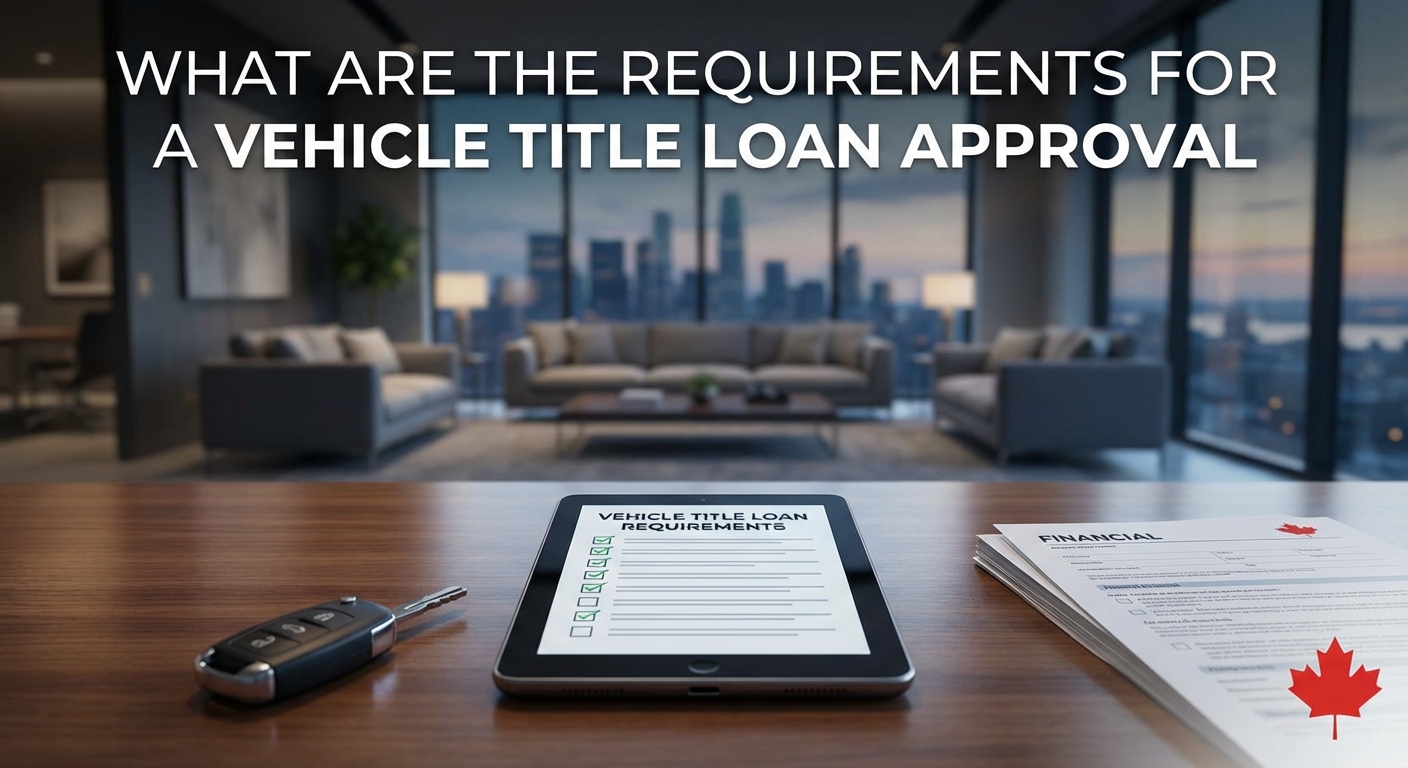
Eligibility Requirements in Canada
While the barriers to entry are lower than a bank loan, there are still strict criteria you must meet to qualify for a title loan in Canada. Lenders need to ensure that the asset is yours to pledge and that it has enough value to cover the loan.
1. Age and Residency
You must be the age of majority in your province (18 or 19) and a legal resident of Canada. Most lenders require a permanent address, as they need to know where the vehicle is stored.
2. Vehicle Specifications
Not every car qualifies. Most Canadian title lenders have "cut-off" points for vehicle age and mileage. Generally, your car should be less than 10 to 12 years old and have fewer than 200,000 kilometres on the odometer. Luxury brands may have slightly more leeway, while economy cars are strictly vetted for their resale potential.
3. Documentation
You will need more than just the keys. Prepare to provide:
- The original vehicle title/registration (it must be in your name).
- A valid Canadian driver's licence.
- Proof of residency (utility bills).
- Proof of insurance (Collision and Comprehensive coverage is mandatory).
- A second set of keys (often required by the lender).
4. Income Requirements
Do you need a job? Surprisingly, many title lenders do not require traditional employment. However, they do require "proof of ability to pay." This can include Canada Pension Plan (CPP) payments, disability income, or even self-employment earnings. The lender wants to see that you have a monthly inflow of cash to handle the interest payments.
The Financial Reality: Interest Rates, Fees, and APR
Why don't the big five banks offer title loans? The answer lies in the risk profile and the regulatory caps on interest. Banks prefer lower-interest, long-term relationships. Title lenders operate in the "subprime" or "alternative" market, where the cost of doing business-and the risk of default-is much higher. Consequently, the borrower pays the price.
In Canada, the Criminal Code sets the maximum effective annual rate of interest at 60%. However, it is vital to distinguish between the "interest rate" and the "Annual Percentage Rate" (APR). A lender might tell you the interest is "only 5% per month." While that sounds manageable, a 5% monthly rate compounds to an APR of over 60% when you factor in fees.
| Fee Type | Average Cost (CAD) | Description |
|---|---|---|
| Administrative Fee | $200 - $500 | Charged for processing the paperwork and setting up the file. |
| Lien Registration | $50 - $150 | The cost of registering the lender's interest with the province. |
| Vehicle Inspection | $100 - $200 | A fee to have a third party verify the condition and value of the car. |
| GPS Installation | $150 - $300 | Some lenders require a GPS tracker to be installed for easy repossession. |
The Legal Landscape: Provincial Regulations and Consumer Protection
Banking is federally regulated in Canada, but "payday" and "high-cost" credit (which includes title loans) often fall under provincial jurisdiction. This creates a patchwork of rules that change as you cross borders.
Ontario
In Ontario, the Payday Loans Act covers some of these transactions, but many title loans are structured to fall under the Consumer Protection Act. Ontario has been aggressive in requiring lenders to be transparent about their APR and forbidding certain predatory collection practices.
British Columbia
BC has some of the strictest regulations in the country. Lenders must be licensed as "High-Cost Credit Grantors." This requires them to follow specific disclosure rules, and it gives borrowers a "cooling-off period" where they can cancel the loan within one or two business days without penalty.
Alberta
Alberta's Consumer Protection Act also regulates high-cost credit. Lenders must provide a standardized front page on all contracts that clearly lists the interest, fees, and the total amount to be repaid. This prevents lenders from hiding the true cost in the fine print of a twenty-page document.
Before signing anything, you should verify the lender's licence. Every province has a consumer affairs office (like Consumer Protection BC or the Ontario Ministry of Public and Business Service Delivery) where you can search for the company's name to ensure they are operating legally.
The Risks: What Happens If You Can't Pay?
The most significant risk of a title loan is right there in the name: your title. If you fail to make payments, the lender can initiate the repossession process. Unlike a credit card company that has to sue you in court to get their money, a title lender already has a registered interest in your property.
The Mechanics of Repossession
In most provinces, if you miss a payment (or two, depending on the contract), the lender can hire a licensed bailiff to seize the vehicle. They don't need a court order to take the car from your driveway or a public parking lot. Once the vehicle is seized, it is typically sold at auction. If the car sells for more than you owe (including the high costs of towing and storage), you are legally entitled to the surplus. However, if it sells for less, you may still be on the hook for the "deficiency balance."
The Credit Score Paradox
Many title lenders do not report your positive payments to credit bureaus like Equifax or TransUnion. This means taking out a title loan usually won't help you rebuild your credit. However, if you default and the car is repossessed, that negative event will likely be reported, further damaging your score and making it even harder to get traditional financing in the future.
Car Title Loans vs. Alternatives: A Comparison
Before you commit your vehicle, you must look at the other players in the emergency credit market. Title loans are often compared to payday loans, but they are very different animals.
| Feature | Car Title Loan | Payday Loan | Personal Loan (Bad Credit) |
|---|---|---|---|
| Loan Amount | Up to $25,000+ | Max $1,500 | $500 - $10,000 |
| Interest Rate | 30% - 60% APR | ~300% - 500% APR | 15% - 47% APR |
| Collateral | Vehicle Title | Next Paycheque | Usually Unsecured |
| Risk | Loss of Vehicle | Wage Garnishment | Credit Damage/Legal Action |
| Speed | Same Day | Instant | 1 - 3 Days |
As the table shows, a title loan is actually "cheaper" than a payday loan in terms of APR, but the risk is significantly higher because you could lose your transportation. If you have a credit union membership, always check their "small amount" or "emergency" loan options first. Many Canadian credit unions have programs specifically designed to steer members away from high-interest alternative lenders.
How to Choose a Reputable Title Loan Lender in Canada
The alternative lending industry has its share of "bad actors." To protect yourself, you need to be a savvy shopper. Avoid any lender that asks for "upfront fees" before the loan is approved. This is a common scam; legitimate lenders deduct their fees from the loan proceeds, they don't ask you to e-transfer money for "insurance" or "processing" beforehand.
Check the Better Business Bureau (BBB) and Google reviews. Look for patterns. Do people complain about hidden fees? Do they mention aggressive collection tactics? A reputable lender will have a physical office address in Canada and a transparent website that clearly outlines their terms. If the contract is "take it or leave it" and the representative won't explain the clauses, walk away. There are enough competitors in the Canadian market that you don't have to settle for a lender that makes you uncomfortable.
Step-by-Step Guide to Unlocking Your Vehicle's Equity
If you have weighed the risks and decided a title loan is your best path forward, follow these steps to ensure the process goes smoothly.
Step 1: Evaluate Your Vehicle's Value
Don't guess what your car is worth. Use the Canadian Black Book online tool to find the "Wholesale" or "Trade-In" value. Lenders will not give you the "Retail" price. Knowing this number prevents you from being low-balled during the appraisal.
Step 2: Gather Your Documentation
Have your original registration, insurance papers, and a utility bill ready. If you can't find your vehicle's "Ownership" (the green slip in Ontario, for example), you will need to go to your local provincial licensing office (like ServiceOntario or ICBC) to get a replacement before applying.
Step 3: Shop for Quotes
Apply to at least three different lenders. Because these are asset-based loans, multiple inquiries won't hurt your credit score nearly as much as traditional loan applications would. Compare the APR, the monthly payment, and the "pre-payment penalty." You want a loan you can pay off early without being charged extra.
Step 4: The Inspection
The lender will want to see the car in person or ask for detailed photos and a video of the engine running. They are checking for damage, the VIN (Vehicle Identification Number), and the odometer reading. Be honest about the car's condition; they will find the issues anyway during the appraisal.
Step 5: Funding and Repayment
Once approved, you will sign the agreement and the lender will register the lien. Funds are usually sent via e-transfer or direct deposit. Immediately set up a repayment schedule. If possible, set up an auto-pay from your bank account to ensure you never miss a deadline and risk your vehicle.
Frequently Asked Questions (FAQ)
Can I get a title loan if I am unemployed?
Yes, many Canadian title lenders accept alternative forms of income. If you receive Employment Insurance (EI), disability payments, or a pension, you can often qualify. The lender's primary concern is the vehicle's value and your ability to make the minimum monthly payment, regardless of where that money comes from.
How much money can I actually borrow against my car?
Typically, you can borrow between 25% and 50% of your vehicle's wholesale value. For example, if your car is valued at $10,000, you can expect a loan offer between $2,500 and $5,000. Lenders rarely go above 50% because they need a "cushion" to cover interest, fees, and potential depreciation if they have to repossess and sell the car.
Will a title loan help me build my credit score?
In most cases, no. Most title lenders in Canada do not report monthly payments to Equifax or TransUnion. If your goal is credit building, a secured credit card or a credit-builder loan from a credit union is a much better option. However, a title loan default will almost certainly be reported and will damage your score.
Can I get a title loan if the car is not in my name?
No. The person applying for the loan must be the legal owner listed on the vehicle's registration and title. If you drive a car owned by a family member, they would have to be the one to apply for the loan and sign the paperwork, effectively taking legal responsibility for the debt.
What happens if the car is damaged during the loan term?
You are required to maintain full comprehensive and collision insurance for the duration of the loan. If the car is totalled in an accident, the insurance payout will go to the lender first (the lienholder) to pay off the balance of the loan. Any remaining funds would then be sent to you.
How long does the approval process take in Canada?
One of the main draws of a title loan is speed. Many lenders offer "instant" online pre-approval. Once you bring the vehicle in for a physical inspection, the final approval and funding can often happen in as little as 30 minutes to two hours.
The Bottom Line
A car title loan is a powerful financial tool, but it is one that comes with a high price tag and significant risk. It makes the most sense when you have a clear plan for repayment and a genuine emergency that cannot wait for a traditional bank's timeline. It is a "bridge" to get you from a crisis to stability-not a long-term solution for chronic financial issues.
Before you sign your title over to a lender, take a moment to look at the total cost of borrowing. Ask yourself: "If I lost this car tomorrow, how would I get to work? How would I get my kids to school?" If the answer is "I couldn't," then the risk of the loan might be too high. Always explore every other avenue-from selling unused items to negotiating a payment plan with your creditors-before you pledge your vehicle. If you do proceed, choose a licensed, transparent Canadian lender, read every word of the fine print, and have a rock-solid plan to pay the loan back as quickly as humanly possible.
Final Borrower's Checklist:
- Is the vehicle fully paid off and in my name?
- Have I checked the Canadian Black Book value?
- Does the lender have a valid provincial licence?
- Have I compared the APR to other options?
- Do I have a guaranteed source of income to make the payments?