Foreign Credit: Not Useless. Your Car Loan Starts Here, Edmonton, Alberta.
Table of Contents
- Foreign Credit: Not Useless. Your Car Loan Starts Here, Edmonton, Alberta.
- Key Takeaways: Your Fast Track to Understanding Car Loans for Newcomers in Canada
- The Newcomer's Car Loan Conundrum: Why 'No Canadian Credit History' Feels Like a Dead End (But Isn't)
- Understanding the 'Catch-22' of Canadian Credit
- The Myth of the 'Impossible' Loan: Shifting Perspectives for Alberta's New Arrivals
- Unpacking 'Foreign Credit History': What Canadian Lenders *Really* Look For Beyond Borders
- Defining 'Foreign Credit History': More Than Just a Number
- The Art of Assessment: How Lenders Interpret International Financial Footprints
- Translating Trust: Bridging the Gap Between Your Past and Your Canadian Future
- The Scotiabank 'StartRight' Blueprint: A Competitor's Case Study & What It Teaches Us About Newcomer Loans
- Decoding the 'StartRight' Advantage: Features and Benefits for Newcomers
- The Eligibility Checklist: Proof of Status, Residency, and the Arrival Date Deadline
- Beyond Scotiabank: How This Program Sets a Standard for Other Lenders
- Beyond Scotiabank: Exploring Other Avenues for Newcomers in Alberta (and Beyond)
- Major Banks' Newcomer Programs: RBC, CIBC, TD, and BMO in the Alberta Landscape
- The Power of Local: Credit Unions in Edmonton and Calgary Stepping Up for Newcomers
- Dealership Financing vs. Bank Loans: Understanding Your Options in Edmonton, Alberta
- Alternative Lenders and Guaranteed Approval: When Are They Right (or Risky)?
- Deconstructing the Loan: Rates, Terms, and the True Cost of Your Car Loan in Edmonton
- Interest Rates for Newcomers: What to Expect and How to Improve Them
- Understanding Loan Terms: Shorter vs. Longer Periods and Their Impact on Payments
- The Hidden Costs: Fees, Insurance, and Add-ons in Alberta's Automotive Market
- Approval Odds & The Golden Documents: What You *Must* Have Ready for Your Application
- The Non-Negotiables: Proof of Status, Income, and Residency
- Leveraging Your Foreign History: Supporting Documents That Make a Difference
- Down Payments and Co-Signers: Boosting Your Chances in Alberta
- Choosing Your Ride: New vs. Used, and How it Impacts Your Loan Eligibility (Edmonton & Alberta Context)
- The Case for a New Car: Manufacturer Incentives and Dealership Programs
- The Practicality of a Used Car: Affordability and Loan Access in Edmonton
- Vehicle Type and Loan Risk: Sedans, SUVs, and Trucks in the Alberta Climate
- Navigating the Dealership: Your Ally or Your Obstacle? (With Examples from Calgary and Ottawa)
- Research First: Knowing Your Worth Before You Walk In
- The Art of Negotiation: Tips for Securing Favorable Terms in Calgary and Ottawa
- Spotting Red Flags: Avoiding Pressure Tactics and Unfair Deals
- Building Your Canadian Credit Foundation: Post-Loan Strategies for Financial Success
- Making Payments On Time: The Cornerstone of Canadian Credit
- Beyond the Car Loan: Credit Cards, Secured Loans, and Other Credit-Building Tools
- Monitoring Your Credit: Understanding Your Score and Report
- Your Next Steps to Approval: Driving Away Confidently in Edmonton, Alberta
- Recap: The Power of Preparation and Persistence
- Your Personal Action Plan for a Car Loan in Edmonton
- Welcome to the Road Ahead, Alberta!
- Frequently Asked Questions (FAQ) About Car Loans for Newcomers in Canada
Foreign Credit: Not Useless. Your Car Loan Starts Here, Edmonton, Alberta.
Arriving in a new country, especially one as vast and welcoming as Canada, comes with a unique blend of excitement and challenges. For many newcomers to Edmonton, Alberta, one of the first major hurdles is transportation. How do you get to work, explore the stunning Rocky Mountains, or simply manage daily life without a reliable vehicle? The common wisdom often dictates that without an established Canadian credit history, securing a car loan is an uphill battle, if not outright impossible. But what if we told you that your financial past, even from beyond Canada's borders, holds more weight than you might think? At SkipCarDealer.com, we understand that your journey is unique, and so should be your path to a car loan. Your foreign credit isn't useless; it's a vital piece of your financial story, and in Edmonton, it could be the very foundation for your next set of wheels.
Key Takeaways: Your Fast Track to Understanding Car Loans for Newcomers in Canada
- Foreign Credit Has Value: Your international financial history, including bank statements, utility bills, and loan records, can be leveraged to support a car loan application in Canada.
- Newcomer Programs Exist: Major Canadian banks (like Scotiabank, RBC, CIBC, TD, BMO) and some credit unions offer specific programs designed to help recent immigrants and temporary foreign workers secure auto financing.
- Preparation is Paramount: Gathering all necessary documents, both Canadian and foreign (with certified translations), significantly increases your approval odds.
- Understand All Options: Explore dealership financing, traditional bank loans, and credit unions to find the best fit for your unique situation in Alberta.
- Build Canadian Credit: A car loan is an excellent tool for establishing and strengthening your Canadian credit score, setting you up for future financial success.
The Newcomer's Car Loan Conundrum: Why 'No Canadian Credit History' Feels Like a Dead End (But Isn't)
Picture this: You've just landed in Edmonton, found a place to live, and secured a job. Life is good, but getting around without a car in Alberta, especially outside the immediate city centre, quickly becomes a logistical puzzle. You approach a lender, full of hope, only to be met with the dreaded phrase: "You have no Canadian credit history." It's a frustrating, often disheartening experience that countless recent immigrants and temporary foreign workers face. This "catch-22" situation – you need credit to get a loan, but you need a loan to build credit – can feel like an insurmountable wall.
Understanding the 'Catch-22' of Canadian Credit
Canadian lenders, much like those in many developed nations, heavily rely on credit scores and credit reports issued by domestic credit bureaus (primarily Equifax and TransUnion). These scores are numerical representations of your financial trustworthiness, built on a history of borrowing and repaying within Canada. They track everything from credit card payments to mortgage histories, providing lenders with a quick, standardized assessment of your risk profile. For someone who has just arrived, this history simply doesn't exist, making traditional lending criteria difficult to meet. Lenders see an unknown, and without a local track record, they're often hesitant to extend significant credit.
The Myth of the 'Impossible' Loan: Shifting Perspectives for Alberta's New Arrivals
Despite the initial roadblocks, it's crucial to understand that securing a car loan as a newcomer in Alberta is far from impossible. The narrative of the "impossible" loan is a myth that needs debunking. While the process may differ from what established Canadians experience, and certainly from what you might have encountered in your home country, there are well-trodden pathways and dedicated programs designed specifically for individuals like you. The key is knowing where to look, what to prepare, and how to present your financial story effectively. Your journey to driving confidently on Alberta's roads starts with shifting your perspective from "can't" to "how can I?"
Pro Tip: Don't Wait – Start Gathering Documents Early!
Even before you land in Canada, begin compiling official financial records from your home country. This includes bank statements, utility bills, credit card statements, and loan repayment histories. Having these ready, and translated if necessary, will give you a significant head start when you arrive in Edmonton or any other Canadian city.
Pro Tip: Don't Wait – Start Gathering Documents Early!
Even before you land in Canada, begin compiling official financial records from your home country. This includes bank statements, utility bills, credit card statements, and loan repayment histories. Having these ready, and translated if necessary, will give you a significant head start when you arrive in Edmonton or any other Canadian city.
Unpacking 'Foreign Credit History': What Canadian Lenders *Really* Look For Beyond Borders
So, if Canadian credit bureaus don't recognize your international financial prowess, how can foreign credit history help get a car loan in Canada? The answer lies in understanding that while a standardized score may be absent, your actual financial behaviour and stability from your home country can still paint a compelling picture for lenders willing to look beyond the immediate Canadian credit report.
Defining 'Foreign Credit History': More Than Just a Number
When we talk about 'foreign credit history,' we're not just hoping a Canadian lender can magically access your international credit score. Instead, we're referring to tangible proof of responsible financial management. This includes:
- Bank Statements: Consistent savings, regular income deposits, and a lack of overdrafts demonstrate financial stability.
- Utility Bills: A history of on-time payments for electricity, water, internet, or phone services shows reliability.
- Rent Payment History: Proof of consistent, on-time rent payments (e.g., letters from landlords or lease agreements with payment records) indicates a responsible borrower.
- Credit Card Statements: Evidence of managing credit limits responsibly and making timely payments on credit cards from your home country.
- Existing Loan Records: Documentation of successful repayment of car loans, personal loans, or even mortgages in your country of origin.
These documents, though not forming a Canadian credit score, provide a narrative of your financial character.
The Art of Assessment: How Lenders Interpret International Financial Footprints
Evaluating foreign credit history is less about an automated score and more about a manual, human review process. Lenders offering newcomer programs have specialized teams or protocols to assess these international financial footprints. They look for patterns of stability, consistency, and responsibility. While there's no universal international credit bureau that seamlessly shares data globally, some lenders might use international credit reporting agencies for specific countries or situations, but this is less common for everyday car loans.
The challenge for lenders is standardizing this evaluation. They need to understand different banking systems, currency fluctuations, and legal frameworks. This is why a clear, well-organized presentation of your foreign documents is absolutely vital.
Translating Trust: Bridging the Gap Between Your Past and Your Canadian Future
To make your foreign financial history resonate with Canadian lenders, you must bridge the informational gap. This often involves:
- Certified Translations: Any document not in English or French must be officially translated by a certified translator. This ensures accuracy and legitimacy.
- Letters of Reference: Obtain letters from your previous banks, landlords, or credit providers in your home country, confirming your good standing and payment history. These should be on official letterhead and ideally mention your consistent repayment.
- Detailed Explanations: Be prepared to explain your financial history verbally, providing context for any discrepancies or unique aspects of your home country's financial system.
By presenting a comprehensive and clearly articulated financial narrative, you empower Canadian lenders to see beyond the "no Canadian credit" label and recognize your inherent creditworthiness.
For more detailed insights on how specific financial documents can help, consider reading our article on Vancouver Auto Loans: Where Your Bank Statements Are the Boss.
The Scotiabank 'StartRight' Blueprint: A Competitor's Case Study & What It Teaches Us About Newcomer Loans
When it comes to newcomer programs, Scotiabank's "StartRight" program is often highlighted as a benchmark. While SkipCarDealer.com provides financing solutions through a network of lenders, understanding what major banks offer helps illustrate the landscape and the possibilities available to you. Scotiabank's initiative demonstrates that financial institutions recognize the unique needs of newcomers and are actively developing solutions.
Decoding the 'StartRight' Advantage: Features and Benefits for Newcomers
The Scotiabank StartRight program for vehicle financing is specifically designed to help Permanent Residents and Temporary Foreign Workers purchase a vehicle without requiring a Canadian credit history. Key features often include:
- No Canadian Credit History Required: This is the cornerstone, directly addressing the biggest hurdle for newcomers.
- Generous Loan Limits: Offers up to $75,000 for a new or used vehicle, providing ample flexibility for a wide range of budgets and vehicle preferences.
- Flexible Term Lengths: Loan terms can extend up to 5 years (60 months), allowing for manageable monthly payments.
- Payment Customization: Options for weekly, bi-weekly, or monthly payments to align with your income schedule.
This program is a clear signal that Canadian lenders are willing to evaluate applicants based on factors beyond a domestic credit score, provided they meet other criteria.
The Eligibility Checklist: Proof of Status, Residency, and the Arrival Date Deadline
To qualify for programs like Scotiabank's StartRight, applicants typically need to meet specific criteria:
- Immigration Status: You must be a Permanent Resident (PR Card holder) or a Temporary Foreign Worker with a valid work permit.
- Arrival Date: Often, there's a requirement that you have arrived in Canada within a specific timeframe, commonly within the last 3 years. This ensures the program targets recent arrivals.
- Proof of Income and Residency: Standard requirements like proof of employment, income stability, and a Canadian address are still essential.
These requirements are designed to balance accessibility for newcomers with prudent lending practices.
Beyond Scotiabank: How This Program Sets a Standard for Other Lenders
The success and visibility of programs like StartRight have a ripple effect across the Canadian financial industry. They:
- Validate the Need: Show other banks and financial institutions that there's a significant, creditworthy market among newcomers.
- Influence Program Development: Encourage competitors to develop similar or even more competitive offerings.
- Educate the Market: Raise awareness among newcomers that options exist, empowering them to seek out specialized programs.
Therefore, even if you don't go with Scotiabank, understanding their program gives you a strong framework for what to expect and what questions to ask when exploring other options in Alberta and beyond.
Pro Tip: Don't Just Compare Rates – Compare Program Features!
While a low interest rate is appealing, for newcomers, the overall program features are often more critical. Look for flexibility in terms, the inclusion of insurance options, and how the program helps you build Canadian credit. Sometimes, a slightly higher rate with better support can be more beneficial in the long run.
Pro Tip: Don't Just Compare Rates – Compare Program Features!
While a low interest rate is appealing, for newcomers, the overall program features are often more critical. Look for flexibility in terms, the inclusion of insurance options, and how the program helps you build Canadian credit. Sometimes, a slightly higher rate with better support can be more beneficial in the long run.
Beyond Scotiabank: Exploring Other Avenues for Newcomers in Alberta (and Beyond)
While Scotiabank's StartRight is a prominent example, it's certainly not the only pathway to a car loan for newcomers in Alberta. The Canadian financial landscape is rich with options, from other major banks to local credit unions and even specialized dealership financing.
Major Banks' Newcomer Programs: RBC, CIBC, TD, and BMO in the Alberta Landscape
The other "Big Five" Canadian banks also offer programs or specialized services for new arrivals. While the names and exact features may vary, they generally aim to address the same "no Canadian credit" challenge:
- RBC (Royal Bank of Canada): Offers various newcomer services, often including tailored credit products and advice. They understand the need for transportation for newcomers in provinces like Alberta.
- CIBC (Canadian Imperial Bank of Commerce): Their "SmartBanking for Newcomers" package includes access to credit solutions, potentially including vehicle financing, designed to ease the transition.
- TD (Toronto-Dominion Bank): TD Canada Trust provides a "New to Canada" banking package that facilitates access to credit cards and loans, often with a focus on helping establish credit.
- BMO (Bank of Montreal): BMO's "NewStart" program offers financial solutions and guidance for newcomers, recognizing the importance of major purchases like a vehicle.
Each of these institutions has a significant presence in Alberta, with branches in Edmonton, Calgary, and other communities, making them accessible resources for newcomers.
The Power of Local: Credit Unions in Edmonton and Calgary Stepping Up for Newcomers
Don't overlook credit unions! These member-owned financial institutions often have more flexible lending criteria and a stronger community focus than larger banks. In Alberta, prominent credit unions like Servus Credit Union and ATB Financial (which operates like a credit union, owned by the province) are excellent places for newcomers to explore. They might be more willing to consider your individual circumstances, including your foreign credit history and employment stability, even if you don't fit a strict "program" mould. Their local presence in Edmonton and Calgary means they understand the specific needs of their communities.
Dealership Financing vs. Bank Loans: Understanding Your Options in Edmonton, Alberta
When seeking a car loan in Edmonton, you essentially have two main routes:
- Traditional Bank/Credit Union Loan: You apply directly to a financial institution. If approved, they give you the funds, and you use that money to purchase a vehicle from any dealership. This often gives you more negotiation power on the vehicle price as you're a cash buyer.
- Dealership Financing: The car dealership itself arranges the loan, typically through a network of partner lenders (which can include major banks, credit unions, and specialized auto lenders). This can be convenient as it's a "one-stop shop" experience. Dealerships often have access to specific programs and incentives, sometimes even for newcomers, that individual banks might not advertise directly.
For newcomers, dealership financing can sometimes be an easier entry point, as their finance managers are experienced in navigating complex credit situations and have relationships with lenders who specialize in newcomer loans. However, it's always wise to compare offers from both banks and dealerships.
Alternative Lenders and Guaranteed Approval: When Are They Right (or Risky)?
You might encounter alternative lenders or offers of "guaranteed approval." While these options can provide financing when traditional routes are closed, they come with caveats. Alternative lenders often cater to higher-risk profiles (including those with no credit history), but this usually translates to significantly higher interest rates and less favourable terms. "Guaranteed approval" often means you *will* get a loan, but it might be for a less desirable vehicle at a very high cost. For newcomers, these should generally be considered a last resort after exhausting all other options from established banks, credit unions, and reputable dealerships. Always read the fine print and understand the true cost of these loans before committing.
Deconstructing the Loan: Rates, Terms, and the True Cost of Your Car Loan in Edmonton
Understanding the fundamental components of a car loan – interest rates, terms, and hidden costs – is crucial for any borrower, but especially for newcomers in Edmonton, Alberta, who may be navigating a new financial system.
Interest Rates for Newcomers: What to Expect and How to Improve Them
For newcomers with no established Canadian credit history, interest rates for car loans are typically higher than what someone with excellent credit would receive. This "newcomer premium" reflects the increased risk perceived by lenders due to the lack of a domestic credit history. Expect rates that could range from 6% to 15% or even higher, depending on the lender, your individual profile (income stability, down payment, job type), and the vehicle's age. To improve your rates:
- Provide Strong Documentation: As discussed, robust foreign credit history documents.
- Offer a Down Payment: A larger down payment reduces the loan amount and the lender's risk, often leading to better rates.
- Secure a Co-Signer: If you have a family member or friend with established Canadian credit willing to co-sign, this can significantly lower your interest rate.
- Shop Around: Different lenders will offer different rates based on their risk assessment models. Comparing offers is key.
For more insights on securing the best rates, check out our guide on Approval Secrets: How to Secure the Best Car Loan Rates for Alberta Newcomers.
Understanding Loan Terms: Shorter vs. Longer Periods and Their Impact on Payments
The loan term refers to the length of time you have to repay the loan. Common terms for car loans range from 36 to 84 months, with newcomer programs often capping at 60 months (5 years) like Scotiabank's StartRight.
| Loan Term | Monthly Payments | Total Interest Paid | Risk for Lender |
|---|---|---|---|
| Shorter (e.g., 36-48 months) | Higher | Lower | Lower |
| Longer (e.g., 60-84 months) | Lower | Higher | Higher (due to depreciation) |
While a longer term means lower monthly payments, making the car more "affordable" on a month-to-month basis, it also means you pay significantly more in total interest over the life of the loan. It's a balance between managing your monthly budget and minimizing the overall cost of borrowing.
The Hidden Costs: Fees, Insurance, and Add-ons in Alberta's Automotive Market
Beyond the principal and interest, a car loan in Alberta can come with several additional costs:
- Administration Fees: Dealerships often charge a documentation or administration fee.
- PPSA (Personal Property Security Act) Fees: A registration fee to secure the lender's interest in the vehicle.
- Taxes: The 5% Goods and Services Tax (GST) is applied to the vehicle's purchase price.
- Mandatory Insurance: You'll need comprehensive car insurance, which can be surprisingly expensive for new drivers in Canada, especially if you don't have a Canadian driving history. Insurance is mandatory before you can register and drive your car in Alberta.
- Optional Add-ons: Extended warranties, rustproofing, paint protection, and credit insurance are often offered. While some might be valuable, assess them carefully and don't feel pressured to accept everything.
Always ask for a full breakdown of all costs before signing any agreement. This ensures transparency and helps you budget accurately for your car in Edmonton.
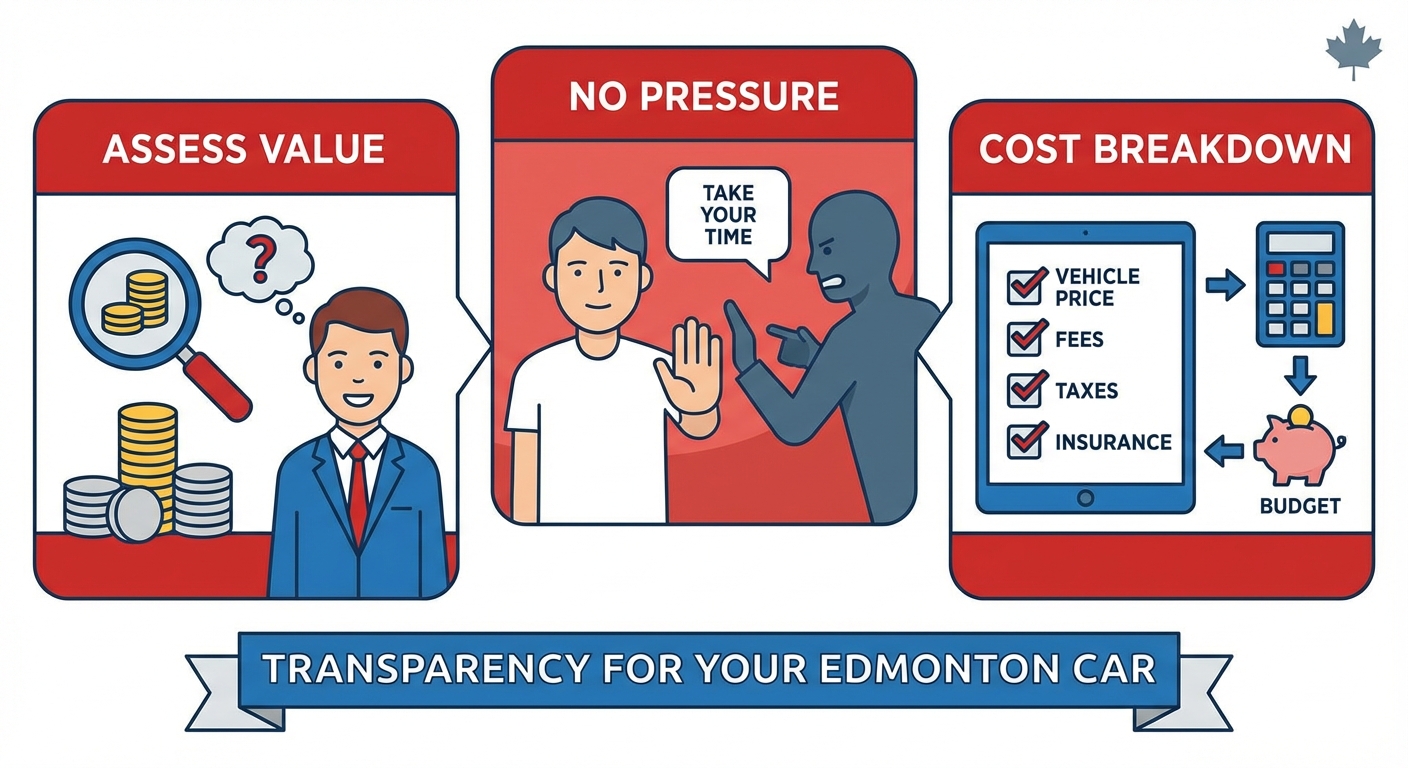
(Context: An infographic illustrating the impact of different interest rates and loan terms on total cost for a typical car loan value, perhaps showing a 'newcomer premium' vs. established credit rates.)
Approval Odds & The Golden Documents: What You *Must* Have Ready for Your Application
Maximizing your approval odds as a newcomer means being meticulously prepared. Lenders are looking for stability, responsibility, and the ability to repay the loan. Your documentation is your primary tool to demonstrate these qualities.
The Non-Negotiables: Proof of Status, Income, and Residency
These are the foundational documents every lender will require:
- Proof of Immigration Status: Your Permanent Resident Card, Study Permit, or Work Permit. Ensure it's valid and clearly shows your status in Canada.
- Proof of Employment/Income: Recent pay stubs (at least 2-3), a letter of employment from your employer in Edmonton, and potentially bank statements showing consistent income deposits. Lenders want to see stable, verifiable income.
- Proof of Address in Canada: Utility bills (electricity, internet, phone) in your name, a lease agreement, or a bank statement showing your current Canadian address in Edmonton.
- Canadian Bank Account: Proof of an active bank account where loan payments can be processed.
- Valid Driver's License: An Alberta driver's license is essential for both driving legally and obtaining insurance.
Leveraging Your Foreign History: Supporting Documents That Make a Difference
As discussed earlier, these documents from your home country can significantly strengthen your application:
- Foreign Bank Statements: Showing a history of stable finances.
- Utility Bill Payment History: Demonstrating consistent bill payments.
- Letters of Reference: From previous financial institutions or landlords.
- Proof of Past Loan/Credit Card Repayments: Showing a track record of responsible borrowing.
- Certified Translations: For any documents not in English or French.
The more compelling a financial picture you can paint with these supporting documents, the higher your chances of approval.
Down Payments and Co-Signers: Boosting Your Chances in Alberta
Two powerful tools can dramatically increase your approval odds and potentially secure better loan terms:
- Down Payment: Putting money down upfront reduces the loan amount, lowers the lender's risk, and shows your commitment. Even a small down payment (5-10% of the vehicle price) can make a significant difference for newcomers.
- Co-Signer: If you have a friend or family member in Alberta with established Canadian credit who is willing to co-sign your loan, their credit history will be factored into the application. This significantly de-risks the loan for the lender, often leading to better rates and easier approval. Ensure your co-signer understands their responsibilities, as they are equally liable for the loan.
Pro Tip: Organize Everything in a 'Financial Binder' Before You Apply!
Gather all your essential documents, both Canadian and foreign, and place them in a well-organized binder or digital folder. Having everything neatly compiled and easily accessible demonstrates your professionalism and preparedness to lenders, making the application process smoother and quicker.
Pro Tip: Organize Everything in a 'Financial Binder' Before You Apply!
Gather all your essential documents, both Canadian and foreign, and place them in a well-organized binder or digital folder. Having everything neatly compiled and easily accessible demonstrates your professionalism and preparedness to lenders, making the application process smoother and quicker.
Choosing Your Ride: New vs. Used, and How it Impacts Your Loan Eligibility (Edmonton & Alberta Context)
The type of vehicle you choose can directly influence your loan approval and the terms offered, especially for newcomers in the Edmonton and broader Alberta market. It's a balance between your needs, your budget, and what lenders are willing to finance.
The Case for a New Car: Manufacturer Incentives and Dealership Programs
While often more expensive, new cars can sometimes be easier to finance for newcomers due to:
- Manufacturer-Backed Programs: Many major manufacturers (e.g., Toyota, Honda, Hyundai, Kia) offer special financing rates or programs for recent graduates or newcomers, sometimes even without extensive Canadian credit.
- Higher Resale Value: New cars generally hold their value better initially, reducing the lender's risk.
- Lower Interest Rates (sometimes): Manufacturer incentives can sometimes provide lower interest rates than what you'd get on an older used car, even as a newcomer.
New cars offer peace of mind with warranties and the latest safety features, which can be appealing for families settling in Edmonton.
The Practicality of a Used Car: Affordability and Loan Access in Edmonton
For many newcomers, a used car is the more practical and accessible option. They are generally more affordable, reducing the overall loan amount needed. Lenders like Scotiabank, for instance, typically finance used vehicles up to 4 or 5 years old. The benefits of a used car include:
- Lower Purchase Price: Immediately reduces the financial burden.
- Less Depreciation: The steepest depreciation occurs in the first few years.
- Wider Availability: A vast inventory of used vehicles in Edmonton and Calgary means more choices to fit your budget.
However, ensure any used car you consider has a clean history report (e.g., CarFax) and ideally passes a mechanical inspection. The maximum age and mileage a lender will finance often varies, so inquire about these limits.
Vehicle Type and Loan Risk: Sedans, SUVs, and Trucks in the Alberta Climate
The type of vehicle can subtly influence lender perception of risk, especially in a region like Alberta with its distinct climate and driving conditions. A reliable, fuel-efficient sedan or a common compact SUV (e.g., Honda CR-V, Toyota RAV4) might be viewed as a lower risk than a high-end luxury vehicle or a very large truck, particularly for a first Canadian car loan. Lenders consider how easily a vehicle could be resold if the loan defaults. Vehicles that are popular, hold their value well, and are practical for Alberta's winter roads (e.g., with all-wheel drive) often present a more favourable risk profile.
Navigating the Dealership: Your Ally or Your Obstacle? (With Examples from Calgary and Ottawa)
Stepping into a car dealership can be daunting for anyone, let alone a newcomer navigating a new market. However, with the right approach, a dealership can be a powerful ally in securing your car loan and vehicle in Alberta.
Research First: Knowing Your Worth Before You Walk In
Empower yourself with knowledge before you even set foot in a dealership in Edmonton or Calgary. Research:
- Vehicle Prices: Understand the fair market value for the specific make and model (new or used) you're interested in. Websites like AutoTrader.ca or Kijiji Autos are great resources.
- Loan Pre-Approval: If possible, get pre-approved for a loan from your bank or a credit union. This gives you a benchmark interest rate and a clear budget, making you a stronger negotiator.
- Newcomer Programs: Know which banks offer newcomer programs and their general terms, so you can discuss these options confidently with the dealership's finance manager.
Walking in with this information signals that you are a serious and informed buyer.
The Art of Negotiation: Tips for Securing Favorable Terms in Calgary and Ottawa
Negotiation is a standard part of car buying in Canada. Don't be afraid to:
- Negotiate the Price: Focus on the total vehicle price first, separate from the financing. Dealerships in cities like Calgary and Ottawa expect some negotiation.
- Discuss Interest Rates: If you have a pre-approval, use it to negotiate a better rate from the dealership's lenders. Even a small difference in rate can save you hundreds over the loan term.
- Separate the Trade-in: If you have a trade-in vehicle, negotiate its value separately from the new car purchase.
- Be Prepared to Walk Away: If the deal doesn't feel right or you're being pressured, politely state you need more time to consider and be prepared to leave. There are many dealerships in Edmonton and surrounding areas.
Remember, the finance manager's job is to get you approved, and they often have relationships with various lenders, including those who specialize in newcomer financing. They can often be your strongest advocate.
Spotting Red Flags: Avoiding Pressure Tactics and Unfair Deals
While most dealerships are reputable, be vigilant for red flags:
- Excessive Pressure: Feeling rushed to sign without fully understanding terms.
- Vague Answers: Unwillingness to provide a detailed breakdown of costs.
- "Limited Time Offers" That Are Always Available: High-pressure sales tactics.
- Pushing Unnecessary Add-ons: Be firm on what you want and need.
- Very High-Interest Rates: Especially if you have strong foreign credit and a down payment.
Always take your time, ask questions, and never sign anything you don't fully understand. If something feels off, it probably is. It's perfectly acceptable to bring a trusted friend or family member with you for support and a second opinion.

(Context: A diverse family or individual confidently interacting with a car salesperson at a modern dealership, perhaps shaking hands or reviewing documents.)
Building Your Canadian Credit Foundation: Post-Loan Strategies for Financial Success
Securing your first car loan as a newcomer isn't just about getting a vehicle; it's a monumental step towards building a robust Canadian credit history. This loan, responsibly managed, will be a cornerstone of your future financial success in Edmonton and beyond.
Making Payments On Time: The Cornerstone of Canadian Credit
This cannot be stressed enough: every single on-time payment you make on your car loan is reported to Canadian credit bureaus (Equifax and TransUnion). This is how you build a positive credit history. Late payments, even by a few days, can negatively impact your score. Conversely, a perfect payment record will steadily improve your creditworthiness, opening doors to better rates on future loans, mortgages, and credit cards.
Beyond the Car Loan: Credit Cards, Secured Loans, and Other Credit-Building Tools
Once you have your car loan, don't stop building. Diversify your credit portfolio:
- Secured Credit Cards: These require a deposit (e.g., $500) that becomes your credit limit. They report to credit bureaus and are an excellent way to show responsible credit card usage.
- Small Secured Loans: Some banks offer "credit builder" loans where the loan amount is held in a savings account until you repay it.
- Utility Payments: While not always reported to credit bureaus, consistent on-time payments for utilities like phone bills can sometimes be used as proof of financial responsibility.
Used wisely, these tools, alongside your car loan, will accelerate the growth of your Canadian credit score.
Monitoring Your Credit: Understanding Your Score and Report
As you build credit, regularly monitor your progress. You are entitled to a free copy of your credit report from Equifax and TransUnion annually. You can also sign up for free credit monitoring services offered by many banks or third-party apps, which provide regular updates to your credit score. Understanding your credit report allows you to:
- Track Progress: See how your score is improving.
- Identify Errors: Dispute any inaccuracies that could negatively impact your score.
- Understand Factors: Learn what influences your score.
Pro Tip: Set Up Auto-Payments to Never Miss a Due Date!
The easiest way to ensure a perfect payment record is to set up automatic payments from your bank account. This eliminates the risk of human error or forgetting a due date, ensuring your credit score benefits from every timely payment.
Pro Tip: Set Up Auto-Payments to Never Miss a Due Date!
The easiest way to ensure a perfect payment record is to set up automatic payments from your bank account. This eliminates the risk of human error or forgetting a due date, ensuring your credit score benefits from every timely payment.
Your Next Steps to Approval: Driving Away Confidently in Edmonton, Alberta
The journey to securing a car loan as a newcomer in Canada, specifically in vibrant Edmonton, Alberta, might seem complex, but it's entirely achievable. You now understand that your foreign credit history is not a dead end but a valuable asset, and that dedicated programs and strategies exist to help you on your way.
Recap: The Power of Preparation and Persistence
Remember the core principles: preparation is paramount, foreign credit is leverageable, and persistence in exploring all your options will lead to success. You are not alone in this process, and many resources are available to support you.
Your Personal Action Plan for a Car Loan in Edmonton
Here’s a clear path forward:
- Gather Your Documents: Compile all Canadian and foreign financial records, ensuring certified translations where necessary.
- Assess Your Budget: Determine what monthly payment you can realistically afford, considering all vehicle-related costs (loan, insurance, fuel, maintenance).
- Explore Newcomer Programs: Research programs from major banks (Scotiabank, RBC, CIBC, TD, BMO) and local Alberta credit unions (Servus Credit Union, ATB Financial).
- Consider a Down Payment/Co-Signer: If feasible, these can significantly improve your chances and terms.
- Visit Reputable Dealerships: Engage with finance managers who understand newcomer financing, like those partnered with SkipCarDealer.com.
- Ask Questions: Don't hesitate to clarify any aspect of the loan, from interest rates to fees and terms.
Welcome to the Road Ahead, Alberta!
The freedom and convenience of owning a car in Alberta are within your reach. By taking these proactive steps, you're not just securing transportation; you're laying down solid financial roots in your new home. Welcome to the road ahead – it's yours to drive!