Temporary Resident? Your Down Payment Just Took a Vacation.
Table of Contents
- Key Takeaways for Temporary Residents Seeking Car Loans
- Lender's Lens: Unpacking the 'Why' Behind the Down Payment Rule
- Risk Mitigation 101: Why Lenders See Temporary Residents as Higher Risk
- The Credit History Void: When Your Past Doesn't Follow You to Canada
- Residency Status & Repayment Certainty: Understanding Lender Concerns About Permit Duration
- The 'Skin in the Game' Principle: How a Down Payment Reduces Lender Exposure
- Who Are We Talking About? Defining 'Temporary Resident' in the Eyes of a Car Lender
- Work Permit Holders: The Most Common Car Loan Applicants
- International Students: Navigating Loans with Limited Income & Shorter Stays
- Other Temporary Statuses: What to Expect for Specific Circumstances
- The Importance of Permit Duration: Why a Longer Permit is a Stronger Application
- Beyond the Bank Account: Crafting Your Loan Application Story for Approval
- The Document Arsenal: What You Absolutely Need (and What Helps)
- Proof of Income: Making Your Earnings Irrefutable
- Bank Statements: Demonstrating Financial Stability and Savings
- Employment Letter: Confirming Your Canadian Job Security
- The Co-Signer Advantage: When a Local Anchor Makes All the Difference
- Showcasing Your Financial Responsibility: Rent Payments, Utility Bills, and Beyond
- The Credit Conundrum: Building Your Financial Footprint from Scratch
- Secured Credit Cards: Your First Step to a Canadian Credit Score
- Credit-Building Loans: Small Steps for Big Impact
- Utility Bills & Rent Reporting: Leveraging Everyday Payments
- The Waiting Game: Understanding How Credit Scores Develop Over Time
- The Lender Labyrinth: Banks, Dealerships, and Alternative Routes for Newcomers
- Traditional Banks: Understanding Policies Like National Bank's 25% Rule
- Credit Unions: Often More Flexible and Community-Focused
- Dealership Financing: Convenience vs. Potentially Higher Rates
- Specialized Newcomer Programs: Do They Really Offer a 'No Down Payment' Option?
- Online Lenders & Brokers: The Digital Frontier for Car Loans
- Your Wheels, Your Way: How Vehicle Choice Impacts Loan Approval & Down Payment
- New vs. Used: Which is Easier to Finance for a Temporary Resident?
- The 8-Year Rule: Why Older Vehicles are a Red Flag for Lenders (e.g., National Bank's Policy)
- Vehicle Value vs. Loan Amount: Navigating the $10,000 Threshold
- Specific Car Brands & Models: Are Some Easier to Finance?
- Beyond the Monthly Payment: Unmasking the True Cost of Car Ownership for Newcomers
- Insurance Premiums: The Sticker Shock for New Drivers in Canada
- Registration & Licensing Fees: The Bureaucratic Essentials
- Maintenance & Repairs: Budgeting for the Unexpected
- Fuel Costs: Understanding Canadian Gas Prices
- Interest Rates: Why Temporary Residents Often Pay More
- Lease or Buy? Weighing Your Options as a Temporary Resident
- The Flexibility of Leasing: Shorter Terms and Lower Monthly Payments
- The Ownership of Buying: Building Equity and Long-Term Value
- Down Payment Implications for Leasing vs. Buying
- End-of-Term Options: What Happens When Your Permit Expires?
Arriving in Canada as a temporary resident is an exciting adventure, full of new opportunities and experiences. One of the first things many newcomers realize is the sheer size of our beautiful country, and with it, the undeniable need for personal transportation. Public transit is excellent in major cities, but for exploring beyond the urban core, commuting to work in less accessible areas, or simply managing daily errands with a family, a car becomes less of a luxury and more of a necessity.
You’re likely here with a clear plan, a job offer, or an enrolment letter, ready to integrate into Canadian life. Part of that integration often involves financing a vehicle. But here’s the unvarnished truth right from the start: if you’re a temporary resident in Canada, the idea of securing a car loan with no down payment is, for most, a vacation that hasn't been booked yet. Lenders in Canada, including major banks and financial institutions, typically require a significant down payment from temporary residents. This isn't to make your life harder; it's a reflection of how they assess risk when you're establishing your new life in a new country.
Don't be discouraged, though. While a zero-down payment loan is rare for temporary residents, understanding the landscape and preparing correctly can make the process smooth and successful. We’ll guide you through the realities, the requirements, and the strategies to get you behind the wheel, even if it means putting some 'skin in the game' upfront.
Key Takeaways for Temporary Residents Seeking Car Loans
- The 25% Down Payment Reality: For car loans exceeding $10,000, temporary residents should generally expect to pay a down payment of at least 25% of the vehicle's purchase price. This is a common benchmark among many Canadian lenders.
- Credit History is King (But Not Always Required): Lenders heavily rely on Canadian credit history to assess risk. As a temporary resident, you likely won't have one. This absence is a primary driver for the down payment requirement, though other factors can help mitigate it.
- Documentation is Your Digital Footprint: Your work permit, proof of income, bank statements, and employment letter are crucial. They serve as your financial narrative in the absence of a credit score.
- Lender Landscape: Not all financial institutions are created equal for newcomers: Some banks and credit unions are more accommodating to temporary residents than others. Dealerships often have access to a wider network of lenders.
- The Power of a Co-Signer: A game-changer for approval and rates: Having a Canadian permanent resident or citizen with good credit co-sign your loan can dramatically improve your chances of approval and secure more favourable interest rates, potentially even reducing the down payment requirement.
Lender's Lens: Unpacking the 'Why' Behind the Down Payment Rule
To truly navigate the car loan process as a temporary resident, it's essential to understand the perspective of the lender. Why do they impose these specific requirements, particularly the significant down payment? It all boils down to risk assessment.
Risk Mitigation 101: Why Lenders See Temporary Residents as Higher Risk
Lending money always involves risk. Lenders want assurance that you will repay the loan as agreed. For temporary residents, several factors can elevate this perceived risk:
- Lack of Established Ties: You're new to the country, and while you may have a job, you haven't built a long-term financial history or established deep roots in Canada. This makes it harder for lenders to predict your long-term commitment and stability.
- Mobility: Temporary residents, by definition, have a finite period of authorized stay. While many transition to permanent residency, there's always the possibility of returning to their home country, which could complicate loan recovery for the lender.
- Limited Asset Base: Newcomers often haven't had the time to accumulate significant assets in Canada that could be used as collateral or demonstrate financial stability.
The Credit History Void: When Your Past Doesn't Follow You to Canada
In Canada, your credit score and credit history are paramount for securing loans. This history tracks how reliably you've managed credit in the past – paying bills on time, managing debt, etc. As a temporary resident, your credit history from your home country typically doesn't transfer to Canada. This means that, from a Canadian lender's perspective, you have a "thin file" or no credit history at all. This isn't a reflection of your financial responsibility, but simply a lack of data for Canadian credit bureaus to assess.
Without this crucial data, lenders need other assurances. A substantial down payment serves as one of the most effective forms of assurance. It directly reduces the amount of money the lender is risking.
Residency Status & Repayment Certainty: Understanding Lender Concerns About Permit Duration
Your temporary residency permit has an expiry date. Lenders are acutely aware of this. If your permit expires before the loan term, it raises questions about your ability to continue making payments. For instance, if you apply for a 5-year car loan but your work permit expires in 2 years, the lender will be hesitant. They need to be confident that your income and legal status in Canada will persist for the entire duration of the loan. This is why a longer permit duration or evidence of an active application for extension or permanent residency can significantly strengthen your application.
The 'Skin in the Game' Principle: How a Down Payment Reduces Lender Exposure
A down payment demonstrates your commitment to the purchase and the loan. It shows you have invested your own money, giving you "skin in the game." From a lender's perspective, a larger down payment reduces their financial exposure. If the loan defaults, the outstanding balance is lower, and the car's resale value (even depreciated) is more likely to cover the remaining debt. This principle is fundamental to lending, especially for applicants perceived as higher risk due to a lack of credit history or established residency.
Who Are We Talking About? Defining 'Temporary Resident' in the Eyes of a Car Lender
The term 'temporary resident' encompasses a broad spectrum of individuals, and while the core challenges remain similar, the nuances of your specific status can influence your loan application. Lenders look at the stability and duration of your legal presence in Canada.
Work Permit Holders: The Most Common Car Loan Applicants
Individuals holding valid work permits are often the most straightforward temporary residents when it comes to car loan applications. This is because they typically have a stable income source, which is a primary factor for loan approval. Lenders will focus on:
- Employer Stability: The reputation and financial health of your employer.
- Job Duration: Whether your employment is permanent, full-time, or contract-based, and how long you've been employed.
- Permit Expiry: How much time remains on your work permit. A permit that aligns with or exceeds the proposed loan term is ideal.
For those employed, demonstrating consistent income is a significant advantage, though the down payment will still likely be a requirement due to the lack of Canadian credit history.
International Students: Navigating Loans with Limited Income & Shorter Stays
International students face unique challenges. While they are temporary residents, their primary purpose is study, not employment. This often means:
- Limited or No Income: Many student permits restrict work hours, or students may not work at all. This makes it difficult to prove a consistent income stream sufficient for loan repayment.
- Shorter Permit Durations: Study permits are often tied to program length, which can be shorter than typical car loan terms.
- Reliance on Funds from Abroad: While some students have substantial funds, proving these as reliable, ongoing income for a Canadian loan can be complex.
For more specific guidance on this, you might find our article Approval Secrets: How International Students Get Car Loans in Ontario particularly helpful.
Other Temporary Statuses: What to Expect for Specific Circumstances
Other temporary statuses, such as those on visitor visas with specific work authorizations (which are rare for car loan purposes), or bridging open work permits, will be assessed on a case-by-case basis. The key questions for lenders will always revolve around:
- Proof of legal status and duration.
- Demonstrated, consistent income.
- Financial stability and savings.
The Importance of Permit Duration: Why a Longer Permit is a Stronger Application
This cannot be stressed enough: the remaining validity of your temporary resident permit is a critical factor. Lenders prefer that your permit duration exceeds the proposed loan term. For example, if you're seeking a 4-year loan, having at least 4.5 to 5 years remaining on your permit (or a clear path to extension/PR) significantly strengthens your application. If your permit expires within the loan term, lenders will likely require a shorter loan term, a larger down payment, or a strong co-signer to mitigate the perceived risk.
Beyond the Bank Account: Crafting Your Loan Application Story for Approval
Even with the down payment requirement, there's much you can do to present a compelling case to lenders. Your application isn't just about numbers; it's about telling a story of responsibility and reliability, especially when a traditional credit history isn't available. For a deeper dive into the specific paperwork required in different provinces, consider reading Approval Secrets: Exactly What Paperwork You Need for Alberta Car Financing.
The Document Arsenal: What You Absolutely Need (and What Helps)
Think of your documents as your financial resume. The more comprehensive and organized they are, the better impression you make.
- Primary Identification: Valid passport, Canadian driver's license (if you have one).
- Proof of Status: Your valid work permit, study permit, or other immigration document. Bring the original.
- Proof of Address: Utility bills, rental agreement, or a bank statement showing your Canadian address.
- Social Insurance Number (SIN): Essential for income verification and any future credit reporting.
Proof of Income: Making Your Earnings Irrefutable
This is arguably the most critical component after your immigration status. Lenders need to see that you have a stable, sufficient income to comfortably afford monthly loan payments, insurance, and other car-related expenses.
- Employment Letter: A formal letter from your Canadian employer stating your position, start date, salary (annual or hourly wage), and whether your employment is full-time, permanent, or contract-based.
- Recent Pay Stubs: Typically the last 2-3 pay stubs to show consistent income.
- Bank Statements: 3-6 months of Canadian bank statements showing your salary deposits. This demonstrates financial activity and consistency.
Bank Statements: Demonstrating Financial Stability and Savings
Your bank statements do more than just prove income. They show:
- Savings: A healthy savings account indicates financial prudence and can act as a buffer for unexpected expenses.
- Spending Habits: While not scrutinized in minute detail, excessively erratic spending or frequent overdrafts can raise red flags.
- Proof of Down Payment: The funds for your down payment should be clearly visible in your Canadian bank account.
Employment Letter: Confirming Your Canadian Job Security
As mentioned, this letter is vital. It provides official confirmation of your employment details directly from your employer, lending credibility to your income claims. Ensure it is on company letterhead and signed by a manager or HR representative.
The Co-Signer Advantage: When a Local Anchor Makes All the Difference
A Canadian co-signer can be a game-changer. This individual, typically a permanent resident or citizen, with a strong Canadian credit history and stable income, agrees to be equally responsible for the loan. If you default, the co-signer is legally obligated to make the payments. This significantly reduces the lender's risk, often leading to:
- Higher approval chances.
- Lower interest rates.
- Potentially a reduced down payment requirement (though still likely not zero).
Pro Tip: The Power of a Canadian Co-Signer – What to Look For and How to Ask
When seeking a co-signer, look for someone with excellent credit, a stable job, and who fully understands the responsibility they are undertaking. This is a significant favour, so approach them with transparency and be prepared to explain all the implications. Ensure they are comfortable with the commitment. A parent, sibling, or very close friend with strong financial footing is usually the best candidate.
Showcasing Your Financial Responsibility: Rent Payments, Utility Bills, and Beyond
Even without a credit score, you can demonstrate responsible financial behaviour. While not directly impacting your credit score, showing consistent, on-time payments for rent, utilities, and even phone bills can paint a positive picture for a lender. Keep records of these payments. Some alternative lenders might consider these factors when assessing your overall risk profile.
The Credit Conundrum: Building Your Financial Footprint from Scratch
While you might need a car loan before you have a solid Canadian credit history, it's crucial to start building one immediately. A good credit score will benefit you for future loans, mortgages, cell phone contracts, and even renting property. For those starting with no credit, our article Zero Credit? Perfect. Your Canadian Car Loan Starts Here offers excellent foundational advice.
Secured Credit Cards: Your First Step to a Canadian Credit Score
A secured credit card is one of the easiest ways for newcomers to begin building credit. You deposit a sum of money (e.g., $500) with the bank, which becomes your credit limit. You use the card like a regular credit card, making purchases and paying your bill in full and on time each month. This activity is reported to credit bureaus, establishing your payment history.
Credit-Building Loans: Small Steps for Big Impact
Some financial institutions offer small "credit-builder" loans. You borrow a small amount, which is held in a locked account, and you make regular payments. Once the loan is fully repaid, you receive the original amount. This also reports positive payment history to credit bureaus.
Utility Bills & Rent Reporting: Leveraging Everyday Payments
While most utility and rent payments aren't automatically reported to credit bureaus, some services and landlords now offer this option. Inquire if your landlord or utility provider reports on-time payments. If so, it's a great way to add more positive data to your credit file.
The Waiting Game: Understanding How Credit Scores Develop Over Time
Building a strong credit score takes time – typically 6 months to a year of consistent, responsible credit use to generate a score, and several years to build an excellent one. Be patient and consistent. Avoid making late payments at all costs, as these have a significant negative impact.
Pro Tip: Don't Apply for Too Much Credit Too Soon – The Art of Strategic Credit Building
While building credit is important, don't apply for every credit card or loan you see. Each application generates a "hard inquiry" on your credit file, which can temporarily lower your score. Apply for one or two credit-building products, manage them responsibly, and let your credit score grow organically. Too many inquiries too quickly can make you appear desperate for credit, which lenders view negatively.
The Lender Labyrinth: Banks, Dealerships, and Alternative Routes for Newcomers
Navigating the Canadian lending landscape can feel complex. Knowing where to look and what to expect from different types of lenders is key to finding the best car loan for your situation as a temporary resident.
Traditional Banks: Understanding Policies Like National Bank's 25% Rule
Major Canadian banks (like RBC, TD, Scotiabank, BMO, CIBC, and National Bank) are often the first stop for car loans. They typically offer competitive interest rates if you meet their criteria. However, their criteria for temporary residents are often stringent. Many, like National Bank, will indeed require a minimum 25% down payment for loans over $10,000 from temporary residents with limited or no Canadian credit history. They also heavily scrutinize permit duration and proof of stable income.
Credit Unions: Often More Flexible and Community-Focused
Credit unions are member-owned financial cooperatives. They sometimes have more flexible lending policies than large banks, especially for newcomers, as they often have a stronger community focus. It's worth exploring local credit unions in your area, as they might be more willing to consider your overall financial situation rather than just a credit score. They may still require a down payment but could offer slightly more lenient terms or personalized advice.
Dealership Financing: Convenience vs. Potentially Higher Rates
Dealerships are often a convenient option because they act as intermediaries, working with a network of lenders, including banks, captive lenders (like Toyota Financial Services), and alternative finance companies. This can be beneficial for temporary residents because:
- They are often experienced with newcomer applications.
- They can "shop around" your application to multiple lenders to find an approval.
- Some dealerships have specific programs for newcomers.
The trade-off for this convenience can sometimes be slightly higher interest rates, especially if your application goes to an alternative lender in their network due to perceived risk.
Specialized Newcomer Programs: Do They Really Offer a 'No Down Payment' Option?
Some manufacturers or dealerships advertise "newcomer programs." While these can be helpful, it's crucial to read the fine print. Very few, if any, will offer a true "no down payment" option for temporary residents, particularly for loans of significant value. These programs often focus on:
- Waiving certain fees.
- Offering slightly better rates than typical high-risk loans.
- Streamlining the application process.
- Still requiring a substantial down payment (e.g., 10-20%).
Always verify the actual terms and conditions, especially regarding down payment requirements.
Online Lenders & Brokers: The Digital Frontier for Car Loans
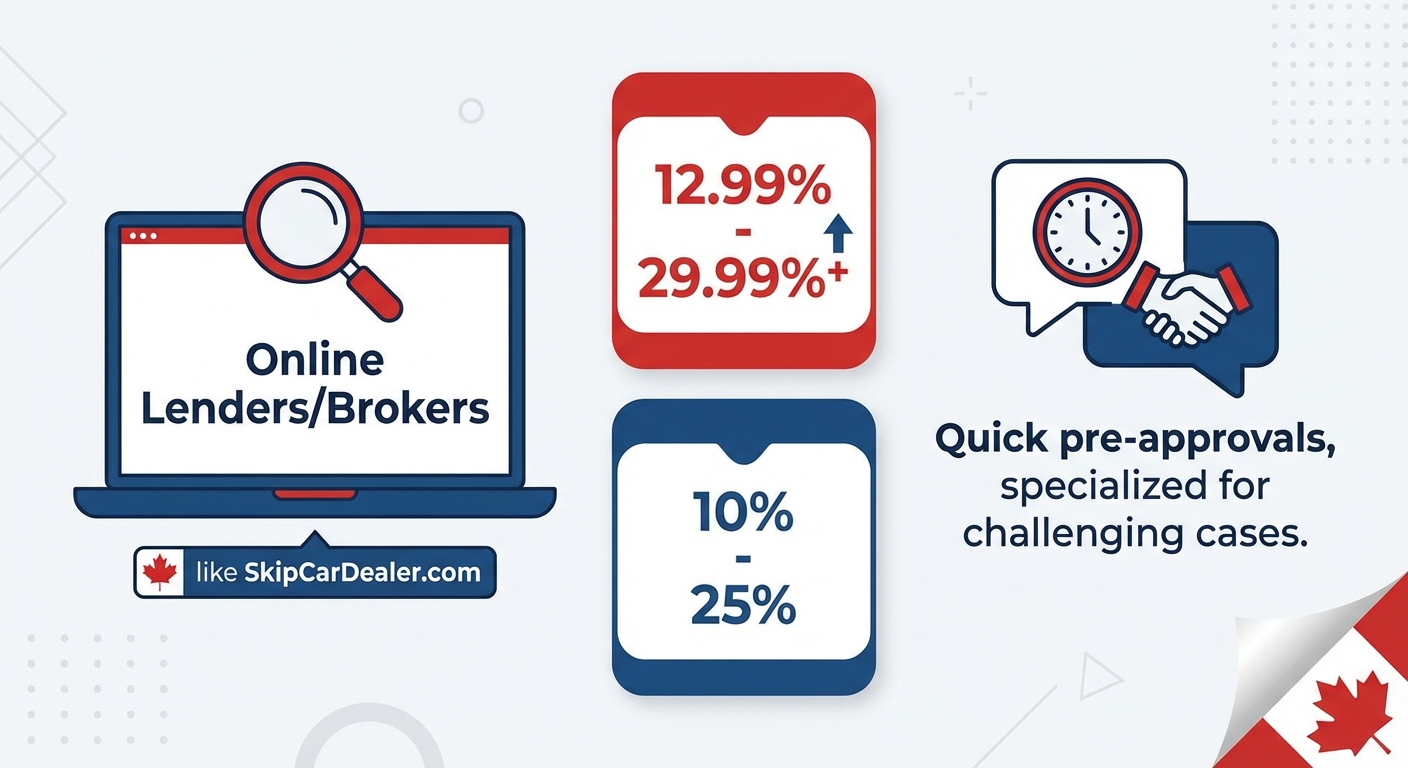
A growing number of online lenders and brokers specialize in helping individuals with challenging credit situations, including newcomers. Companies like SkipCarDealer.com fall into this category. They can often provide quick pre-approvals and connect you with lenders who are more flexible. While they might have options for temporary residents, the down payment requirement will almost certainly remain, and interest rates might be higher than those from traditional banks due to the higher perceived risk.
Pro Tip: Comparing APRs – Don't Just Look at the Monthly Payment
When comparing loan offers from different lenders, always focus on the Annual Percentage Rate (APR), not just the monthly payment. The APR includes the interest rate plus any additional fees, giving you the true cost of borrowing. A lower monthly payment over a longer term might seem appealing, but it often means paying significantly more in interest over the life of the loan. A table comparing typical APR ranges for different lenders might look something like this:
| Lender Type | Typical APR Range (Temporary Resident) | Down Payment Expectation | Key Consideration |
|---|---|---|---|
| Traditional Banks | 6.99% - 12.99% | 25% or more | Strict criteria, strong documents required. |
| Credit Unions | 7.99% - 14.99% | 15% - 25% | More flexible, community-focused. |
| Dealership Financing (Primary Lenders) | 7.99% - 15.99% | 15% - 25% | Convenient, various options. |
| Dealership Financing (Alternative Lenders) | 14.99% - 29.99%+ | 10% - 20% (sometimes lower) | Higher rates, more flexible approvals. |
| Online Lenders/Brokers (like SkipCarDealer.com) | 12.99% - 29.99%+ | 10% - 25% | Quick pre-approvals, specialized for challenging cases. |
Your Wheels, Your Way: How Vehicle Choice Impacts Loan Approval & Down Payment
The car you choose isn't just about personal preference; it's a significant factor in your loan application, especially as a temporary resident. Lenders assess the vehicle's value, age, and marketability, as these influence their risk.
New vs. Used: Which is Easier to Finance for a Temporary Resident?
Generally, financing a newer, lower-kilometre used car (1-3 years old) can sometimes be easier than a brand-new vehicle or a very old one. New cars depreciate rapidly, meaning the loan amount quickly exceeds the car's value. While new cars often come with manufacturer financing incentives, these are usually for applicants with excellent credit. Very old cars, on the other hand, pose reliability risks and have lower resale values, making them less attractive collateral for lenders.
A good quality, slightly used vehicle often strikes the right balance between affordability, reliability, and loan eligibility for temporary residents.
The 8-Year Rule: Why Older Vehicles are a Red Flag for Lenders (e.g., National Bank's Policy)
Many lenders have policies regarding the age of the vehicle they will finance. A common guideline is the "8-year rule," meaning they may not finance a car that will be older than 8 years by the end of the loan term. For example, if you apply for a 5-year loan, the car cannot be older than 3 years at the time of purchase. This is because older vehicles are more prone to mechanical issues, have lower resale values, and are considered higher risk collateral. National Bank, for instance, is known to adhere to such policies. This means if you're looking at a 2017 model, a 5-year loan might push it past the 8-year mark, making it difficult to finance.
Vehicle Value vs. Loan Amount: Navigating the $10,000 Threshold
The total loan amount also influences the down payment. As mentioned, for loans over $10,000, a 25% down payment is often expected. If you can keep the total financed amount lower, say below $10,000 (which might require a larger down payment on a more expensive car or choosing a less expensive vehicle), you might find slightly more flexible terms. However, finding a reliable car for under $10,000 in Canada can be challenging.
Specific Car Brands & Models: Are Some Easier to Finance?
While not an explicit rule, popular, reliable brands with good resale value (like Honda, Toyota, Mazda, Hyundai, Kia) can sometimes be marginally easier to finance. Lenders see these vehicles as less risky because they are generally dependable and hold their value better, making them better collateral if the loan defaults. Niche or luxury brands, or those with known reliability issues, might be harder to finance or come with stricter terms.
Pro Tip: Consider a More Affordable Vehicle to Reduce Your Down Payment Burden
If the down payment is a significant hurdle, consider adjusting your vehicle expectations. Opting for a slightly less expensive car can directly reduce the required down payment amount. For example, a 25% down payment on a $25,000 car is $6,250, but on a $18,000 car, it's $4,500. This smaller amount might be more manageable, getting you on the road sooner.
Beyond the Monthly Payment: Unmasking the True Cost of Car Ownership for Newcomers
Securing a car loan is just one piece of the puzzle. As a temporary resident in Canada, it's crucial to understand the full spectrum of costs associated with car ownership. These can often be higher for newcomers and can significantly impact your budget.
Insurance Premiums: The Sticker Shock for New Drivers in Canada
Car insurance in Canada, particularly in provinces like Ontario and British Columbia, can be shockingly expensive, especially for new drivers or those without a Canadian driving history. Insurance companies view new drivers (even if experienced internationally) as higher risk. Premiums can easily range from $200 to $500+ per month, depending on your location, vehicle type, age, and driving record. This is often the largest recurring cost after your loan payment.
Registration & Licensing Fees: The Bureaucratic Essentials
You'll need to register your vehicle and obtain licence plates, which involves provincial fees. These vary by province but are generally annual costs. You'll also need to transfer your international driver's license to a provincial one, which involves testing and associated fees.
Maintenance & Repairs: Budgeting for the Unexpected
Cars require regular maintenance (oil changes, tire rotations) and can unexpectedly break down. Budgeting for these costs is essential. A general rule of thumb is to set aside $50-$100 per month for maintenance and potential repairs, especially for a used car.
Fuel Costs: Understanding Canadian Gas Prices
Gasoline prices in Canada fluctuate and are generally higher than in many other countries. They also vary significantly by province and even within cities. Factor in your commute distance and driving habits to estimate your monthly fuel budget. Remember, prices are typically quoted per litre, not per gallon.
Interest Rates: Why Temporary Residents Often Pay More
Due to the higher perceived risk (lack of credit history, temporary status), temporary residents often face higher interest rates than permanent residents or citizens with established credit. This increases the overall cost of your loan significantly. A higher down payment can help to mitigate some of this, as can a strong co-signer.
Pro Tip: Get Insurance Quotes BEFORE You Buy Your Car – It Can Make or Break Your Budget
Before you even finalize your car purchase, obtain multiple insurance quotes for the specific make, model, and year of the vehicle you are considering. Insurance costs can vary wildly and might make an otherwise affordable car completely unaffordable. Knowing this cost upfront is critical for accurate budgeting and preventing unexpected financial strain.
Lease or Buy? Weighing Your Options as a Temporary Resident
When considering vehicle acquisition, temporary residents have two primary routes: buying or leasing. Each has distinct advantages and disadvantages, especially when factoring in permit duration and future plans.
The Flexibility of Leasing: Shorter Terms and Lower Monthly Payments
Leasing involves paying to use a vehicle for a set period (e.g., 2-4 years) and agreed-upon kilometres. At the end of the lease, you return the car or have the option to buy it. For temporary residents, leasing can be appealing due to:
- Lower Monthly Payments: Lease payments are often lower than loan payments for a comparable vehicle, as you're only paying for the depreciation during your usage period.
- Shorter Terms: Lease terms often align better with typical temporary resident permit durations (e.g., 2-3 year leases).
- Newer Vehicle Access: You can drive a new car every few years without the long-term commitment of ownership.
However, leases usually come with mileage restrictions, and excess wear and tear can incur charges. Also, getting a lease as a temporary resident still typically requires a significant down payment and strong financial credentials, similar to buying.
The Ownership of Buying: Building Equity and Long-Term Value
Buying a car means you own the vehicle once the loan is repaid. For temporary residents, buying offers:
- Asset Building: You build equity in the vehicle over time.
- No Mileage Restrictions: Drive as much as you need without penalty.
- Customization: You can modify the car as you wish.
- Potential Resale Value: You can sell the car when you no longer need it, recovering some of your investment.
The downsides include higher monthly payments, the responsibility for all maintenance and repairs, and dealing with depreciation.
Down Payment Implications for Leasing vs. Buying
Both leasing and buying will likely require a down payment for temporary residents. For leases, this down payment reduces your monthly payments and can sometimes secure a better lease rate. For purchases, it reduces the financed amount and improves your loan terms. The percentage required for a down payment is often similar for both options for temporary residents.
End-of-Term Options: What Happens When Your Permit Expires?
This is a critical consideration. If your permit expires before your lease or loan term ends, you need a plan. For a lease, you might be able to transfer it, buy out the lease, or return the car (potentially with penalties). For a loan, you would need to sell the car to pay off the remaining balance. If you plan to apply for permanent residency, a longer-term loan or lease might be manageable, but if your stay is definitely temporary, aligning the vehicle term with your permit is paramount.
Pro Tip: Calculate the Total Cost of Ownership for Both Leasing and Buying Over Your Anticipated Stay
Don't just compare monthly payments. Create a spreadsheet to calculate the total cost of ownership for both leasing and buying