Think EI Means No Car? Ontario, Your Down Payment Just Vanished.
Table of Contents
- Key Takeaways
- The EI Car Loan Mirage: Why 'No Car' Isn't the Only Answer for Ontarians
- Deconstructing EI: What Lenders *Really* See When You Apply for a Car Loan
- Pro Tip: Understanding the Lender's Risk Profile: How to Frame Your EI Income Positively
- The Elusive 'No Money Down' on EI in Ontario: Separating Fact from Fiction
- Unlocking Opportunities: Your Financial Leverage Beyond a Paycheck
- Your Credit Score: The Unspoken Co-Signer
- The Power of a Co-Signer: A Lifeline or a Liability?
- Proof of Future Income: Turning 'Temporary' into 'Reliable'
- Asset-Backed Loans: When Your Existing Valuables Become Your Best Friend
- Pro Tip: Building a 'Lender-Friendly' Financial Narrative: Proactively Address Concerns
- Navigating the Ontario Lending Labyrinth: Who Says Yes to EI Applicants?
- Dealership Finance Departments: Your First Port of Call?
- Traditional Banks & Credit Unions: A Tougher Sell, But Not Impossible
- Specialty & Subprime Lenders: Understanding the Trade-offs
- Crafting Your Winning Application: A Step-by-Step Blueprint for Ontarians on EI
- Budgeting Beyond the Loan: The True Cost of Car Ownership on EI
- Choosing the Right Vehicle: Practicality Over Prestige
- Essential Documentation Checklist: Don't Get Caught Flat-Footed
- The Art of the 'Soft Pull' vs. 'Hard Pull': Protecting Your Credit During the Search
- Pro Tip: The Importance of Transparency and Honesty: Building Trust with Your Lender
- Beyond Approval: Guarding Against the EI Loan Pitfalls in Ontario
- The Interest Rate Gauntlet: Why Your Rate Might Be Higher and How to Mitigate It
- Understanding Loan Terms: Short vs. Long, and Why It Matters on EI
- The 'Add-ons' Trap: What to Say No To (Extended Warranties, Rust Proofing, etc.)
Navigating the financial landscape in Ontario can be tricky at the best of times, but when you find yourself relying on Employment Insurance (EI), the thought of securing a car loan can feel like an impossible dream. Many Ontarians believe that EI income is an automatic disqualifier, especially if you're hoping to avoid a down payment. But what if that conventional wisdom is costing you essential mobility and the chance to get back on your feet?
At SkipCarDealer.com, we understand the unique challenges faced by Canadians in various financial situations. We're here to tell you that while securing a car loan on EI with no money down in Ontario is indeed a significant hurdle, it's far from an insurmountable one. This comprehensive guide will equip you with the strategies, insights, and practical steps you need to navigate the process, understand lender expectations, and ultimately drive away in a reliable vehicle.
Key Takeaways
- Securing a car loan on EI in Ontario, especially with no money down, is challenging but not impossible.
- Lenders view EI as temporary income, so demonstrating stability (co-signer, future job prospects, strong credit) is crucial.
- 'No money down' often comes with higher interest rates; a small down payment significantly improves odds and terms.
- Specialty lenders and dealership finance departments are often more accommodating than traditional banks for EI applicants.
- Thorough budgeting for *all* car ownership costs (insurance, maintenance, fuel) is essential before applying.
- Your credit score is paramount – a good score can offset some of the EI income concerns.
- Transparency with lenders about your EI situation and future plans builds trust.
The EI Car Loan Mirage: Why 'No Car' Isn't the Only Answer for Ontarians
The moment many Ontarians find themselves on Employment Insurance, a common and often crippling assumption takes hold: "I can't get a car loan now." This misconception stems from a general understanding that lenders prefer stable, full-time employment income. While this preference is real, the idea that EI automatically disqualifies you from car financing is a mirage that prevents many from even exploring their options.
Let's set the realistic stage: it's undoubtedly harder to get approved for a car loan when your primary income is EI, especially without a down payment. However, specific strategies and types of lenders exist that are willing to work with applicants in your situation. The key is understanding these avenues and presenting your financial profile in the most favourable light possible.
Why is reliable transportation often essential for job searching and daily life in Ontario? Consider the sprawling nature of many Ontario cities and the limited reach of public transit in suburban or rural areas. A car isn't just a luxury; it's often a necessity for:
- Attending job interviews outside of public transit routes.
- Commuting to a new job that might not be easily accessible.
- Meeting family responsibilities, like taking children to school or appointments.
- Accessing essential services, medical appointments, or even grocery stores, particularly for those with mobility challenges or living outside urban centres.
- Maintaining independence and mental well-being during a challenging financial period.
Without a car, the job search itself can become an uphill battle, creating a vicious cycle. Recognizing this, some lenders are more open to financing solutions for EI recipients, provided you can demonstrate a credible plan for repayment and future stability. It's about presenting a complete picture, not just your current income source.
Deconstructing EI: What Lenders *Really* See When You Apply for a Car Loan
To a lender, not all income is created equal. While your EI benefits provide crucial financial support, they are almost universally categorized as 'temporary' income, distinct from the 'stable' and predictable earnings of a long-term job. This fundamental distinction is at the heart of why securing a car loan on EI can be challenging.
Lenders operate on risk assessment. They want to be confident that you can make your loan payments consistently for the entire term. Temporary income sources like EI introduce an element of uncertainty. They know EI benefits have a finite duration and may not fully cover your previous earnings, impacting your overall financial capacity.
The income-to-debt ratio challenge is particularly pronounced for EI recipients. This ratio is a critical metric lenders use to assess your ability to manage monthly payments. It compares your total monthly debt payments (including the proposed car loan) to your gross monthly income. Since EI benefits are typically lower than a full-time salary, your income-to-debt ratio can appear less favourable, even if your existing debt load hasn't changed. This can make a lender hesitate, as it suggests a higher risk of default.
Understanding the 'risk assessment' matrix from a lender's perspective involves looking at several factors beyond just your income source:
- Income Stability: How long will your EI last? Do you have a clear plan for re-employment?
- Credit History: Your past payment behaviour is a strong indicator of future responsibility.
- Debt Load: How much other debt do you carry (credit cards, lines of credit, other loans)?
- Down Payment: A down payment reduces the loan amount and signals your commitment.
- Vehicle Choice: A more expensive car represents a higher risk for the lender.
- Co-signer: The presence of a financially strong co-signer significantly mitigates risk.
Knowing how lenders perceive these elements allows you to proactively address their concerns. It's about crafting a compelling financial narrative that demonstrates your commitment and capacity, despite your current income situation.
Pro Tip: Understanding the Lender's Risk Profile: How to Frame Your EI Income Positively
Don't just state you're on EI. Explain *why* you're on EI (e.g., temporary layoff, seasonal work, short-term illness with a clear return date). Highlight any efforts you're making to secure new employment, such as job interviews, certifications, or training. Emphasize your consistent payment history on previous debts and any savings you have. This proactive approach helps shift the perception from "temporary income" to "temporary situation with a plan."
The Elusive 'No Money Down' on EI in Ontario: Separating Fact from Fiction
The concept of 'no money down' car loans is appealing to anyone, but when you're on EI in Ontario, it transitions from being merely difficult to exponentially more challenging. Lenders view a down payment as a crucial risk mitigator. It reduces the amount they have to lend, and it demonstrates your commitment and ability to save. For more on how lenders approach different income types, check out our guide on EI Income? Your Car Loan Just Said 'Welcome Aboard!'
The role of a down payment is multifaceted:
- Reduces Lender Risk: A smaller loan amount means less risk for the lender. If you default, they have less capital to recover.
- Lowers Monthly Payments: A down payment reduces the principal loan amount, directly translating to lower monthly payments, which is highly beneficial when on EI.
- Decreases Total Interest Paid: Less principal means less interest accrues over the life of the loan.
- Builds Equity Faster: You start with some equity in the vehicle, reducing the risk of negative equity (owing more than the car is worth).
- Signals Financial Responsibility: Having saved for a down payment shows lenders you are financially disciplined and serious about your purchase.
Scenarios where 'no money down' *might* be feasible for an EI recipient are rare and typically involve compensating factors:
- Exceptional Credit Score: If you have a long history of perfect payments, a very high credit score (750+), and a low debt-to-income ratio (even with EI income), a lender might consider it.
- Strong Co-Signer: A co-signer with impeccable credit, stable high income, and a low debt load can significantly bolster your application, making a zero-down option more likely.
- Specific Lender Programs: Some specialty lenders or dealership finance departments might have programs designed for unique situations, but these often come with higher interest rates to offset the increased risk.
- Proof of Imminent High-Income Employment: If you have a signed offer letter for a high-paying job starting very soon, a lender might approve a no-down-payment loan based on your future income, but this is less common.
It's vital to understand the hidden costs of zero down. While appealing upfront, 'no money down' typically leads to:
- Higher Principal: You're financing the entire cost of the vehicle.
- Longer Terms: To keep monthly payments manageable, the loan term might be stretched, meaning you pay interest for a longer period.
- Increased Interest: Lenders often charge higher interest rates on zero-down loans, especially for higher-risk applicants like those on EI, to compensate for their increased exposure.
- Negative Equity Risk: You're immediately "underwater" on the loan, meaning you owe more than the car's depreciated value.
Unlocking Opportunities: Your Financial Leverage Beyond a Paycheck
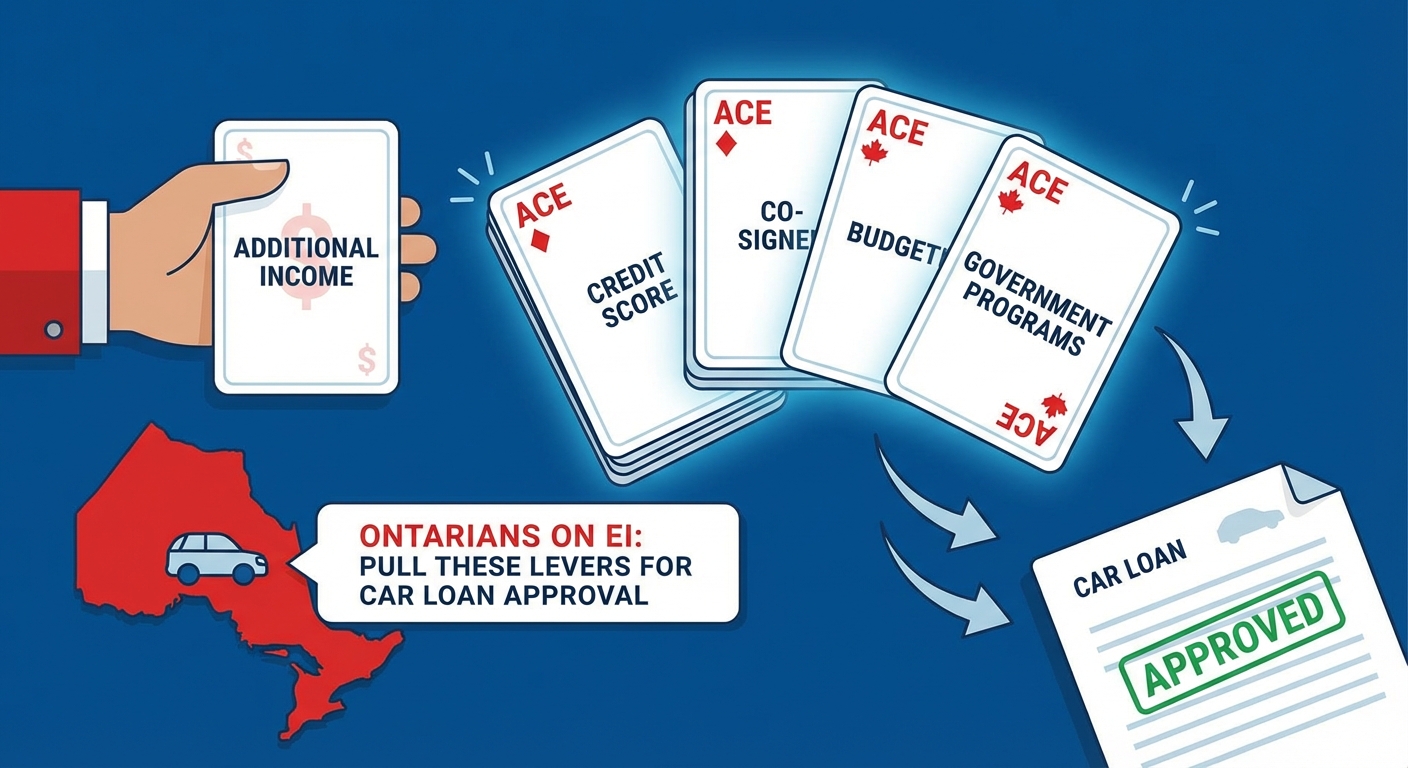
When traditional income isn't your strongest card, you need to play other aces. For Ontarians on EI, there are several powerful financial levers you can pull to significantly improve your chances of car loan approval, even with limited or no down payment.
 (Context: A person looking thoughtfully at a car dealership, perhaps a bit overwhelmed, representing the challenge of securing a loan on EI. The image should convey contemplation and the weight of the decision.)
Your Credit Score: The Unspoken Co-Signer
Your credit score is arguably the most critical factor after income, and for EI recipients, it can become your primary advocate. A strong credit history tells lenders you are responsible with borrowed money, regardless of your current income source. It acts as an unspoken co-signer, vouching for your reliability.
Lenders look for several key elements in your credit report:
- Payment History: This is paramount. Consistent on-time payments for all your debts (credit cards, previous loans, utilities) demonstrate reliability. Missed payments are a major red flag.
- Credit Utilization: This is the amount of credit you're using compared to your total available credit. Keeping this below 30% (e.g., owing $300 on a $1,000 limit) shows you're not over-reliant on credit.
- Length of Credit History: A longer history with good behaviour is generally better, as it provides more data points for lenders to assess.
- Types of Credit: A mix of credit (e.g., credit card, line of credit, installment loan) can be positive, showing you can manage different types of debt.
- New Credit: Too many recent credit inquiries or new accounts can be seen as risky.
Strategies for quickly improving your score, even while on EI:
- Pay Bills On Time: Even small bills, like phone or internet, if reported to credit bureaus, can impact your score.
- Reduce Credit Card Balances: Pay down balances to lower your credit utilization.
- Avoid New Debt: Don't open new credit accounts or apply for multiple loans simultaneously.
- Check for Errors: Obtain your credit report from Equifax and TransUnion and dispute any inaccuracies.
The Power of a Co-Signer: A Lifeline or a Liability?
When your income is temporary or your credit isn't stellar, a co-signer can be the bridge to loan approval. A co-signer is someone who agrees to be equally responsible for the loan. If you miss payments, they are obligated to pay, and their credit will be affected just as yours would be.
When a co-signer is essential:
- You have a lower credit score.
- Your EI income alone doesn't meet the lender's debt-to-income ratio requirements.
- You're seeking a no-money-down loan.
Choosing the right co-signer is crucial: look for someone with excellent credit, stable and significant income, and a low debt load. They should be someone you trust implicitly and who understands the full implications of their commitment.
The risks and responsibilities for the co-signer are substantial:
- Full Responsibility: They are legally obligated to repay the loan if you cannot.
- Credit Impact: The loan appears on their credit report, affecting their credit utilization and potentially their ability to secure future credit.
- Relationship Strain: If you default, it can severely damage your relationship.
Proof of Future Income: Turning 'Temporary' into 'Reliable'
EI is temporary. What comes next? Lenders want to see a clear path to stable income. Demonstrating upcoming employment, verifiable return-to-work dates, or alternative income sources can significantly strengthen your application.
- Offer Letter: A signed job offer letter from a new employer, detailing your start date, salary, and position, is powerful evidence.
- Return-to-Work Letter: If you're on temporary layoff or short-term disability, a letter from your previous employer confirming your return date is invaluable.
- Contract Work: If you have secured a new contract, provide the contract details and evidence of payment terms.
The more concrete and verifiable your proof of future income, the more comfortable lenders will be in extending credit.
Asset-Backed Loans: When Your Existing Valuables Become Your Best Friend
If you own other valuable assets outright, they can serve as collateral for a secured loan. This reduces the lender's risk, as they can seize the asset if you default. For Ontarians on EI, this can be a viable path to approval.
- Paid-Off Vehicle: If you own an older car free and clear, you might be able to use its title to secure a loan for a newer vehicle. For more on this, explore EI? Your Car Doesn't Care. Cash Out Its Title.
- Property: Homeowners might consider a home equity line of credit (HELOC) or a second mortgage, though these are typically for larger sums and more significant financial needs.
Understanding the risks and benefits of using collateral is essential. While it can secure a loan you might otherwise not get, you risk losing the asset if you fail to make payments.
Pro Tip: Building a 'Lender-Friendly' Financial Narrative: Proactively Address Concerns
When you apply, don't wait for the lender to ask all the difficult questions. Be prepared to explain your EI situation, your plans for re-employment, why you need a car, and how you've managed your finances responsibly in the past. Bring all supporting documents (offer letters, credit report, budget) to show you're organized and serious. This transparency builds trust and confidence.
Navigating the Ontario Lending Labyrinth: Who Says Yes to EI Applicants?
Not all lenders are created equal, especially when it comes to unconventional income sources like EI. Knowing where to focus your efforts in Ontario can save you time, protect your credit score, and increase your chances of approval. If you've been Denied a Car Loan on EI? They Lied. Get Approved Here.
Dealership Finance Departments: Your First Port of Call?
For many EI recipients, dealership finance departments are often the most promising starting point. Here's why:
- Relationships with Diverse Lenders: Dealerships work with a wide network of banks, credit unions, and specialty lenders, including those who are more flexible with non-traditional income. They can shop your application around to find the best fit.
- Volume and Incentives: Dealerships want to sell cars. They often have internal incentives to approve loans and may be more willing to work with you to find a solution.
- 'Buy Here, Pay Here' Models: Some dealerships offer in-house financing, often known as 'buy here, pay here' loans. While these can be a last resort for those with very poor credit or challenging income situations, they often come with significantly higher interest rates and less favourable terms. Understand the pitfalls: higher prices, limited vehicle selection, and potentially predatory loan structures.
Traditional Banks & Credit Unions: A Tougher Sell, But Not Impossible
Major banks (e.g., RBC, TD, BMO, Scotiabank, CIBC) generally have the most stringent requirements for temporary income sources like EI. They prioritize long-term, stable employment and excellent credit. While you can apply, expect a more rigorous process and a higher likelihood of denial unless you have a very strong credit history, significant assets, or a robust co-signer.
Credit Unions in Ontario, however, can be a different story. Often overlooked, they can be more flexible and community-focused than large banks. As member-owned institutions, they sometimes have a greater willingness to understand individual circumstances and offer more personalized lending solutions. If you're a member of a credit union, or eligible to join one, it's definitely worth exploring their options.
Specialty & Subprime Lenders: Understanding the Trade-offs
This category of lenders specializes in working with individuals who don't fit traditional lending criteria, including those with lower credit scores, non-traditional income, or a history of financial challenges. For an EI recipient, these lenders might be your most viable option, but it's crucial to understand the trade-offs.
- Higher Interest Rates: To compensate for the increased risk, subprime loans typically come with significantly higher interest rates compared to prime loans.
- Less Favourable Terms: You might encounter longer loan terms (to reduce monthly payments), stricter repayment schedules, or additional fees.
- Identifying Reputable Lenders: It's critical to distinguish between reputable subprime lenders and predatory ones. Look for transparency in terms, clear communication, and positive customer reviews. Avoid lenders who pressure you, demand upfront fees, or don't fully disclose all costs.
| Lender Type | Pros for EI Applicants | Cons for EI Applicants | Likely Interest Rates |
|---|---|---|---|
| Dealership Finance | Access to multiple lenders, flexible options, willing to work with unique situations, potential for in-house financing. | May push higher-profit vehicles/add-ons, 'buy here, pay here' can be high-cost. | Variable (prime to subprime, depending on lender network) |
| Traditional Banks | Lowest interest rates (if approved), established reputation. | Very strict income requirements, low tolerance for temporary income, often require excellent credit. | Lowest (if approved, typically prime rates) |
| Credit Unions | Potentially more flexible, community-focused, personalized service, competitive rates for members. | May still have strict income criteria, membership required. | Competitive (often slightly better than banks for similar risk) |
| Specialty/Subprime Lenders | Most willing to approve non-traditional income/lower credit, focus on ability to repay. | Significantly higher interest rates, less favourable terms, risk of predatory lenders. | Highest (subprime rates) |
Crafting Your Winning Application: A Step-by-Step Blueprint for Ontarians on EI
Getting a car loan on EI is less about magic and more about meticulous preparation. By following this blueprint, you can present a compelling case to lenders and significantly boost your approval chances.
Budgeting Beyond the Loan: The True Cost of Car Ownership on EI
Before you even think about loan applications, you need a rock-solid budget. A car loan payment is just one piece of the puzzle. In Ontario, particularly, other costs can be substantial.
- Loan Payments: Your principal and interest.
- Insurance: This is a significant cost in Ontario, often among the highest in Canada. Factors include your age, driving record, vehicle type, and postal code. Get quotes *before* you apply for a loan.
- Fuel: Estimate your weekly or monthly fuel consumption based on your anticipated driving.
- Maintenance: Budget for oil changes, tire rotations, unexpected repairs. A general rule of thumb is 1-2% of the car's value annually.
- Registration & Licensing: Annual plate renewal fees.
- Parking: If applicable in your area.
Creating a realistic budget that accounts for EI income fluctuations is paramount. Can you comfortably afford all these costs *every month*? Be honest with yourself. Overestimating your affordability is a fast track to financial trouble.
Choosing the Right Vehicle: Practicality Over Prestige
When on EI, your vehicle choice should prioritize reliability, fuel efficiency, and affordability. This is not the time for luxury. A modest, reliable used car is almost always the smartest choice.
- Lower Purchase Price: Reduces the loan amount, making it easier to get approved and lowering payments.
- Lower Insurance Costs: Older, less expensive, and less powerful cars generally have lower insurance premiums. Research insurance costs for specific makes/models *before* you apply – this can vary wildly in Ontario.
- Better Fuel Economy: Saves you money at the pump, a crucial factor when on a limited income.
- Lower Maintenance Costs: Generally, simpler cars have cheaper parts and repairs.
Essential Documentation Checklist: Don't Get Caught Flat-Footed
Walk into a lender's office or complete an online application with all your ducks in a row. Having these documents ready demonstrates your seriousness and organization:
- Proof of EI Benefits: Recent payment stubs, Service Canada statements, or a letter from Service Canada confirming your benefits and their duration.
- Bank Statements: Recent statements (3-6 months) showing consistent income deposits (EI) and responsible spending habits. Lenders look for stability and avoid excessive overdrafts.
- Proof of Residency: Utility bills (hydro, gas, internet), lease agreements, or mortgage statements with your current address.
- Driver's License: Valid Ontario driver's license.
- Insurance Quotes: Get several quotes for the vehicle you intend to buy. This shows you've done your homework and understand the full cost.
- Proof of Future Income/Employment: Any offer letters, return-to-work letters, or contracts (as discussed earlier).
- Current Debt Statements: Credit card statements, existing loan statements, to verify your debt-to-income ratio.
The Art of the 'Soft Pull' vs. 'Hard Pull': Protecting Your Credit During the Search
Each time a lender checks your credit, it's recorded as an inquiry. Too many 'hard pulls' (inquiries that impact your score) in a short period can negatively affect your credit score, making you appear riskier. This is why understanding the difference is key.
- Soft Pull: A preliminary credit check that doesn't impact your score. Often used for pre-qualifications or when you check your own score.
- Hard Pull: A full credit check performed when you formally apply for credit. This can temporarily lower your score by a few points.
How to get pre-approved without damaging your score: Ask lenders if they can do a 'soft pull' for a pre-qualification. This gives you an idea of what you might be approved for without committing to a full application. When you are ready to formally apply, try to do so within a focused 14-45 day window (depending on the credit bureau model), as multiple hard pulls for the same type of loan within this period may be counted as a single inquiry, minimizing impact.
Pro Tip: The Importance of Transparency and Honesty: Building Trust with Your Lender
Never misrepresent your income or financial situation. Lenders will verify your information, and any discrepancies will lead to an immediate denial and could harm your ability to get credit in the future. Be upfront about being on EI, explain your circumstances, and present your plan for repayment. Honesty builds credibility, which is invaluable when you're in a challenging financial position.
Beyond Approval: Guarding Against the EI Loan Pitfalls in Ontario
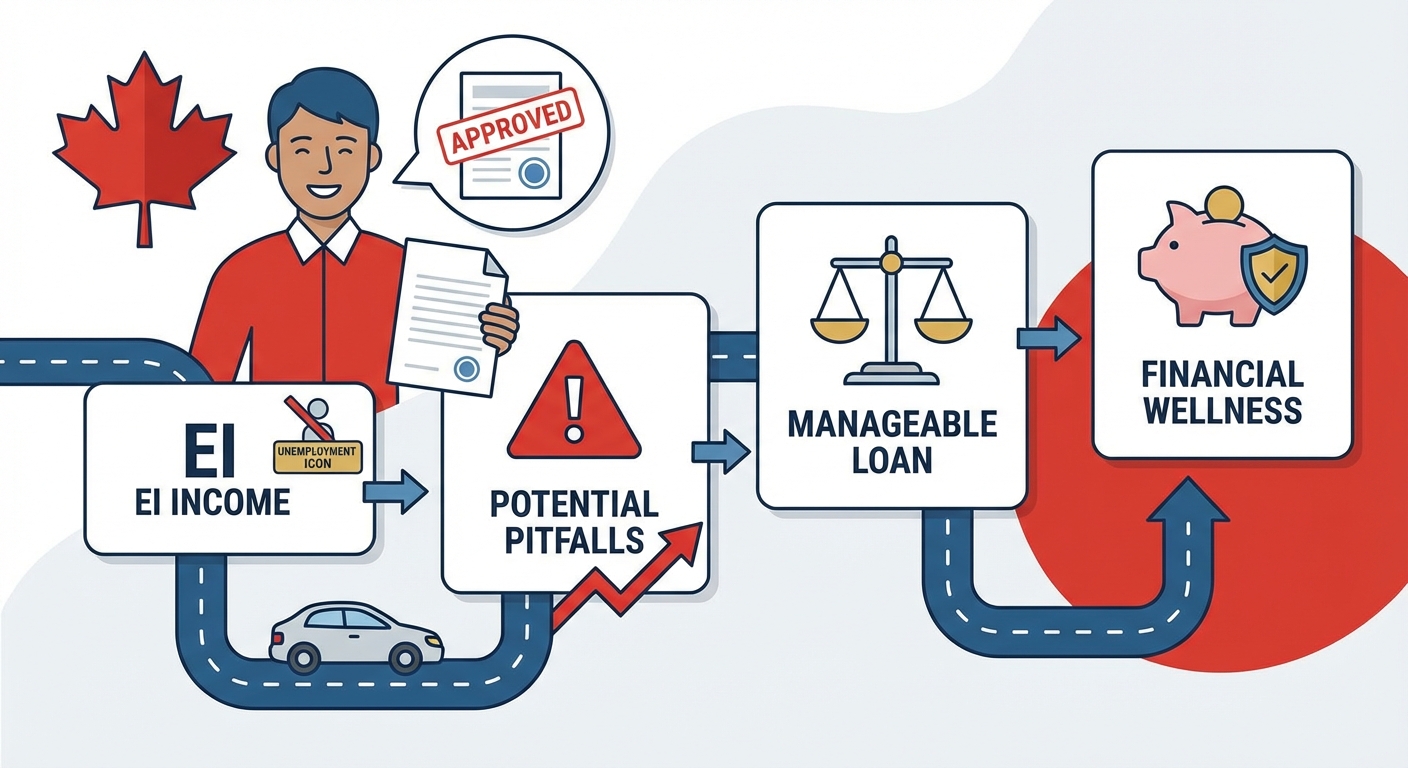
Congratulations, you've been approved! But the journey doesn't end there. For Ontarians securing a car loan on EI, it's crucial to be aware of potential pitfalls and how to navigate them to ensure your loan remains manageable and doesn't lead to further financial strain.
 (Context: A clear, easy-to-read infographic illustrating the breakdown of a car loan payment, including principal, interest, and perhaps even insurance estimates, to show the full financial picture. This visually reinforces the 'true cost'.)
The Interest Rate Gauntlet: Why Your Rate Might Be Higher and How to Mitigate It
As an EI recipient, you're generally considered a higher-risk borrower. This often translates to higher interest rates compared to someone with stable, full-time employment and an excellent credit score. Factors influencing your interest rate include:
- Risk Profile: Your EI income, credit score, and debt-to-income ratio.
- Loan Term: Longer terms often come with slightly higher rates.
- Vehicle Age/Type: Older or less reliable vehicles can sometimes incur higher rates.
- Market Conditions: General interest rate environment.
Strategies for mitigating higher rates:
- Down Payment: Even a small down payment can signal less risk and potentially lower your rate.
- Co-Signer: A strong co-signer can significantly reduce the perceived risk.
- Shorter Loan Term: If you can afford higher monthly payments, a shorter term usually means a lower interest rate and less interest paid overall.
- Refinancing Later: Once you secure stable employment and improve your credit score, you can explore refinancing the loan at a lower interest rate. Keep an eye on market rates and your financial situation.
Understanding Loan Terms: Short vs. Long, and Why It Matters on EI
Loan terms (the length of time you have to repay the loan) typically range from 36 to 84 months. There's a critical trade-off to consider, especially when on EI:
- Longer Terms (e.g., 72-84 months): Offer lower monthly payments, which might seem appealing when on a limited EI income. However, you'll pay significantly more in total interest over the life of the loan. You also risk being in negative equity for a longer period.
- Shorter Terms (e.g., 36-60 months): Come with higher monthly payments but result in less total interest paid and faster equity build-up.
Matching the loan term to your expected EI duration and future income stability is key. If you anticipate being back to full employment within 6-12 months, a slightly shorter term might be manageable. If your EI is expected to last longer, you might need a longer term for affordability, but be acutely aware of the increased total cost.
The 'Add-ons' Trap: What to Say No To (Extended Warranties, Rust Proofing, etc.)
Dealerships often push various add-ons and extras, such as extended warranties, rust proofing, paint protection, fabric protection, and GAP insurance. While some might have marginal value, many are overpriced and inflate your loan unnecessarily. When on EI, every dollar counts.
- Identify Unnecessary Extras: Most add-ons are high-profit items for the dealership. Carefully evaluate if