
Denied a Car Loan on EI? They Lied. Get Approved Here.
Table of Contents
- Denied a Car Loan on EI? They Lied. Get Approved Here.
- Key Takeaways: Your Fast Track to EI Car Loan Success
- The EI Car Loan Myth Debunked: Why 'No' Isn't the Final Answer
- Why the Hesitation? Understanding Lender Psychology
- EI as a Verifiable Income: What Lenders Actually Look For
- Understanding Your EI Income: What Lenders Really See and How to Maximize It
- Deconstructing Your EI Benefits: Regular, Sickness, Parental – Does it Matter?
- The EI Income Calculation: Real Numbers for Real Approvals
- Proof of Income: What Documentation You'll Need
- Beyond EI: The Pillars of Your Car Loan Approval
- Your Credit Score: The Unseen Power Player in EI Lending
- The Magic of a Down Payment: Reducing Lender Risk, Increasing Your Chances
- The Co-Signer Advantage: Sharing the Burden, Doubling the Odds
- Debt-to-Income Ratio: Your Financial Health Check-Up for Lenders
- Choosing the Right Vehicle: Practicality Over Flash
- Navigating the Lender Landscape: Who Will Say 'Yes' to Your EI Car Loan?
- Traditional Banks & Credit Unions: The Uphill Climb (But Not Impossible)
- Dealership Financing & Subprime Lenders: Your Most Likely Allies
- Online Lenders & Brokers: The Digital Fast Track (with Caveats)
- The Application Masterclass: From Pre-Approval to Driving Away
- Step 1: Get Your Financial Ducks in a Row (Before You Even Look at Cars)
- Step 2: The Power of Pre-Approval: Knowing What You Can Afford
- Step 3: Shopping Smart: Car Choice & Negotiation Strategies
- Step 4: Decoding the Loan Offer: Rates, Terms, and Hidden Fees
- Beyond the Loan: Smart Car Ownership While on EI
- Budgeting for Car Ownership: It's More Than Just Payments
Denied a Car Loan on EI? They Lied. Get Approved Here.
You've been told it's impossible. You've faced rejections. The idea of securing a car loan while on Employment Insurance (EI) might feel like a distant dream. But what if we told you that many 'no's' are based on misconceptions, not reality? This deep-dive article isn't just about 'if' you can get a car loan on EI, but 'how' – with strategies, insights, and a clear path to approval. We're here to debunk the myths, illuminate the process, and empower you to drive away in the vehicle you need. At SkipCarDealer.com, we understand the Canadian lending landscape, and we know that your current employment status, while important, doesn't define your entire financial story. Let's uncover the truth about securing a car loan on EI and put you in the driver's seat.
Key Takeaways: Your Fast Track to EI Car Loan Success
Before we dive in, here are the absolute essentials you need to know to secure a car loan while receiving Employment Insurance:
- EI is Verifiable Income: While temporary, lenders *can* and *do* recognize EI as a legitimate income source. It's a government-backed benefit, making it more reliable than some other forms of temporary income.
- Credit Score is King: Your credit history often outweighs your income source for many lenders. A good score significantly improves your odds and rates, even when your income is from EI.
- Down Payment Power: Even a small down payment dramatically increases your approval chances and lowers your overall loan cost. It signals commitment and reduces the lender's risk.
- Strategic Lender Choice: Not all lenders are created equal. Dealerships and specialized subprime lenders are often more accommodating than traditional banks for EI recipients.
- Budget Wisely: Beyond the monthly payment, factor in insurance, maintenance, and fuel. Don't overcommit to a vehicle that will strain your finances.
- Co-Signer Advantage: A financially stable co-signer can be your golden ticket, especially with a lower credit score or if your EI benefit period is shorter.
- Know Your Rights: Understand loan terms, interest rates, and avoid predatory practices. Always read the fine print before signing.
The EI Car Loan Myth Debunked: Why 'No' Isn't the Final Answer
The pervasive belief that 'you can't get a car loan on EI' stems from a misunderstanding of how lenders assess risk. For many Canadians, the initial rejection from a traditional bank can feel like a definitive 'no' from the entire financial system. However, the Canadian lending landscape is vast and diverse, with many institutions and dealerships willing to work with individuals whose income sources might be considered non-traditional or temporary. The myth persists because it's easier for some lenders to simply say no rather than to take the time to understand your unique financial situation and the nuances of EI benefits. We'll explore why this myth persists and how to navigate around it to find the 'yes' you're looking for.
Why the Hesitation? Understanding Lender Psychology
Lenders, at their core, prioritize stability and the ability to repay a loan consistently. EI, by its very nature, is a temporary income source designed to bridge gaps between employment. This temporary aspect is the primary concern for many traditional lenders. They worry about what happens when your EI benefits run out. Will you have secured new employment? Will you be able to continue making payments? These are legitimate questions from a risk management perspective. Lenders also look at your overall financial picture: your credit history, existing debts, and the stability of your past employment. If your EI is coupled with a poor credit score or a history of unstable employment, the perceived risk escalates. Understanding these concerns allows you to proactively address them in your application.
EI as a Verifiable Income: What Lenders Actually Look For
Despite its temporary nature, EI is a government-backed, consistent payment. This makes it a *verifiable* income source, which is crucial. Lenders are more concerned with the predictability and reliability of your income, and EI, for its duration, offers that. They will typically look for documentation such as your Record of Employment (ROE), your EI Statement of Benefits, and recent bank statements showing regular EI deposits. This allows them to confirm the amount you receive and the expected duration of your benefits. They use this information to project your repayment capacity over the initial months of the loan. While they won't treat it like a long-term salary, they can factor it into their calculations for a significant period. For more detailed information on the paperwork required, you might find our article on Approval Secrets: Exactly What Paperwork You Need for Alberta Car Financing helpful, as many of the principles apply across Canada.
Pro Tip: Frame your EI as a 'temporary but verifiable income stream,' not 'unstable.' Emphasize your proactive steps to secure future employment or transition off EI. Lenders appreciate transparency and a clear plan for your financial future beyond EI.
Understanding Your EI Income: What Lenders Really See and How to Maximize It
Not all EI is created equal in the eyes of a lender. While the government calculates your benefit based on your average insurable earnings, lenders consider additional factors. This section dives deep into the nuances of your EI benefits and how to present them effectively to maximize your chances of approval.
Deconstructing Your EI Benefits: Regular, Sickness, Parental – Does it Matter?
While the core benefit calculation is similar, the *duration* and *context* of your EI can subtly influence lender perception. Regular EI benefits, typically for job loss, might be viewed with slightly more scrutiny regarding your job search efforts. Sickness or compassionate care benefits, while also temporary, might be seen as having a clearer, finite end date, potentially making them more predictable for a lender. Parental benefits, which have a defined maximum duration (e.g., 12 or 18 months), can sometimes be viewed more favourably due to their inherent predictability and the likelihood of returning to previous employment or securing new work post-leave. The key is how you communicate the expected end date and your plan for income thereafter.
The EI Income Calculation: Real Numbers for Real Approvals
Lenders won't just take your gross EI amount at face value. They'll consider your net income, the remaining duration of your benefits, and your potential future income. In Canada, EI typically pays 55% of your average insurable weekly earnings, up to a maximum weekly amount (which adjusts annually). For example, the maximum weekly benefit for 2024 is $650. Lenders will assess how this translates to a monthly payment and how much of that is available after essential expenses. They want to see that your projected monthly car payment, plus insurance, is a manageable percentage of your net EI income.
Consider this example:
| Factor | Typical Lender Assessment | Impact on Loan |
|---|---|---|
| EI Benefit Rate | 55% of average insurable earnings | Determines your gross borrowing capacity. |
| Maximum Weekly Benefit (e.g., $650 in 2024) | Your cap, regardless of higher previous earnings. | Sets the upper limit of your EI income for calculations. |
| Benefit Period (e.g., 26-45 weeks) | Remaining weeks are converted to months. | Lenders prefer the loan term to be shorter than, or significantly overlap with, your remaining benefit period. |
| Net EI Income | Gross EI minus taxes (which are deducted). | Your actual disposable income for loan payments. |
| Debt-to-Income (DTI) Ratio | Total monthly debt payments / Net monthly EI income. | Lenders typically want this below 40-50%. |
Understanding the benefit period and how it aligns with potential loan terms is crucial. If you have 30 weeks of EI remaining, a 36-month loan term might be seen as riskier than a 12-month term, unless you have a clear plan for income after EI.
Proof of Income: What Documentation You'll Need
To verify your EI income, you'll need to provide comprehensive documentation. Being prepared with these documents upfront can significantly speed up the approval process:
- Your Record of Employment (ROE) from your previous employer(s), detailing your last day of work and insurable hours.
- Your EI Statement of Benefits, which confirms your weekly benefit amount and the start/end dates of your claim. This can often be accessed through your My Service Canada Account.
- Recent bank statements (typically 3-6 months) showing consistent EI deposits. This verifies that you are indeed receiving the benefits as claimed.
- Proof of identity (e.g., valid Canadian driver's license, passport).
- Proof of residence (e.g., utility bill, lease agreement).
- Any other income verification if you have secondary sources of income (e.g., part-time work, child tax benefits, spousal support).
Beyond EI: The Pillars of Your Car Loan Approval
While EI is your current income, it's only one piece of the puzzle. Your overall financial profile plays a critical role in securing a car loan. Mastering these elements will significantly boost your approval odds, making your EI income a supportive factor rather than a barrier.
Your Credit Score: The Unseen Power Player in EI Lending
A good credit score is often *more* influential than your current income source when dealing with non-traditional income like EI. Why? Because it demonstrates your historical reliability in managing debt. A high credit score tells lenders that even if your income source is temporary, you have a proven track record of making payments on time. This reduces their perceived risk significantly and can lead to better interest rates and more flexible terms. Lenders in Canada primarily use scores from Equifax and TransUnion.
- Understanding Equifax and TransUnion scores: These bureaus collect data on your borrowing and repayment history. Scores typically range from 300 to 900, with anything above 650 generally considered good, and above 750 excellent.
- Factors that build a strong credit score: Consistent on-time payments, low credit utilization (using less than 30% of your available credit), a long credit history, and a mix of credit types (e.g., credit card, line of credit, previous loan).
- The impact of credit inquiries on your score: Each 'hard' inquiry (when a lender checks your credit for a loan) can slightly lower your score temporarily. It's wise to limit these and apply strategically.
For those looking to understand how credit scores are assessed, especially after financial challenges, our article Post-Proposal Car Loan: Your Credit Score Just Got a Mulligan offers valuable insights into rebuilding credit, which can be highly relevant even if you haven't been through a proposal.
Pro Tip: Actionable steps to check your credit score for free (e.g., through Credit Karma or Borrowell) and identify areas for improvement *before* you apply. Paying down small debts or correcting errors on your report can significantly boost your score and literally save you thousands in interest over the life of a car loan.
The Magic of a Down Payment: Reducing Lender Risk, Increasing Your Chances
Even a small down payment signals commitment and dramatically reduces the loan-to-value (LTV) ratio, making you a less risky borrower. When you put money down, the lender has less to lose if you default, and it shows you have some financial discipline. A down payment also reduces the total amount you need to borrow, which means lower monthly payments and less interest paid over the life of the loan. While 10-20% is often ideal, even 5% can make a significant difference. It’s a powerful tool to strengthen your application, especially when your income is temporary.
The Co-Signer Advantage: Sharing the Burden, Doubling the Odds
If your credit isn't perfect, your EI income is borderline, or your benefit period is short, a co-signer can be a game-changer. A co-signer with strong credit and stable income essentially lends their financial credibility to your application, guaranteeing the loan if you cannot make payments. This significantly reduces the lender's risk and can help you secure approval and even better interest rates.
- Qualities of an ideal co-signer: Someone with excellent credit, stable employment, a low debt-to-income ratio, and a willingness to take on the responsibility. This is often a trusted family member.
- The risks and responsibilities for the co-signer: It's crucial that your co-signer understands they are equally responsible for the loan. Their credit will be impacted if payments are missed.
- How a co-signer can secure better interest rates: Lenders will assess the application based on the stronger of the two credit profiles, often leading to more favourable loan terms.
Debt-to-Income Ratio: Your Financial Health Check-Up for Lenders
Lenders look at your total debt obligations versus your income to determine if you can comfortably afford new payments. This is your Debt-to-Income (DTI) ratio. To calculate it, add up all your monthly debt payments (credit cards, existing loans, rent/mortgage) and divide that by your gross monthly income (your EI benefits). Lenders typically prefer a DTI below 40-50%. Keeping this ratio low is crucial for approval, especially when on EI, as it demonstrates responsible financial management and capacity for new debt.
Choosing the Right Vehicle: Practicality Over Flash
The type of car you choose significantly impacts your approval odds and interest rates. When on EI, a practical, affordable, and reliable used car is often a smarter choice than a brand-new luxury model. Lenders prefer to finance vehicles that retain their value and are within a reasonable price range for your income. A less expensive car means a smaller loan amount, lower monthly payments, and thus, lower risk for the lender. Consider a vehicle that is a few years old with reasonable kilometres and a good resale value. Avoid vehicles that are too old or have extremely high mileage, as these can also be seen as higher risk due to potential maintenance costs.
Navigating the Lender Landscape: Who Will Say 'Yes' to Your EI Car Loan?
Forget the idea that all lenders are the same. This section exposes the different types of lenders and where you're most likely to find approval when on EI. Understanding these distinctions is key to directing your application to the right place and avoiding unnecessary rejections.
Traditional Banks & Credit Unions: The Uphill Climb (But Not Impossible)
Major Canadian banks and credit unions are often the toughest nut to crack for EI recipients. Their lending criteria are typically very stringent, prioritizing long-term, stable employment income. They view EI as a high-risk, temporary income. While not impossible, securing a loan from a traditional bank while solely on EI usually requires an exceptional credit score, a substantial down payment, a very short loan term, and/or a strong co-signer. They might consider your application if your EI is a very short-term bridge to confirmed, upcoming employment, or if you have significant assets. Otherwise, it can be an uphill battle, often leading to frustration.
Dealership Financing & Subprime Lenders: Your Most Likely Allies
This is where your chances significantly improve. Dealerships often have access to a wide network of lenders, including those specializing in non-traditional income and varying credit profiles. These are often referred to as 'subprime' or 'non-prime' lenders. They are more flexible and willing to assess your application based on your overall financial picture, rather than solely on your current employment status. They understand that life happens, and people need vehicles even during transitional periods. Many dealerships have dedicated finance managers who work tirelessly to match you with a lender that fits your specific situation, including those receiving EI.
- How dealership finance managers work with multiple lenders: They act as a broker, submitting your application to several specialized lenders simultaneously. This increases your chances of approval without multiple hard inquiries on your credit report.
- Understanding subprime lending: These lenders cater to individuals with less-than-perfect credit or non-traditional income. They accept a higher risk, which typically translates to higher interest rates compared to prime loans. However, they offer greater accessibility and a path to vehicle ownership when other options are closed.
- The benefits of applying directly through a dealership's finance department: They have established relationships with these specialized lenders and understand their specific criteria for EI income. They can also often structure deals to make them more attractive to these lenders. For more insights on how these types of lenders operate with non-traditional income, consider checking out EI Income? Your Car Loan Just Said 'Welcome Aboard!', which further elaborates on this topic.
Pro Tip: How to identify reputable subprime lenders vs. predatory ones. Look for transparent terms, clear fees, and positive customer reviews. Reputable lenders will still conduct a credit check and assess your ability to repay. Avoid anyone guaranteeing approval without checking your financial situation, or pressuring you into signing immediately.
Online Lenders & Brokers: The Digital Fast Track (with Caveats)
The convenience of online applications can be appealing, offering quick pre-approvals from the comfort of your home. Many online lenders and brokers specialize in connecting individuals with various credit profiles and income types to suitable financing options. However, it's crucial to understand their processes, potential pitfalls, and how to verify their legitimacy. Always check for proper licensing and read reviews. While they offer speed, it's vital to ensure you're getting a fair deal and not falling prey to excessively high rates or hidden fees. Often, these online services are aggregators that then pass you to a dealership or specialized lender.
The Application Masterclass: From Pre-Approval to Driving Away
Don't just apply blindly. Follow this step-by-step guide to maximize your chances of approval and secure the best possible terms, even when you're on EI. Strategic preparation is your most powerful tool.
Step 1: Get Your Financial Ducks in a Row (Before You Even Look at Cars)
This foundational step is arguably the most important. Before you even browse car listings, gather all necessary documents: your ROE, EI Statement of Benefits, 3-6 months of bank statements, proof of identity, and proof of residence. Access your credit score and report (from Equifax or TransUnion) to understand where you stand. Create a realistic budget that accounts for your EI income, all current expenses, and the potential costs of car ownership (payments, insurance, fuel, maintenance). Knowing your financial limits upfront prevents overcommitment and strengthens your confidence when speaking with lenders.
Step 2: The Power of Pre-Approval: Knowing What You Can Afford
Pre-approval is key. It's a conditional approval from a lender that tells you how much you can borrow, at what estimated interest rate, based on your current financial situation, including your EI income and credit score. It's not a full loan commitment, but it provides a realistic budget before you start shopping. This empowers you in several ways:
- What pre-approval means and why it's different from a full loan application: Pre-approval is a soft inquiry on your credit (which doesn't harm your score) and gives you a clear spending limit. A full application involves a hard inquiry and specific vehicle details.
- How pre-approval empowers you at the dealership: You walk into a dealership as a cash buyer, knowing exactly what you can afford. This shifts the negotiation power in your favour, allowing you to focus on the car's price rather than being swayed by monthly payment schemes before knowing your true budget.
Step 3: Shopping Smart: Car Choice & Negotiation Strategies
Armed with pre-approval, you can focus on finding the right car. Remember our advice: practicality over flash. Look for reliable, fuel-efficient used cars that fit within your pre-approved budget. When negotiating at the dealership, focus on the total price of the vehicle, not just the monthly payment. Since your financing is already in place (or you know your pre-approved limit), you can separate the car price negotiation from the financing discussion. Don't be afraid to walk away if you don't feel the deal is right. There are always other options.
Step 4: Decoding the Loan Offer: Rates, Terms, and Hidden Fees
This is where many people get tripped up. Once you have a firm loan offer, scrutinize every detail. Understanding the Annual Percentage Rate (APR) is critical, as it includes the interest rate plus any additional fees, giving you the true cost of borrowing. Compare offers from different lenders if possible. Also, pay close attention to the loan term (e.g., 36, 48, 60 months). A longer term means lower monthly payments but significantly more interest paid over time. A shorter term, while having higher monthly payments, saves you money in the long run.
- Understanding Annual Percentage Rate (APR) vs. interest rate: The interest rate is the cost of borrowing; APR includes interest plus other fees, providing a more accurate total cost.
- The impact of loan term on total cost and monthly payments: A 60-month loan will have lower payments than a 36-month loan for the same amount, but you'll pay substantially more in total interest.
- Common fees to watch out for: Administrative fees, documentation fees, extended warranties, rustproofing, and other add-ons. Question everything and only pay for what you truly need or want.
Pro Tip: Create a checklist of questions to ask your lender/dealership about the loan terms, total cost, and any fees. Request a full amortization schedule. Never sign anything you don't fully understand, and don't feel pressured to make a decision on the spot. Take the contract home and review it carefully.
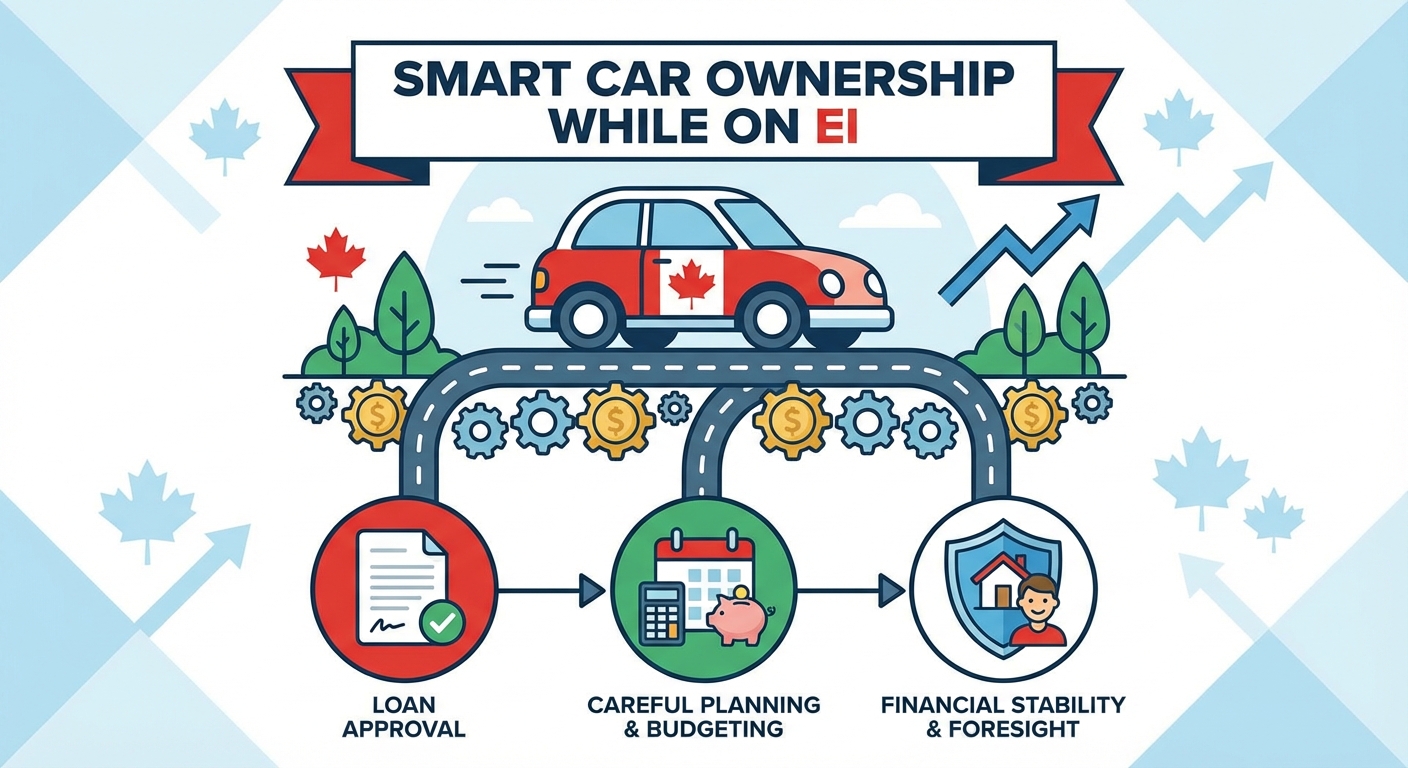
Beyond the Loan: Smart Car Ownership While on EI
Getting the loan is just the beginning. Responsible car ownership, especially while on EI, requires careful planning and financial foresight. Your goal isn't just to get a car, but to maintain your financial stability.
 (Context: A person confidently reviewing loan documents with a pen, possibly at a dealership desk or home office, with a computer screen showing loan calculators in the background. Caption: 'Empower yourself by understanding every line of your loan agreement. Knowledge is your best negotiation tool.')
Budgeting for Car Ownership: It's More Than Just Payments
A