Vehicle Financing After Debt Settlement: Non-Dealer Car 2026
Table of Contents
- The Definitive Guide to Financing a Private Sale Car in 2026 After Debt Settlement
- Key Takeaways
- The Post-Settlement Crossroads: Why Your Situation is Unique
- 2026 Market Outlook: Navigating New Rules and Economic Headwinds
- Deep Dive: Decoding Your Post-Settlement Credit Report
- The Lender's Gauntlet: Why Private Sales Are a Higher Hurdle (And How to Clear It)
- Building Your 'Yes' File: A Pre-Approval Checklist for the Savvy Buyer
- The Money Talk: Realistic Rates, Hidden Costs, and Loan Structures
- Your Roadmap to the Driver's Seat: A Final 30-Day Action Plan
- Frequently Asked Questions (FAQ)
The Definitive Guide to Financing a Private Sale Car in 2026 After Debt Settlement
You’ve done the hard work. You faced your financial challenges head-on, successfully navigated a debt settlement, and closed a difficult chapter. Now, you’re ready for the next step: getting a reliable vehicle to move forward. But you’re not interested in the dealership experience; you’ve found the perfect car from a private seller. The big question looms: can you actually get vehicle financing after a debt settlement for a non-dealer car in 2026?
The answer is a definitive yes, but it requires a different strategy. Lenders see your situation as a unique combination of risk factors: a recently repaired credit history and a private vehicle sale that lacks the structure of a dealership. This guide is your new playbook. We’ll break down exactly what lenders are looking for, how to navigate the 2026 market, and how to build an undeniable case for approval.
Key Takeaways
- Private Sale Approval is Possible: Lenders are wary, but with the right preparation (larger down payment, solid income proof), you can secure a loan for a non-dealer car.
- Your Settlement Letter is Gold: This document is non-negotiable proof your past debts are resolved. It's the first thing lenders will ask for.
- Expect Higher Rates (Initially): Post-settlement financing comes with interest rates reflecting higher risk. We'll show you how to find the most competitive subprime rates.
- The 2026 Market Shift: Anticipate tighter lending criteria and fluctuating used car values. Proactive credit rebuilding is more crucial than ever.
- Lender Choice is Key: Credit unions and specialized online lenders are often more flexible than traditional banks for private party auto loans post-settlement.
The Post-Settlement Crossroads: Why Your Situation is Unique
Securing vehicle financing after a debt settlement for a non-dealer car is achievable by presenting lenders with proof of settlement completion, stable income, and a significant down payment. Your success hinges on demonstrating that the past financial hardship is resolved and you are now a low-risk borrower, mitigating the lender's concerns about private sales.
Let's be clear: you've accomplished something significant. A debt settlement is a proactive step to regain control of your finances. You didn't ignore the problem; you confronted it and found a resolution. This is a point of strength, not shame.
However, from a lender's perspective, the situation is complex. The core friction comes from two places:
- The Debt Settlement: On your credit report, a settlement often appears as "settled for less than full amount." To a traditional lender's automated system, this is a major red flag indicating past inability to meet obligations.
- The Private Sale: Dealerships provide a layer of security for lenders. They verify the vehicle's existence, condition, and title. A private sale removes that safety net, placing all the verification burden on you and the lender.
This journey is different from financing a car during a consumer proposal, where a trustee oversees the process. A completed settlement gives you more freedom to choose your vehicle and lender, but it also means you have to be your own best advocate. You need to build the case for your loan, piece by piece.
Pro Tip: Frame your debt settlement as a sign of financial responsibility—you faced a problem and resolved it. This narrative is powerful when speaking to loan officers at a credit union or a specialized lender. Instead of saying "I had a debt settlement," try "I successfully completed a debt resolution program in 2025 and have since maintained a perfect payment history."
2026 Market Outlook: Navigating New Rules and Economic Headwinds
The landscape for auto financing is constantly shifting, and 2026 presents its own set of challenges and opportunities, especially for borrowers in unique situations. Understanding these trends is critical to setting realistic expectations and building a winning strategy.
Interest Rate Forecasts
Following a period of rate hikes, monetary policy is expected to influence lending costs into 2026. For subprime borrowers (the category most post-settlement applicants fall into), this means that while prime rates may stabilize, the risk premium applied to your loan will remain significant. Expect rates to be higher than they were a few years ago. A small change in the Bank of Canada's overnight rate can translate to a noticeable difference in your monthly car payment.
The Used Car Value Bubble
The wild price fluctuations of the post-pandemic used car market are expected to have settled by 2026. While this means more predictable pricing for you as a buyer, it also means lenders will be scrutinizing Loan-to-Value (LTV) ratios more carefully. LTV is the amount of your loan compared to the car's actual cash value. With values no longer artificially inflated, your down payment becomes even more critical to keep the LTV in a range that lenders find acceptable (typically under 110%).
Lender Policy Shifts
In our experience, when economic uncertainty rises, lenders tighten their belts. The automated approval systems used by big banks in cities like Toronto and Vancouver are likely to become even stricter. These algorithms may automatically decline applications with a recent debt settlement notation. This trend makes personal relationships more valuable than ever. A loan officer at a local credit union who can look beyond the score and see your stable income and down payment is a powerful ally.
New Tech in Lending
The good news is the rise of fintech. New AI-driven lending platforms are emerging that can analyze more than just your credit score. These platforms may place greater weight on your real-time cash flow, employment stability, and the consistency of your bank account deposits. This can be a huge advantage for someone with a strong income history but a damaged credit score.
Deep Dive: Decoding Your Post-Settlement Credit Report
Your credit score is just the headline. Lenders read the whole story, and after a settlement, your credit report has some unique chapters. Understanding what they see is the first step to controlling the narrative.
Forget the three-digit number for a moment. Lenders are looking at specific trade line notations. An account included in your settlement will be marked with a code like R9 or I9 and a comment such as "Settled for less than full amount," "Account legally paid in full for less than the full balance," or it may show as a "charge-off." These are the historical facts.
What matters more is what comes *after*. Lenders want to see a clear dividing line between your past and your present. This is where two concepts become your best friends: credit aging and new, positive data.
Credit Aging
The impact of a negative event like a settlement fades over time. An approval is much more likely 18 months after your final settlement payment than 18 days after. Lenders want to see a proven track record of financial stability *since* the event. The more time you can put between the settlement and your car loan application, the better.
The Power of New, Positive Data
You cannot erase the past, but you can bury it under a mountain of new, positive information. Immediately after your settlement is complete and reported, it is crucial to begin generating a fresh history of on-time payments. The most effective tools for this are:
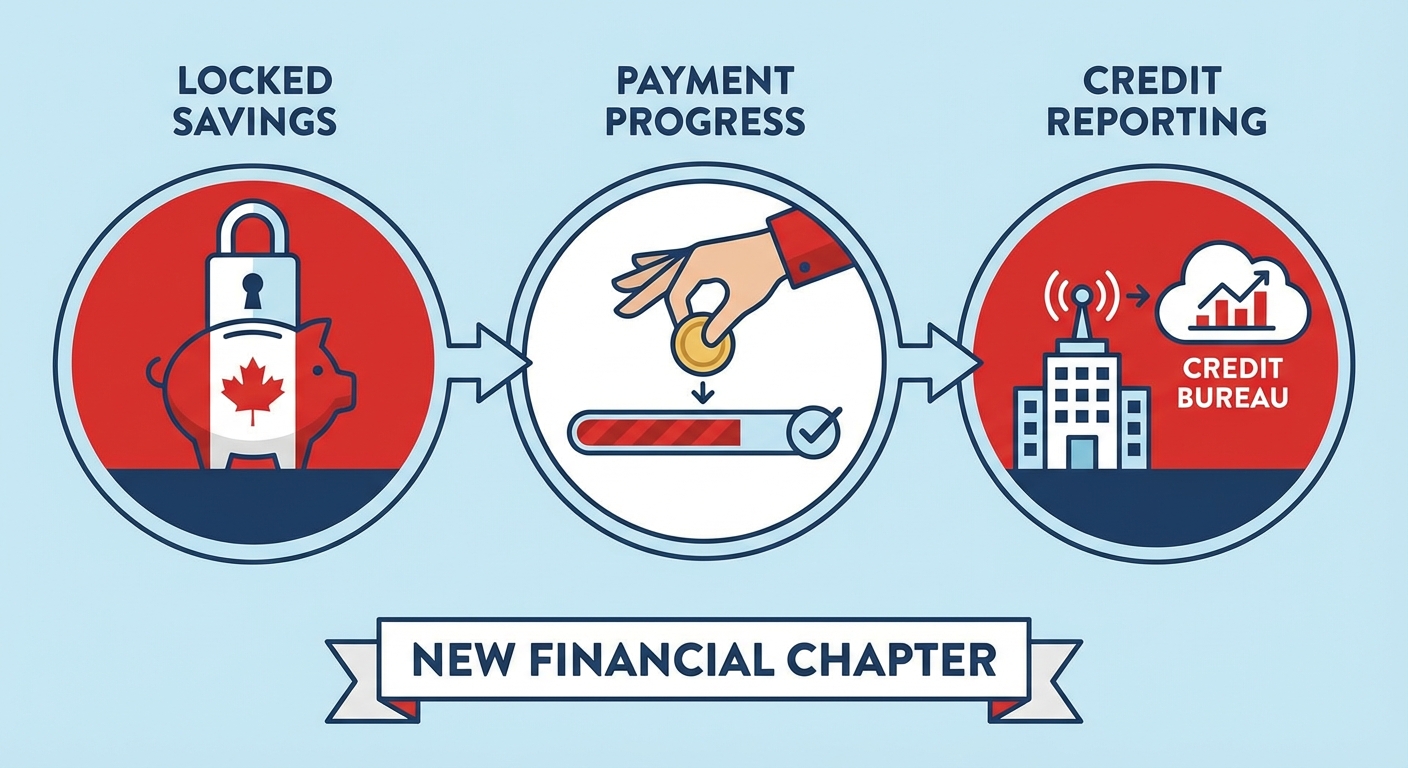
- A Secured Credit Card: You provide a small security deposit (e.g., $300), which becomes your credit limit. Use it for a small, recurring bill like a streaming service, and pay it off in full every single month.
- A Credit-Builder Loan: This is a loan where the funds are held in a savings account until you've paid it off. It's essentially a forced savings program that reports to the credit bureaus.
This strategy shows lenders that the settlement wasn't just a temporary fix but the start of a new, responsible financial chapter.
The Lender's Gauntlet: Why Private Sales Are a Higher Hurdle (And How to Clear It)
Now, let's add the second layer of complexity: you're not buying from a dealership. For a lender, financing a private sale is like walking a tightrope without a net. Understanding their specific fears is how you build the safety net for them.
From a lender's perspective in Calgary or Montreal, the risks of a private deal fall into three main categories:
- Vehicle Verification Risk: At a dealership, the lender trusts that the car is real, that it's in reasonable condition, and that the title is clean. In a private sale, how do they know the 2019 Honda Civic you want to buy isn't a salvaged wreck or doesn't even exist?
Your Solution: Proactively provide a third-party pre-purchase inspection (PPI) report from a licensed mechanic and a comprehensive vehicle history report (like a CarFax). This shows you're a serious, transparent buyer. - Fraud Risk: The potential for scams is much higher in private transactions. Lenders worry about title washing (where a salvaged title is illegally made to look clean) or dealing with a seller who doesn't legally own the vehicle.
Your Solution: Insist on seeing the seller's ID and matching it to the vehicle's ownership documents. Plan to conduct the final transaction at a bank or the lender's office. - Transaction Complexity: Paying a business is simple. Managing a payout to a private individual, ensuring any existing liens are cleared, and properly registering the new lien in their name involves more administrative work and risk.
Your Solution: Having your financing pre-approved makes you a cash buyer in the eyes of the seller, simplifying the process. The lender will then provide clear instructions on how they will handle the payment to the seller. For a complete rundown of the process in Ontario, check out our guide: Ontario Private Car Loan 2026: Skip the Dealership Drama.
Pro Tip: When you first contact a potential lender, your very first question should be, "Do you offer financing for private vehicle sales?" Don't even mention your credit situation yet. Many banks and even some online lenders simply do not offer this product. This one question will save you hours of wasted time and focus your search on institutions that can actually help you.
Building Your 'Yes' File: A Pre-Approval Checklist for the Savvy Buyer
Approaching a lender after a debt settlement isn't about asking for a favour; it's about presenting a business case. You need to assemble a professional, comprehensive package that anticipates every question and erases every doubt. We call this your 'Yes' File.
The Document Arsenal:
Gather these items before you even speak to a loan officer. Having them ready demonstrates you are organized, serious, and prepared.
- Proof of Settlement Completion: The official letter or certificate from your insolvency trustee or credit counselling agency. This is the single most important document you have. It is non-negotiable.
- Income Verification: For employees, this means your last 3-6 months of pay stubs and a letter of employment. For self-employed individuals, it's typically your last two years of tax returns (T1s) and corresponding Notices of Assessment. Proving income when you're self-employed can be tricky, but we have strategies to help. For a deeper dive, read Self-Employed? Your Bank Statement is Our 'Income Proof'.
- Proof of Residence: A recent utility bill or a copy of your lease agreement.
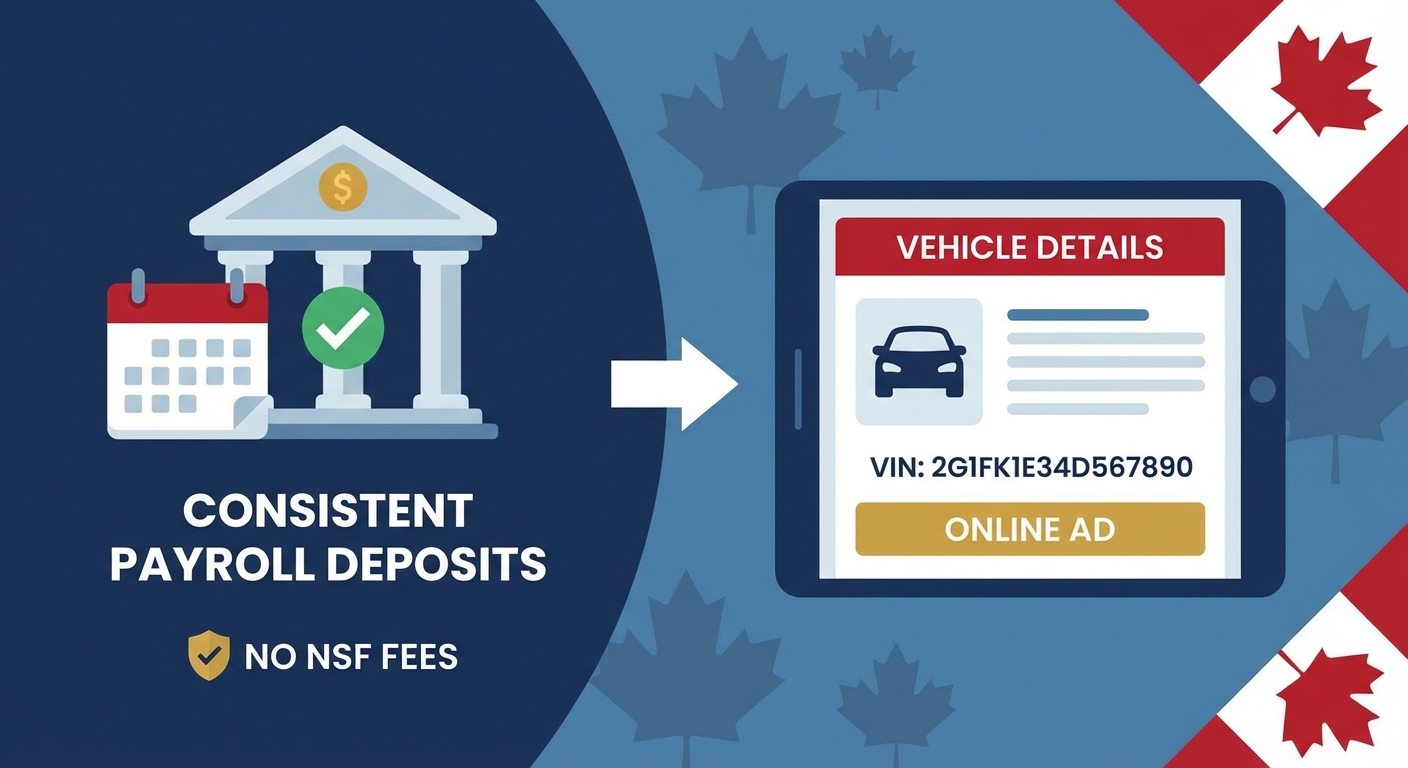
- Bank Statements: Your last 3-6 months of statements from your primary chequing account. Lenders want to see consistent payroll deposits and responsible account management (i.e., no non-sufficient funds charges).
- Vehicle Details: A spec sheet or online ad for the car you want to buy. If you have it, the Vehicle Identification Number (VIN) is ideal.
The Down Payment Equation
In the world of subprime lending, the down payment is king. It's the single most powerful tool you have to increase your approval odds. Why? It reduces the lender's risk. A significant down payment shows you have skin in the game and lowers the all-important LTV ratio.
While some programs exist that advertise no money down, they are extremely difficult to qualify for after a settlement. For a private sale, a large down payment is practically a requirement. Aim for 20-25% of the vehicle's purchase price. This is the magic number that makes lenders sit up and take notice. If you're looking for strategies to get a car with less upfront, our article on Zero Down Car Loan After Debt Settlement 2026 explores some niche options.
The Money Talk: Realistic Rates, Hidden Costs, and Loan Structures
Let's talk numbers. Optimism is great, but realism gets you approved. After a debt settlement, you will not qualify for the 5.99% rate you see advertised on TV. You are rebuilding, and your interest rate will reflect the lender's perceived risk. The goal is not to get a perfect rate, but the *best possible rate for your specific situation*.
With a credit score around 600 post-settlement, a strong income, and a 20% down payment on a $20,000 car, you might realistically see rates in the 12% to 18% range from a specialized lender. With less money down or a shakier income, that could climb to 20% or higher.
Here’s how that plays out on a $20,000 private vehicle purchase over 60 months:
| Scenario | Down Payment | Loan Amount | Interest Rate (APR) | Monthly Payment | Total Interest Paid |
|---|---|---|---|---|---|
| Strong Applicant (Post-Settlement) | $4,000 (20%) | $16,000 | 12.99% | $364 | $5,840 |
| Average Applicant (Post-Settlement) | $2,000 (10%) | $18,000 | 17.99% | $458 | $9,480 |
| Prime Borrower (Reference) | $4,000 (20%) | $16,000 | 7.99% | $325 | $3,500 |
Deep Dive: The Amortization Trap
With a higher interest rate, it's crucial to understand amortization. In the early years of your loan, the vast majority of your payment goes towards interest, not the principal (the amount you borrowed). On that $18,000 loan at 17.99%, over $2,700 of your first year's payments will be pure interest. This is why it's so important to make extra payments whenever possible to attack the principal directly.
Beyond the Rate: Hidden Costs
Subprime loans can sometimes come with extra fees. Be sure to ask about:
- Loan Origination Fees: A fee for processing the loan, sometimes a percentage of the loan amount.
- Administrative Fees: Vague fees that can add several hundred dollars to your total cost.
- Lien Registration Fees: A standard fee for registering the lender's interest in the vehicle with the provincial authorities.
Always ask for a full breakdown of the loan agreement before you sign anything.
Pro Tip: Always ask for the "Total Cost of Credit." This single number, which is legally required on loan agreements in Canada, includes all interest and fees you will pay over the entire term of the loan. It is the ultimate tool for comparing two different loan offers. An offer with a lower interest rate but high fees might actually cost you more than an offer with a slightly higher rate and zero fees.
Your Roadmap to the Driver's Seat: A Final 30-Day Action Plan
Feeling overwhelmed? Don't be. Let's break this down into a clear, week-by-week action plan to take you from reading this article to holding the keys to your new car.
Week 1: Foundation
This week is all about preparation. Pull your credit reports from both Equifax and TransUnion (you can get them for free). Scrutinize them for errors and ensure your settled accounts are reporting correctly. Gather every single document from the 'Yes' File checklist and organize them in a digital folder. No excuses—get it all together now.
Week 2: Lender Shopping
It's time to find your financial partner. Identify two local credit unions and two national online lenders that specialize in your situation (like SkipCarDealer.com). Contact them with your opening question: "Do you finance private vehicle sales for applicants who have completed a debt settlement?" Based on their answers, submit your pre-approval applications with your complete 'Yes' File. Getting pre-approved gives you immense negotiating power.
Week 3: Car Hunting & Inspection
With a pre-approval letter in hand, you know your budget. Now the fun begins. Find the specific car you want from a private seller online or through your network. The moment you agree on a price, make the deal conditional on a successful pre-purchase inspection from a neutral, third-party mechanic. This is non-negotiable protection for you and your lender.
Week 4: Closing the Deal
Provide the final vehicle information and the inspection report to your chosen lender. They will draw up the final loan documents. Arrange to meet the seller at the lender's branch or your local bank to finalize the transaction. The lender will pay the seller directly (often with a bank draft), you'll sign the paperwork, and the seller will sign over the ownership. You're officially a car owner.