Tax Return Car Loan: Self-Employed Approval Canada 2026
Table of Contents
- The Self-Employed Car Loan Code: Cracking Approval in Canada Using Your Tax Returns
- Your Quick-Start Guide: Key Takeaways for Approval
- Key Takeaways
- The Freelancer's Dilemma: Why Your Tax Return Doesn't Tell the Whole Story (And How to Fix It)
- Gross vs. Net Income: Translating Your T1 General for Lenders
- Pro Tip: The Statement of Income Adjustments
- The 'Add-Back' Advantage: Unlocking Your Hidden Income Potential
- Assembling Your 'Shock and Awe' Document Portfolio
- The Core Four: Must-Have Documents for Every Application
- Visualizing Your Path to Approval: The Self-Employed Document Funnel
- Supporting Evidence: Documents That Can Tip the Scales in Your Favour
- Pro Tip: Show Your Upward Momentum
- The Lender Showdown: Where to Get Your Loan in Canada
- The Big Banks (RBC, TD, etc.) vs. Your Local Credit Union
- Dealership Financing: The Path of Least Resistance?
- Pro Tip: The Pre-Approval Power Move
- Alternative & Private Lenders: The Self-Employed Specialist
- Comparison Table: Choosing Your Financing Partner
- Decoding the Numbers: Credit Score, Down Payment, and Interest Rates
- Your Credit Score: The Great Equalizer
- The Down Payment Power Play: How Much is Enough?
- Beyond the Loan: Tax Implications and Business Strategy
- Writing It Off: Can You Deduct Your Car Loan Interest?
- Personal Name vs. Corporation: A Critical Decision
- Your Approval Roadmap: A 7-Step Plan from Application to Keys in Hand
- Frequently Asked Questions (FAQ)
Navigating the world of car loans as a self-employed Canadian can feel like trying to explain your job to your grandparents. You know you make good money, but the numbers on your tax return—meticulously optimized by your accountant to save you thousands—tell a different story to a traditional lender. This is the core challenge for entrepreneurs, freelancers, and contractors across Canada. For 2026, the game hasn't changed, but the strategies to win have become clearer.
Lenders are slowly catching up to the reality of the gig economy and modern entrepreneurship. They're learning that a low figure on Line 23600 of your T1 General isn't the whole picture. Your success in securing a car loan hinges on your ability to translate your real financial health into a language they understand. This guide is your translator. We'll break down how to use your tax returns not as a barrier, but as a key to unlocking approval, whether you're a graphic designer in Toronto, a contractor in Calgary, or a tech consultant in Vancouver.
The Self-Employed Car Loan Code: Cracking Approval in Canada Using Your Tax Returns
Getting car loan approval as a self-employed Canadian using tax returns means proving your *true* earning power, not just your declared net income. Lenders need to see stable, verifiable cash flow and financial discipline. The key is to present a comprehensive financial picture using your Notice of Assessment, bank statements, and a strong credit history to bridge the gap left by tax write-offs.
Your Quick-Start Guide: Key Takeaways for Approval
Key Takeaways
- Your NOA is King, But Cash is Queen: Your Canada Revenue Agency (CRA) Notice of Assessment (NOA) is the most trusted income document. However, for a more accurate picture, supplement it with 6-12 months of business bank statements to prove consistent cash flow.
- Lenders "Add Back" Expenses: Don't panic over a low net income. Savvy lenders will "add back" certain non-cash expenses like depreciation (CCA) and some one-time costs to your declared income to calculate your actual ability to pay.
- Credit & Cash Overcome Income Gaps: A strong credit score (700+) and a substantial down payment (15% or more) are your most powerful tools. They significantly reduce the lender's risk and can make them overlook a lower-than-ideal declared income.
- Think Beyond the Big Banks: Alternative lenders and credit unions often specialize in self-employed clients. They have flexible programs (like "stated income" or "bank statement" loans) designed for entrepreneurs in major hubs like Toronto or Vancouver.
The Freelancer's Dilemma: Why Your Tax Return Doesn't Tell the Whole Story (And How to Fix It)
Here's the fundamental conflict every self-employed person faces: your accountant's goal is to minimize your taxable income, while a lender's goal is to verify the highest possible income. You spend all year strategically claiming every legitimate expense—home office, vehicle costs, supplies, software—only to find that the resulting net income makes it look like you can't afford a new hatchback, let alone the work truck you need.
This isn't a dead end; it's a communication challenge. Your job isn't to hide your write-offs, but to reframe your financial story for the lender. You need to show them the robust, healthy business that exists *before* the tax-saving deductions are applied. It’s about building a bridge from your T1 General to your real-world bank account balance.
Gross vs. Net Income: Translating Your T1 General for Lenders
When a lender looks at your T1 General tax return, two lines jump out: Line 15000 (Total Income) and Line 23600 (Net Income). For a traditional employee, these numbers are often very close. For you, they can be worlds apart.
Line 15000 (Gross Income): This is your victory lap. It represents every dollar your business brought in. A high gross income is a powerful signal of a healthy, active business. It's your starting point and proves there's significant revenue flowing through your enterprise.
Line 23600 (Net Income): This is your taxable income after all business expenses have been deducted. While crucial for the CRA, it can be a misleading metric of your ability to service debt. A lender who focuses solely on this number might unfairly deny your application.
Your task is to draw the lender's attention back to the gross income and then intelligently explain the gap between the two. This demonstrates financial literacy and transparency.
Pro Tip: The Statement of Income Adjustments
Prepare a simple, one-page letter titled 'Statement of Income Adjustments'. In it, briefly list your major business expense categories (e.g., Vehicle Expenses, Office Supplies, Subcontractor Fees) that connect your gross and net income. This isn't about making excuses; it's about providing professional context. Attaching this to your application shows you're organized and on top of your finances.
The 'Add-Back' Advantage: Unlocking Your Hidden Income Potential
This is where working with an experienced lender pays off. Sophisticated lenders who understand self-employed finances don't just look at Line 23600. They perform a calculation to determine your "true" or "normalized" income. They do this by "adding back" certain non-cash or one-time expenses to your net income.
Common add-backs include:
- Depreciation / Capital Cost Allowance (CCA): This is the most common add-back. You didn't actually spend this money this year; it's a paper deduction for the wear-and-tear on your assets. Lenders know this and will almost always add it back to your income.
- One-Time Capital Expenses: Did you buy a new $5,000 computer system last year? A lender may be willing to add that back, as it's not a recurring monthly expense that will affect your ability to make a car payment this year.
- Discretionary Expenses: Sometimes, a portion of home office costs, meals, and entertainment can be added back, though this is more common with specialized alternative lenders.
Hypothetical Example: An Edmonton-based sole proprietor plumber has a net income of $45,000 on their NOA. However, their T1 General shows they claimed $12,000 in CCA for their tools and truck. A savvy lender would "add back" the $12,000, qualifying them based on an income of $57,000.
Assembling Your 'Shock and Awe' Document Portfolio
Approaching a car loan application isn't just about filling out a form. It's about presenting a compelling, undeniable case for your financial stability. Think of it as preparing for a business pitch. The more professional, organized, and comprehensive your documentation is, the more confidence you instill in the underwriter.
The Core Four: Must-Have Documents for Every Application
- T1 General Tax Returns (2-3 years): Provide the full T1 package, not just the summary. Lenders want to see the breakdown of your income and expenses (Statement of Business or Professional Activities). Two years is the minimum standard; three is even better as it shows a longer trend of stability.
- Notices of Assessment (NOA) from the CRA (2-3 years): This is the lender's gold standard. An NOA is the CRA's official confirmation that they have reviewed and accepted your tax filing. It proves the income you've declared is legitimate and that you don't owe back taxes. In our experience, this document carries more weight than the T1 itself.
- Business Registration / Articles of Incorporation: This proves your business is legitimate and registered correctly. For sole proprietors, this might be your Master Business License. For corporations, it's your incorporation documents.
- Personal & Business Bank Statements (6-12 months): This is your proof of cash flow. Lenders are looking for consistent monthly deposits that align with the gross income on your T1s. They're also scanning for red flags like Non-Sufficient Funds (NSF) charges or erratic cash withdrawals. Clean statements are critical.
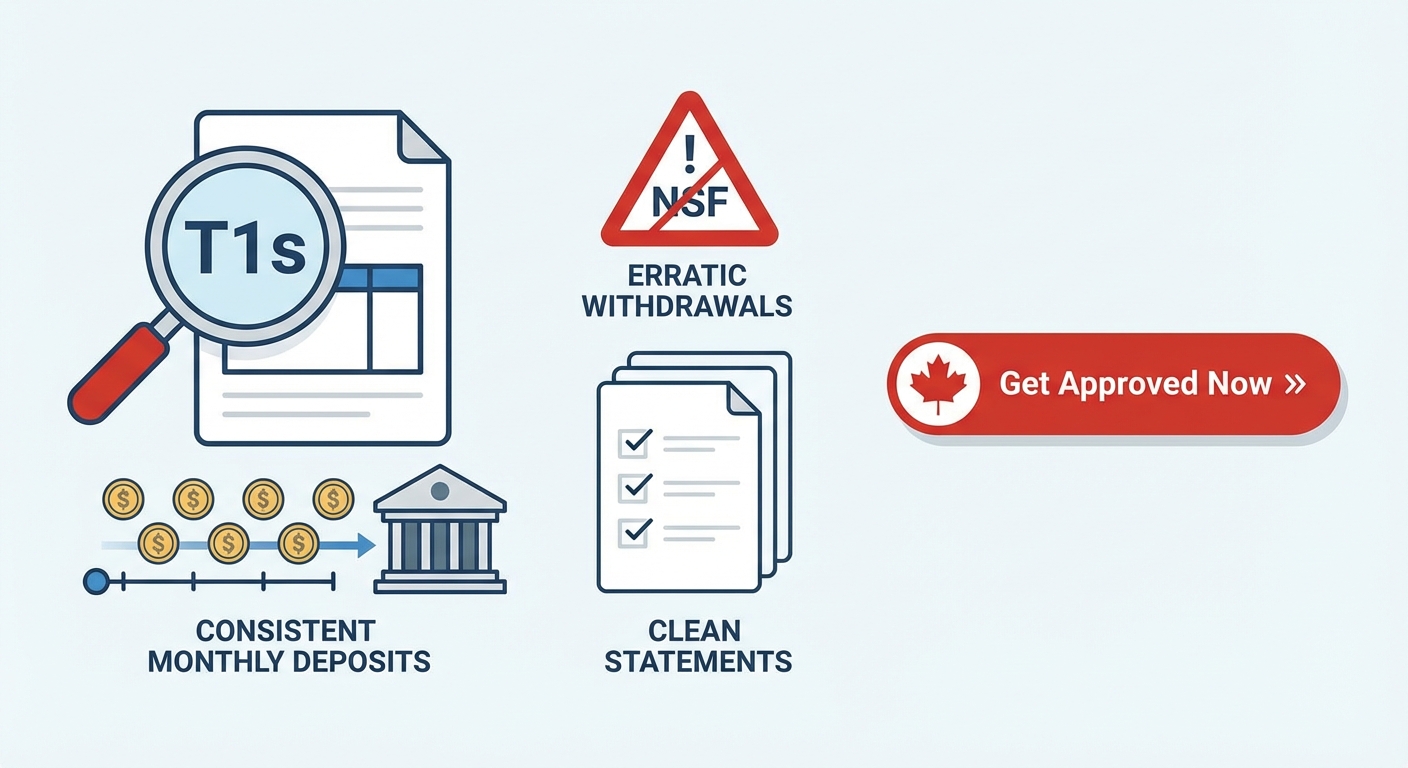 Visualizing Your Path to Approval: The Self-Employed Document Funnel
An infographic or flowchart showing the documents needed at each stage: Initial Inquiry -> Pre-Approval -> Underwriting -> Final Approval. This simplifies the process and reduces overwhelm.
Supporting Evidence: Documents That Can Tip the Scales in Your Favour
If your application is on the borderline, these documents can provide the extra push needed for approval:
- Major Client Contracts: Have a new, lucrative contract with a well-known company? Include it! This shows future income stability.
- GST/HST Registration & Remittance Proof: This demonstrates you're a serious, established business that is compliant with federal tax regulations.
- Professionally Prepared Financial Statements: If you use an accountant, a year-end or interim financial statement (Balance Sheet, Income Statement) adds a huge layer of credibility.
Pro Tip: Show Your Upward Momentum
Was your income last year good, but this year is shaping up to be great? Don't wait for next year's tax return. Ask your accountant to prepare a year-to-date Profit and Loss (P&L) statement. Presenting this alongside your older tax returns shows positive momentum and can allow lenders to use your more current, higher income for qualification.
The Lender Showdown: Where to Get Your Loan in Canada
Not all lenders are created equal, especially when it comes to self-employed applicants. Choosing the right one for your specific situation is a strategic decision that can save you thousands in interest and headaches.
The Big Banks (RBC, TD, etc.) vs. Your Local Credit Union
Pros: If you have a long-standing relationship, excellent credit, and a high, stable declared net income (especially if you're incorporated), you may secure the best interest rates here. Credit unions can sometimes offer more personalized service than the big five banks.
Cons: They are often the most rigid and conservative. Their underwriting systems are typically black-and-white, relying heavily on the net income from your NOA. They are less likely to be flexible with "add-backs" or considering bank statement deposits alone.
Best for: Incorporated professionals in provinces like Ontario with consistently high declared incomes and strong credit scores.
Dealership Financing: The Path of Least Resistance?
Pros: Unbeatable convenience. You shop for the car and the financing in one place. Dealership finance managers work with a wide network of lenders (including major banks and alternative lenders), meaning they can shop your application around to find an approval.
Cons: You may not get the absolute lowest rate, as the dealership is a middleman. There can also be pressure to add on warranties or other products. Honesty is key here: while convenient, it's a volume business, and ensuring you get the best possible terms requires you to be prepared.
Pro Tip: The Pre-Approval Power Move
Always, always, always try to secure a pre-approval from your own bank or a credit union *before* you step into a dealership. This pre-approval is your ultimate negotiating tool. It sets a benchmark rate that the dealership's finance manager has to beat. Walking in with financing already secured gives you all the power.
Alternative & Private Lenders: The Self-Employed Specialist
Pros: These lenders built their business model around clients the big banks turn away. They specialize in "stated income" or "bank statement" programs. They understand a freelancer's cash flow and are experts at calculating your true income with add-backs. If your income structure is complex or you're a newer business owner, this is often your best bet for approval.
Cons: This flexibility comes at a cost. Interest rates and fees are almost always higher than with A-lenders like banks. It's crucial to read the fine print.
Best for: New entrepreneurs, those with large but inconsistent cash deposits, or individuals with complex tax write-offs in competitive markets like Vancouver or Calgary.
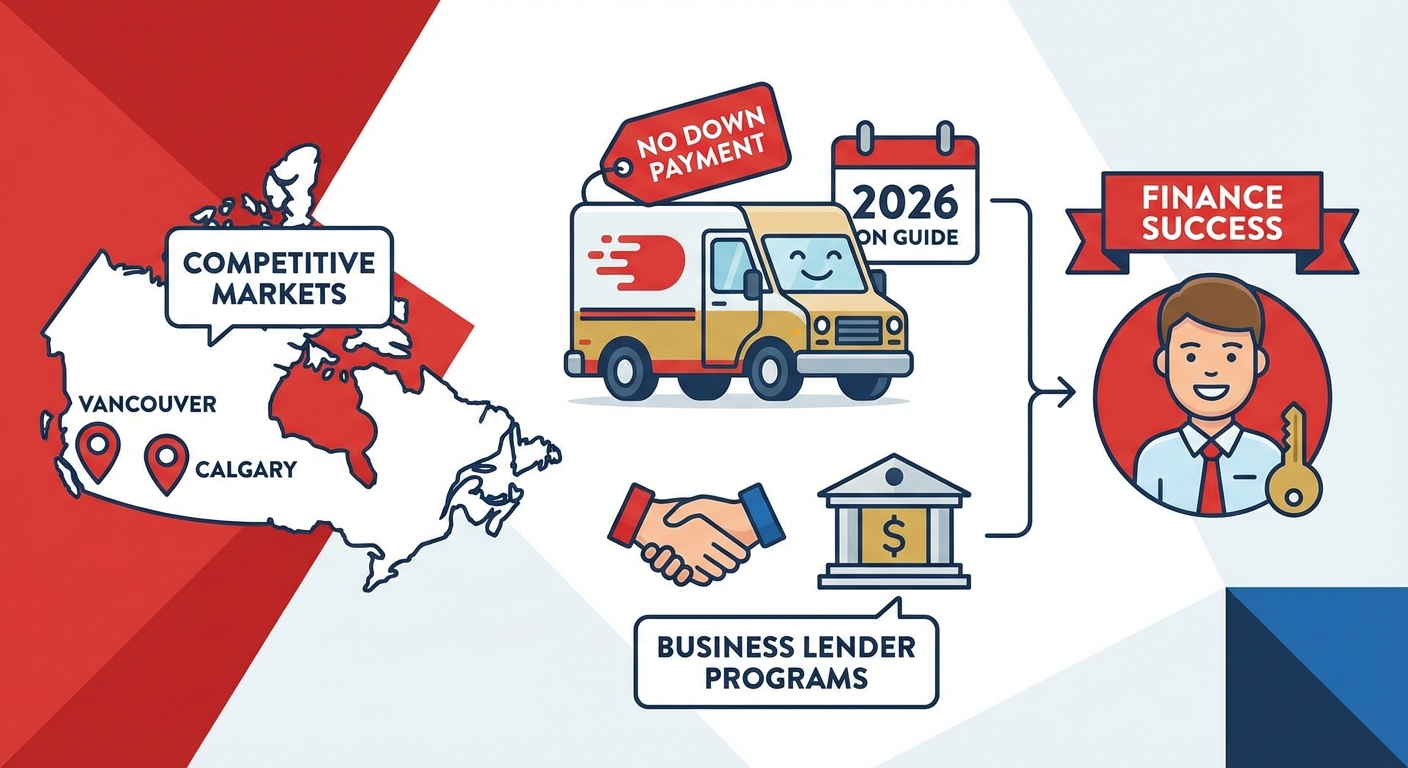
Many of these lenders offer programs specifically designed for business owners. If you're looking to Finance a Delivery Van, No Down Payment | 2026 ON Guide, these specialists are often the way to go.
 Comparison Table: Choosing Your Financing Partner
| Lender Type | Interest Rate (Typical Range) | Document Flexibility | Approval Speed | Best For Scenario |
|---|---|---|---|---|
| Major Banks | Prime (6.5% - 9%) | Low (Strictly NOA-based) | Moderate (2-5 days) | High-income incorporated professionals with excellent credit. |
| Credit Unions | Prime (6.5% - 9.5%) | Low-Moderate (Slightly more flexible) | Moderate (2-5 days) | Members with a long-standing relationship and strong finances. |
| Dealership Financing | Prime to Subprime (7% - 25%+) | Moderate (Access to various lenders) | Fast (Same day) | Convenience seekers and those who want multiple options with one application. |
| Alternative Lenders | Subprime (9% - 29.9%) | High (Bank statement programs) | Fast (1-2 days) | New businesses, complex incomes, or those with bruised credit. |
Decoding the Numbers: Credit Score, Down Payment, and Interest Rates
Your documentation tells the story of your income, but your credit score and down payment tell the story of your financial character. For a self-employed applicant, these two numbers can make or break a deal.
Your Credit Score: The Great Equalizer
A high credit score is your secret weapon. It acts as a powerful signal of trust to lenders. If you have a score of 720 or higher, it tells a lender that you have a long history of paying your debts on time, which significantly mitigates the risk they perceive from your variable, self-employed income.
In many cases, a stellar credit score can compensate for a net income that's on the lower end. A lender might approve a loan for someone with a 780 score and $50,000 declared income over someone with a 650 score and $60,000 declared income.
Actionable Tip: Before applying, get a copy of your credit report from Equifax or TransUnion. Pay down credit card balances to below 30% of their limits—this can provide a quick and significant boost to your score. If you're struggling with past issues, remember that Your 'Bad Credit' Isn't a Wall. It's a Speed Bump to Your New Car, Toronto.
The Down Payment Power Play: How Much is Enough?
For a self-employed applicant, a down payment is more than just money; it's a statement of commitment. While you can sometimes get approved with zero down, providing a significant down payment (15-25%) dramatically increases your chances and improves your terms.
Why?
- It Reduces Lender Risk: The more of your own money is in the vehicle, the less the lender stands to lose if you default.
- It Shows Financial Discipline: It proves you have the ability to save and manage cash, a key concern for lenders looking at variable incomes.
- It Lowers Your Payment: A larger down payment means a smaller loan, resulting in a more manageable monthly payment that is easier to qualify for.
Scenario: A Calgary-based contractor wants to buy a $40,000 truck.
- Applicant A (5% down - $2,000): The lender is financing $38,000. This is a higher risk, likely resulting in a higher interest rate (e.g., 9.99%) and stricter income verification.
- Applicant B (25% down - $10,000): The lender is only financing $30,000. This is a much lower risk. The lender may offer a better rate (e.g., 7.99%) and be more flexible on the income documents.
Beyond the Loan: Tax Implications and Business Strategy
Getting the loan is just the beginning. How you structure the purchase and use the vehicle has significant implications for your business's bottom line. This is where you can turn your new vehicle into a valuable business asset.
Writing It Off: Can You Deduct Your Car Loan Interest?
Yes, you absolutely can, provided you use the vehicle to earn business income. The Canada Revenue Agency (CRA) allows you to deduct the interest portion of your car loan payments. The deductible amount is proportional to the percentage of time you use the vehicle for business.
Furthermore, you can claim Capital Cost Allowance (CCA), which is the CRA's term for depreciation. This allows you to deduct a portion of the vehicle's capital cost each year. For a deeper dive into how this works for business owners, check out how Self-Employed? Your Income Verification Just Got Fired. can pair with smart tax strategies.
CRITICAL: To make these deductions, you MUST keep a detailed mileage log tracking every trip—business and personal. A simple notebook in the glovebox or a smartphone app is essential. Without a log, the CRA can disallow your claim in an audit.
Personal Name vs. Corporation: A Critical Decision
Should you finance the vehicle in your personal name or through your incorporated business? There are pros and cons to each.
Financing Personally:
- Pros: Easier to qualify for as it's based on your personal credit history. The process is generally simpler.
- Cons: You are personally liable for the debt. The loan and any payment history will appear on your personal credit report.
Financing Corporately:
- Pros: The debt is held by the corporation, shielding you from personal liability (though a personal guarantee is often required). It keeps business and personal finances cleanly separated.
- Cons: Can be harder to qualify for, especially for newer corporations. Lenders will want to see 2-3 years of corporate financial statements and tax returns.
Consult with your accountant to determine the best strategy for your specific business structure and financial situation.
Your Approval Roadmap: A 7-Step Plan from Application to Keys in Hand
Feeling overwhelmed? Don't be. Here is a clear, step-by-step plan to take you from reading this article to driving your new vehicle.
- Assess & Clean: Pull your own credit report. Dispute any errors. Organize your last two to three years of T1 Generals and NOAs into a single folder.
- Build Your Portfolio: Gather the 'Core Four' documents plus any supporting evidence like major contracts or a year-to-date P&L statement.
- Get a Pre-Approval: Start with your own bank or a trusted credit union to set a baseline interest rate. Don't be discouraged by a 'no'—it's just data.
- Shop for the Vehicle: With your budget set and pre-approval in hand, you can now shop with the confidence of a cash buyer.
- Let Dealers Compete: Once you've chosen a vehicle, allow the dealership's finance office to try and beat your pre-approved rate. Their network is vast, and they often can.
- Review the Fine Print: Before signing, scrutinize the final loan agreement. Confirm the interest rate (APR), the term length (in months), the total cost of borrowing, and any administrative fees.
- Drive Away & Log Your Miles: Congratulations! The moment you drive off the lot, start your mileage log. Your first business trip begins now.