The traditional Canadian car-buying experience is notorious for high-pressure sales tactics, confusing "admin fees," and the exhaustion of spending an entire Saturday in a fluorescent-lit showroom. But the landscape is shifting. From the suburbs of Toronto to the rainy streets of Vancouver, Canadians are choosing a different path: buying cars from their couches. This isn't just a trend; it's a fundamental restructuring of how we handle one of the largest purchases of our lives.
Online car dealers have moved beyond being simple classified sites. They are now full-service ecosystems that handle everything from mechanical reconditioning and financing to home delivery and provincial registration. However, with this convenience comes a new set of questions. Is the quality really there? How does "instant financing" work without ruining your credit score? And what happens if the car arrives and it just doesn't feel right? We are diving deep into the mechanics of the digital auto industry to uncover the secrets the industry usually keeps behind the curtain.
Key Takeaways
- Mainstream Shift: Platforms like Clutch and CarDoor have normalized "couch-commerce" in Canada, offering end-to-end digital transactions.
- Transparency Standards: Detailed 200+ point inspection reports and CARFAX history are now the baseline expectation, not an optional extra.
- The New Test Drive: The 7-Day Money-Back Guarantee has replaced the 15-minute drive around the block, giving buyers real-world "trial periods."
- Soft-Credit Magic: Instant financing secrets revolve around soft-credit pulls, allowing you to see actual interest rates without a hard hit to your credit score.
- Hidden Savings: By eliminating physical showrooms and commissioned sales staff, online dealers often scrap the "documentation" and "admin" fees common at traditional lots.
The Digital Revolution of the Canadian Auto Industry
For decades, the power dynamic in car buying was heavily skewed toward the dealer. They had the information, they had the inventory, and they had the "closer" in the back office. Today, that power has shifted into the hands of the consumer. Why? Because transparency is the new currency. Canadians are ditching the traditional model not just for convenience, but for the peace of mind that comes with fixed pricing.
An "Online Car Dealer" in the modern Canadian context is a platform that owns its inventory. Unlike sites that merely list cars from various sources, these companies buy the vehicles, inspect them in their own facilities, and sell them directly to you. It is a vertical integration that removes the middleman and, theoretically, the headache. You aren't just buying a car; you're buying a logistics service that includes a vehicle.
The Major Players: Who Are the Online Car Dealers in Canada?
The market is currently dominated by a few heavy hitters who have invested millions in infrastructure. Clutch.ca is perhaps the most recognizable name, having scaled rapidly across Ontario, the Maritimes, and Western Canada. Their model focuses on high-volume inventory and a streamlined mobile app experience. They've turned car buying into something that feels as simple as ordering from a food delivery app.
Then there is CarDoor.ca, which leans heavily into lifestyle-based shopping. Instead of just filtering by "Sedan" or "SUV," they allow you to shop by categories like "Eco-Friendly," "Luxury," or "Family-Ready." Their 215-point inspection is one of the most rigorous in the industry, designed to compete directly with Certified Pre-Owned (CPO) programs from major manufacturers.
While these players are expanding, regional availability still varies. Ontario is the most competitive market, but Alberta and BC are seeing a surge in digital-first independent dealers. The Maritimes are also becoming a focus point as logistics networks improve. Regardless of which platform you choose, you must verify their credentials.
The Step-by-Step Mechanics of Buying a Car Online
How does one actually buy a $30,000 machine without touching it first? The process is designed to be incremental, building trust at every stage.
1. Digital Browsing and Filtering
The journey starts with sophisticated filters. You can narrow down your search by "Monthly Payment" rather than just "Total Price," which is how most Canadians actually budget. You can filter for specific features like Apple CarPlay, heated steering wheels (a Canadian must-have), or specific safety tech like blind-spot monitoring.
2. The Transparency Report
Before you even look at the price, you look at the "Health Report." This includes the CARFAX (showing accident history, lien status, and service records) and the dealer's own inspection report. If a car had a minor fender bender three years ago, a reputable online dealer will show you the exact repair cost and location.
3. The Virtual Walkaround
High-definition 360-degree photography is the standard. These aren't just pretty pictures; they include "imperfection call-outs." If there is a 2mm paint chip on the hood or a small scuff on the rear bumper, the dealer will highlight it with a dedicated close-up photo. This level of honesty is designed to prevent "surprises" upon delivery.
4. The Checkout and Documentation
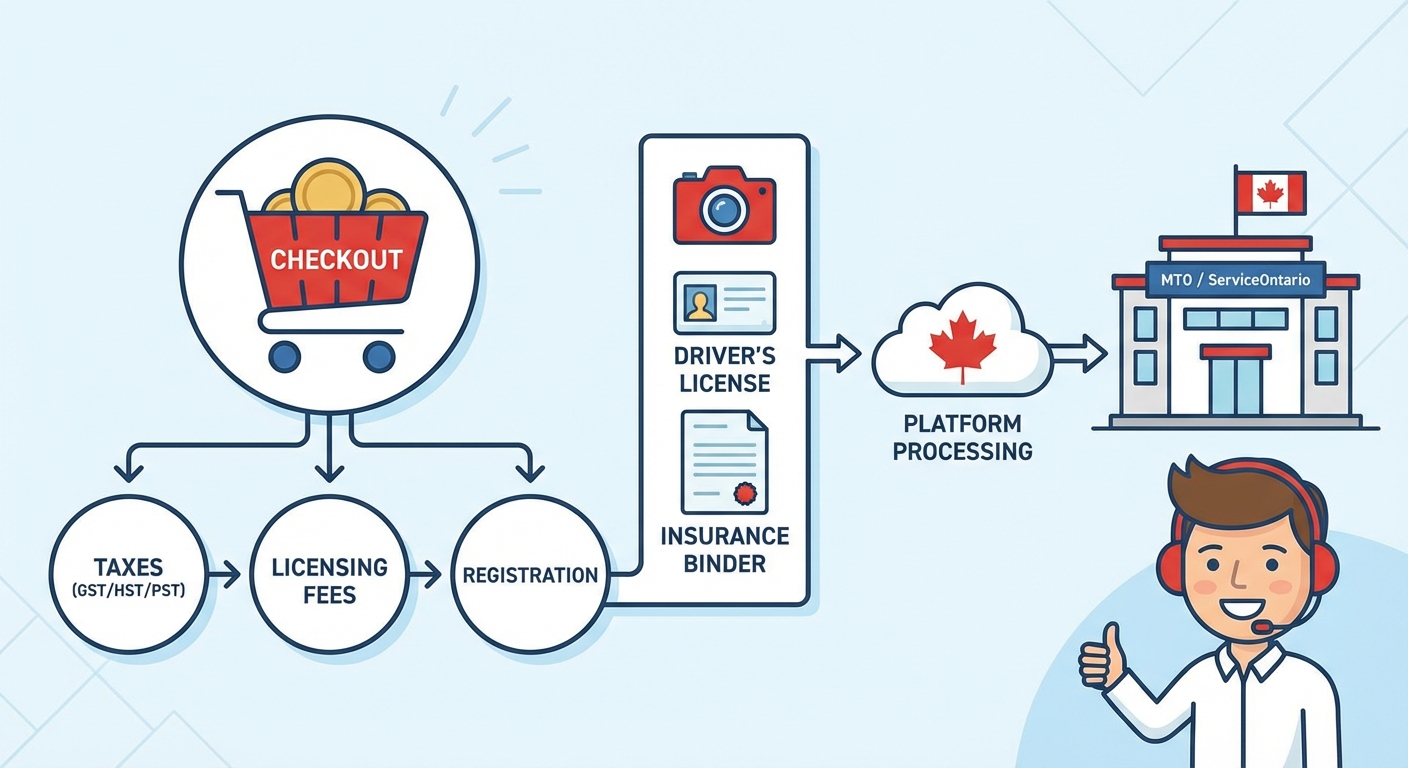
Once you select a car, the "Checkout" phase integrates taxes (GST/HST/PST based on your province), licensing fees, and registration. You upload a photo of your driver's license and insurance binder, and the platform handles the trip to the MTO or ServiceOntario for you.
The Truth About Quality: Inspections vs. Reality
A "215-Point Inspection" sounds impressive, but what does it actually mean? To an online dealer, these inspections are a risk-mitigation tool. If they sell you a lemon, they lose money on the return shipping and the re-listing process. Therefore, it is in their best interest to ensure the car is mechanically sound.
These inspections typically cover:
- Mechanical: Engine compression, transmission shift points, cooling system pressure, and exhaust integrity.
- Interior: Every button, switch, and USB port is tested. They check for "odour neutrality" (no smoke or pet smells).
- Exterior: Tire tread depth (usually a minimum of 5/32"), brake pad thickness, and structural integrity.
- Road Test: A technician drives the car at highway speeds to check for vibrations, alignment issues, or wind noise.
Most online dealers also offer a 90-day or 6,000km "protection plan" for free. This isn't a full bumper-to-bumper warranty, but it covers the major components (engine, transmission, drivetrain) to ensure you aren't stuck with a massive bill shortly after purchase.
Instant Financing Secrets: What the Dealers Don't Tell You
The "Instant Approval" button is the most alluring part of the online experience. But how do they do it so fast? The secret lies in Soft Credit Pulls. Traditional dealers often "shotgun" your credit application to 10 different banks, resulting in 10 hard inquiries that can temporarily tank your credit score. Online platforms use sophisticated API integrations with major Canadian banks (like Scotiabank, TD, or RBC) to perform a soft pull first.
This allows the system to see your credit profile and provide "real rates" without affecting your score. You only get a hard inquiry when you officially sign the final contract. This "Tiered Lending" model is a game-changer because the platform's algorithm automatically matches you with the lender most likely to give you the lowest APR based on your specific profile (e.g., a "New to Canada" program or a "First Time Buyer" incentive).
| Feature | Online Dealer Financing | Traditional Dealer Financing |
|---|---|---|
| Credit Impact | Soft pull for pre-qualification | Immediate hard pull (usually) |
| Rate Transparency | Instant, algorithm-driven rates | Negotiated via the "F&I" Manager |
| Lender Variety | Aggregated (Multiple Banks + Private) | Limited to dealer's partner banks |
| Down Payment Impact | Real-time payment adjustments | Manual recalculations |
One secret to lower payments in today's high-interest environment is the "Down Payment Lever." Because online platforms show you the math in real-time, you can see how adding just $1,000 to your down payment might drop your interest rate by a full percentage point if it moves you into a different "Loan-to-Value" (LTV) bracket. Traditional dealers often hide these brackets to maximize their back-end profit.
Trading In and Selling: The 'Real Offer' Guarantee
The biggest hurdle to buying online is often the car currently sitting in your driveway. Online dealers have solved this with "Instant Valuation" tools. They use Canadian Black Book data combined with real-time auction results to give you a firm offer. This isn't an "estimate"-it is a guaranteed price, provided your description of the car's condition is accurate.
The real magic happens during delivery. The flatbed truck arrives with your new car, and the driver inspects your old one. If everything checks out, they load your old car onto the truck and drive away. You never have to step foot in a dealership or deal with the "tire-kickers" on Facebook Marketplace.
In Canada, there is a massive tax advantage to this. If you are in Ontario and your new car is $30,000 and your trade-in is $10,000, you only pay the 13% HST on the difference ($20,000). This "Tax Shield" can save you thousands compared to selling your car privately and buying the new one separately.
The Safety Net: The 7-Day Money-Back Guarantee
The "7-Day Money-Back Guarantee" is the industry's answer to the lack of a traditional test drive. It is a psychological safety net that is actually more robust than a 15-minute drive with a salesperson breathing down your neck. It allows you to see if the car seats are comfortable for your morning commute, if the strollers fit in the trunk, and if the car actually fits in your garage.
However, there are rules to this "Return Policy":
- Kilometre Caps: You usually have a limit of 250 to 750 kilometres. If you exceed this, you may be charged per kilometre or lose the right to return.
- Condition: The car must be in the exact same condition it was delivered in. No new scratches, no interior stains, and definitely no accidents.
- Documentation: You must keep all the original paperwork and keys.
The refund process typically takes 5 to 10 business days. If you financed the car, the dealer will coordinate with the bank to "unwind" the loan. It is a clean break, but it does require some patience as the digital paperwork moves through the banking system.
Comparing the Costs: Online vs. Traditional Dealerships
When you look at a car price on a traditional dealer's website, that is rarely what you pay. You get to the office and suddenly there is a $599 "Admin Fee," a $399 "Window Etching" fee, and a $299 "Nitrogen in Tires" charge. Online dealers generally operate on an "All-In" pricing model.
| Cost Element | Traditional Dealership | Online Platform |
|---|---|---|
| Sticker Price | Negotiable (High stress) | Fixed (No-haggle) |
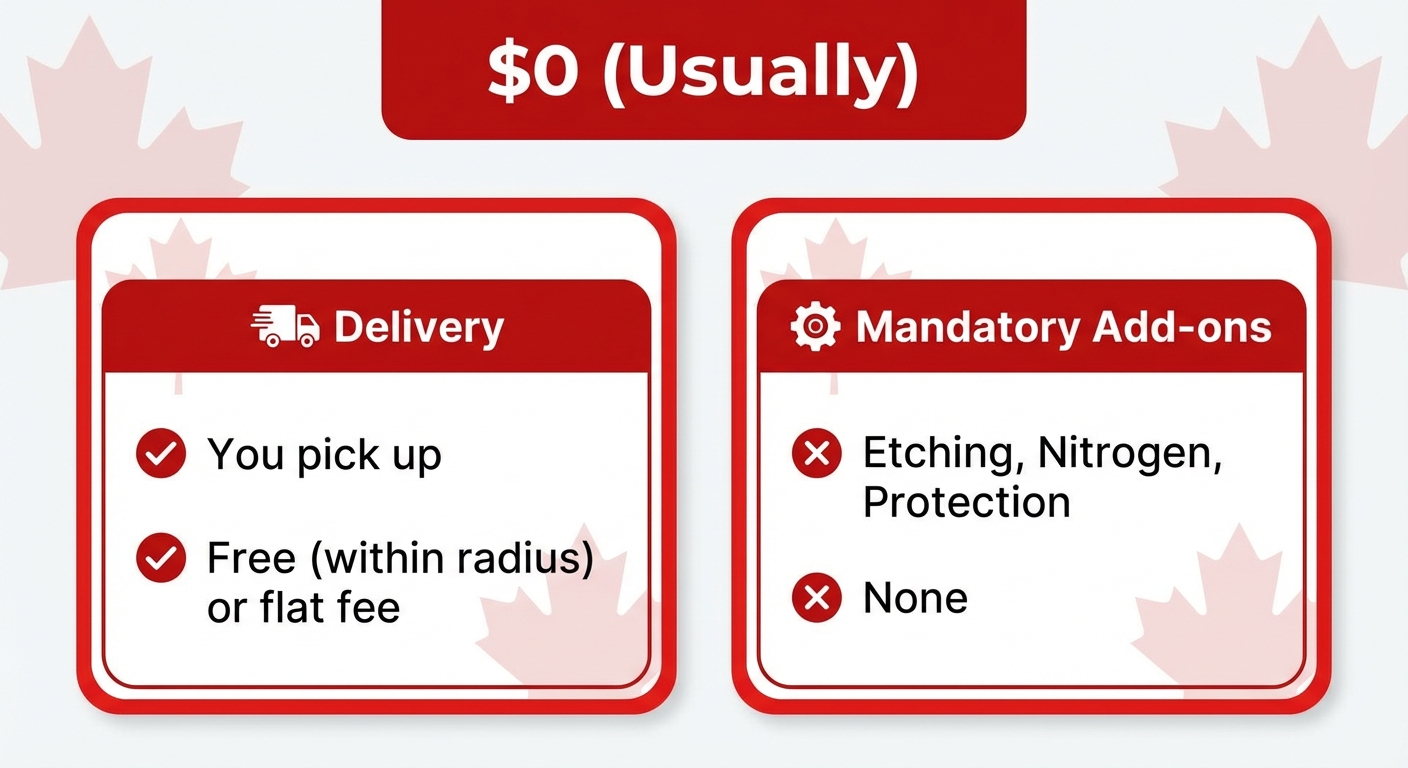
| Admin/Doc Fees | $495 - $995 | $0 (Usually) |
| Delivery | You pick up | Free (within radius) or flat fee |
| Mandatory Add-ons | Etching, Nitrogen, Protection | None |
Is the "No-Haggle" price actually lower? Not always. A skilled negotiator might be able to grind a traditional dealer down to a lower price. However, data shows that the average consumer saves about $1,000 to $1,500 by buying online simply because they avoid the predatory fees and high-margin "back-office" products that are pushed in the final stages of a traditional sale.
Common Pitfalls and How to Avoid Them
While the process is streamlined, it isn't foolproof. One common pitfall is overlooking the Fine Print in the Financing Contract. Just because you were "instantly approved" doesn't mean you shouldn't read the terms. Check for "pre-payment penalties." Most reputable Canadian online dealers use open loans (meaning you can pay them off early without penalty), but you must verify this.
Another issue is Registration Logistics. While the dealer handles the paperwork, the timing can be tricky. If you are transferring a custom plate or moving between provinces (e.g., buying in Ontario but living in Quebec), the "Click to Curb" timeline might stretch from 3 days to 10 days. Always ask for a clear timeline on when the physical plates and registration will arrive.
Finally, don't ignore the Wear and Tear Standards. If you plan on using the 7-day return policy, treat that car like a museum piece. If your dog claws the leather or you spill coffee on the seat, the dealer has the right to refuse the return or deduct a significant "reconditioning fee" from your refund.
Frequently Asked Questions (FAQ)
Can I trade in a car that still has an active loan on it?
Yes. This is a very common scenario. The online dealer will contact your current lender to get a "payoff quote." If your car is worth $20,000 and you owe $15,000, they will apply the $5,000 "equity" toward your new purchase. If you owe more than the car is worth (negative equity), they can often roll that balance into your new loan, depending on your credit score.
Do online car dealers offer test drives before I buy?
Generally, no. The model is built on the 7-day money-back guarantee replacing the traditional test drive. Some dealers may allow a brief inspection upon delivery before you sign the final acceptance, but the "real" test drive happens during your first week of ownership.
How does the car get registered in my name?
Online dealers employ dedicated licensing teams. They take your information, collect the provincial taxes, and visit the provincial licensing office (like the MTO or ICBC) on your behalf. The car typically arrives with temporary permits or your new plates already attached.
What happens if the car arrives and I don't like the colour?
This falls under the 7-day money-back guarantee. You don't need a mechanical reason to return the car. If you decide the "Midnight Blue" looks more like "Purple" in your driveway, you can initiate a return. Just be aware that you might be responsible for a delivery/pick-up fee if the return is purely for aesthetic reasons.
Is the price on the website negotiable?
No. Online dealers operate on a "Fixed Price" model. The price you see is the price you pay (plus taxes and licensing). This is designed to remove the stress of haggling and ensure that every customer gets the same fair deal regardless of their negotiation skills.
Are EVs and Hybrids available through online dealers?
Absolutely. In fact, online dealers are often the best place to find used EVs (like Teslas or Hyundai IONIQs) because they source inventory from across the country, whereas local dealers may only have what was traded in at their specific location.
Conclusion: Is an Online Car Dealer Right for You?
Buying a car online isn't for everyone. If you are the type of person who loves the "thrill of the hunt," enjoys spending hours negotiating with a sales manager, and needs to smell the interior of five different cars before making a choice, the traditional model still exists for you. But for the modern Canadian-the one who values their time, demands price transparency, and wants to avoid the "dealership drama"-the online model is a revelation.
The key to success in this new frontier is staying informed. Use the digital tools provided, but don't abandon your common sense. Read the inspection reports, use your own bank's interest rates as a benchmark, and always utilize that 7-day trial period to its fullest extent. The power has shifted; it's time you used it.