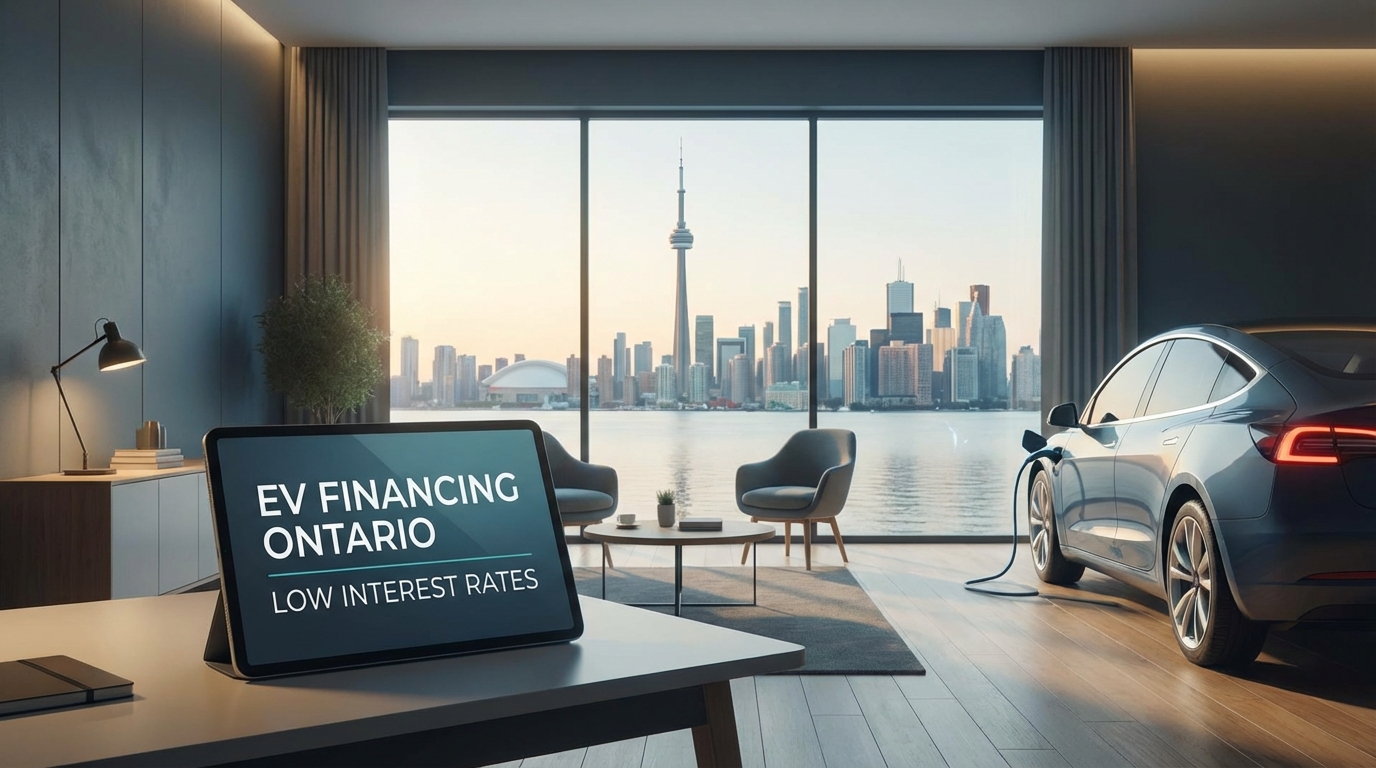
Self-Employed EV Financing Ontario: Low Rates 2026
Table of Contents
- Self-Employed EV Financing Ontario: Low Rates 2026
- Key Takeaways
- The Self-Employed EV Dream: Opportunity Meets Challenge in Ontario's Green Shift
- Decoding Low Rates: How Self-Employed Income Impacts Your EV Loan Eligibility
- Beyond the Pay Stub: Proving Income as a Self-Employed Borrower
- The Credit Score Conundrum: Building and Maintaining Excellent Credit for EV Loans
- Pro Tip: The Power of a Strong Business Plan in Loan Applications Don't underestimate the impact of a well-articulated, forward-looking business plan, even if you're a sole proprietor or freelancer. A clear plan demonstrates your vision, market understanding, revenue projections, and strategies for growth and financial stability. It instills confidence in lenders, showing them you're not just earning money, but strategically building a sustainable enterprise. This can be a significant differentiating factor in securing better rates and approval, especially for newer businesses or those with fluctuating income.
- Pro Tip: The Power of a Strong Business Plan in Loan Applications
- Unlocking Ontario's EV Ecosystem: Incentives, Savings, and Hidden Costs
- Federal and Provincial Perks: Maximizing Your EV Rebates and Tax Credits
- The True Cost of Ownership: Fuel Savings vs. Charging Infrastructure in Ontario
- Insurance Insights: What to Expect for EV Premiums in Ontario
- Pro Tip: Future-Proofing with Home Charging Solutions Strategically investing in a Level 2 home charging solution is one of the smartest moves an EV owner can make. It offers unparalleled convenience, allowing you to "fuel up" overnight and start each day with a full charge. While DC fast charging at home is generally not feasible or necessary for most, a Level 2 charger ensures you maximize your electricity savings and minimize reliance on public infrastructure. Consider potential future energy cost fluctuations and the added value a dedicated home charger brings to the overall EV ownership experience and even your property value.
- Pro Tip: Future-Proofing with Home Charging Solutions
- Navigating the Lender Landscape: Where Self-Employed Individuals Find the Best EV Rates
- Banks vs. Credit Unions vs. Dealerships: A Comparative Analysis for Self-Employed Loans
- The Online Lender Advantage: Speed and Specialization for Niche Markets
- Negotiation Mastery: Securing the Lowest Interest Rate Possible
- Pro Tip: Don't Just Compare Rates – Compare the Entire Loan Package The interest rate is crucial, but it's only one piece of the puzzle. Scrutinize the entire loan package. Look for administrative fees, origination fees, and any prepayment penalties if you plan to pay off your loan early. Understand the loan term (e.g., 60 months, 72 months) and how it impacts your monthly payment and total interest. A slightly higher rate with no fees and more flexible terms might be a better choice than a marginally lower rate with hidden costs or restrictive clauses. Ensure the chosen loan aligns with your long-term financial goals and cash flow.
- Pro Tip: Don't Just Compare Rates – Compare the Entire Loan Package
- Your EV, Your Business: Strategic Vehicle Selection and Usage for Self-Employed Professionals
- Matching the Machine to Your Mission: EVs for Every Self-Employed Need
- Tax Implications and Deductions: Leveraging Your EV for Business Write-Offs
- Pro Tip: Consult a Tax Professional for Maximum EV Business Benefits While the tax benefits of an EV for self-employed individuals are substantial, the rules can be complex, especially concerning CCA limits, personal vs. business use allocation, and specific provincial nuances. Before making a purchase, consult with a qualified tax professional or accountant. They can help you navigate the intricacies of Canadian tax law, optimize your deductions, and ensure you're leveraging every possible advantage related to your EV ownership for your self-employed business.
- Pro Tip: Consult a Tax Professional for Maximum EV Business Benefits
- The Road Ahead: Future-Proofing Your EV Investment in Ontario
- Battery Health and Resale Value: Protecting Your Asset
- Evolving Infrastructure: What to Expect for Charging and Servicing in Ontario
- Your Next Steps to Driving Electric with Confidence in Ontario
- Frequently Asked Questions (FAQ) About Self-Employed EV Financing in Ontario
Self-Employed EV Financing Ontario: Low Rates 2026
For Ontario's dynamic self-employed professionals, the road to a sustainable future is increasingly paved with electric vehicles. The allure of reduced operating costs, a smaller environmental footprint, and a modern professional image makes an EV a compelling choice for your business and personal life. However, navigating the financing landscape when you don't have a traditional pay stub can feel like an uphill climb, especially when you're aiming for those coveted low interest rates.
This comprehensive guide from SkipCarDealer.com is designed to empower self-employed individuals across Ontario – from the bustling streets of Toronto to the serene landscapes of Sudbury – with the knowledge and strategies needed to secure optimal EV financing by 2026. We'll demystify the lender's perspective, unlock valuable incentives, and equip you with the negotiation tactics to drive away with an electric vehicle at a rate that truly works for your business.
Key Takeaways
- Preparation is Paramount: Self-employed individuals need meticulous financial documentation (T1 Generals, NOAs, business statements) to prove income stability, often for 2-3 years.
- Credit is King: A strong personal and business credit score is the single most significant factor in securing low interest rates. Monitor and actively improve your credit health.
- Leverage All Incentives: Maximize federal iZEV rebates and explore any provincial/municipal programs to significantly reduce your EV's net cost, making financing more affordable.
- Shop Smart, Not Hard: Compare offers from traditional banks, credit unions, and online lenders. Don't just look at the rate; scrutinize the entire loan package.
- Business Benefits: Understand the tax implications, including Capital Cost Allowance (CCA) and mileage deductions, to optimize the financial advantages of your business EV.
The Self-Employed EV Dream: Opportunity Meets Challenge in Ontario's Green Shift
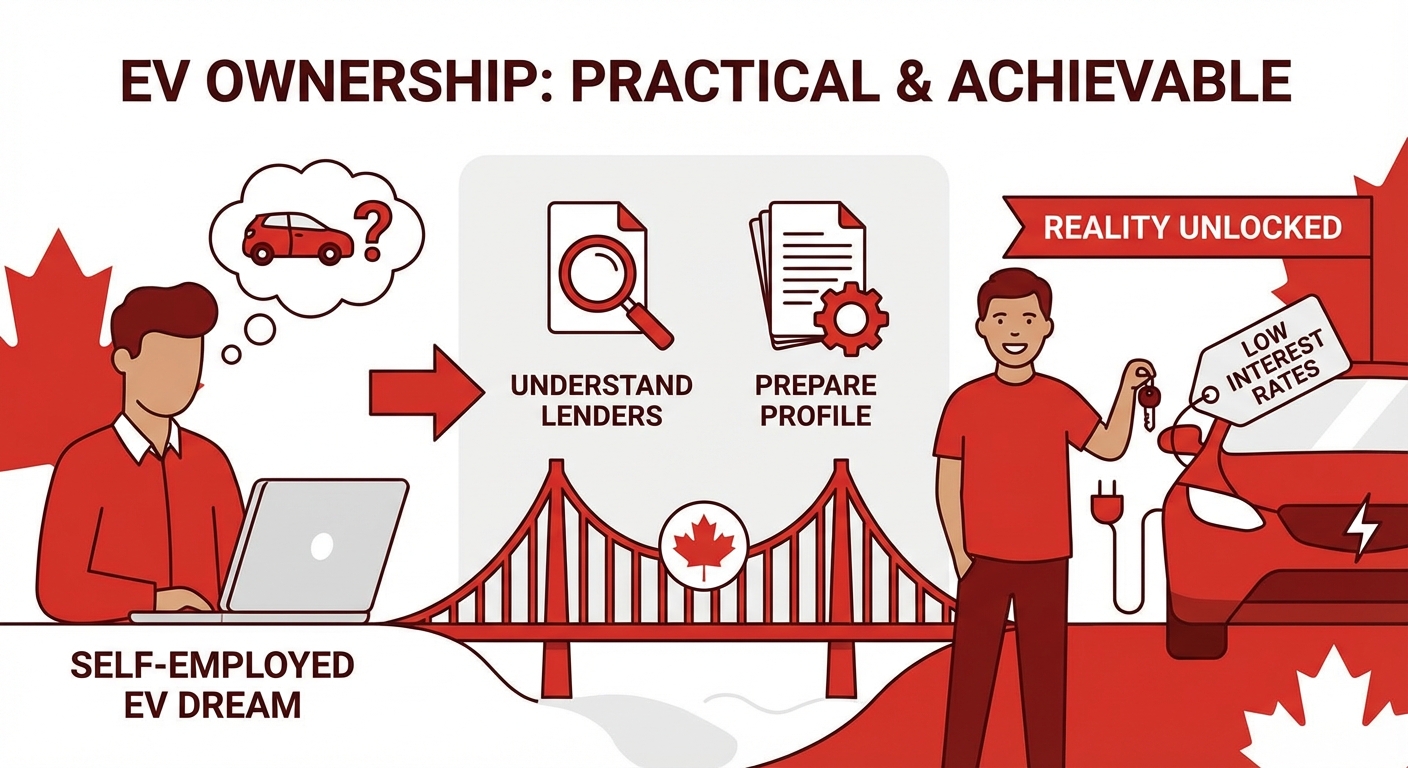
For self-employed professionals in Ontario, securing an electric vehicle loan at a low interest rate requires a strategic approach to demonstrate financial stability and creditworthiness, often differing from traditional salaried applicants. It means meticulously presenting your business's health and your personal financial discipline to lenders who seek a clear, consistent repayment capacity.
Imagine the freedom and financial benefits of powering your business with an electric vehicle. For self-employed individuals across Ontario, EVs offer more than just transportation; they present a strategic advantage. You save on fluctuating fuel costs, reduce maintenance expenses, and project a modern, environmentally conscious image to your clients, whether you're a real estate agent in Kingston, a contractor in Hamilton, or a freelance consultant commuting in Vaughan. The personal and professional benefits are clear, aligning perfectly with Ontario's accelerating green shift.
However, the journey to EV ownership isn't always straightforward for those who forge their own path. Lenders, accustomed to the predictability of a bi-weekly pay stub, often view self-employed income with a heightened sense of scrutiny. The primary challenge lies in proving consistent, reliable income and a robust financial history to secure the competitive interest rates typically offered to salaried employees. This often means providing more extensive documentation and demonstrating a longer track record of financial stability.
Despite these hurdles, the opportunity is immense. Ontario's urban centres are rapidly expanding charging infrastructure, and even rural areas are seeing increased adoption, making EV ownership more practical than ever. By understanding what lenders look for and proactively preparing your financial profile, you can overcome these challenges and unlock the low interest rates that make your self-employed EV dream a reality.
Decoding Low Rates: How Self-Employed Income Impacts Your EV Loan Eligibility
Securing low interest rates as a self-employed individual hinges on your ability to clearly articulate your financial health to lenders. Your income, while potentially robust, often appears less "stable" on paper than that of a salaried employee. This section dives into how lenders assess your unique financial situation and what you can do to present the strongest possible application.
Beyond the Pay Stub: Proving Income as a Self-Employed Borrower
When you're self-employed, your income isn't neatly summarized on a single pay stub. Lenders understand this, but they still need to ascertain your true, consistent earning potential and your ability to comfortably manage loan repayments. They're looking for stability, profitability, and a clear picture of your business's financial health over time.
This means going beyond the basics. Expect to provide a detailed suite of documentation, typically covering the last two to three years of your financial activity. Here’s what lenders truly look for:
- T1 Generals & Notices of Assessment (NOAs): These are your personal income tax returns and the Canada Revenue Agency's (CRA) official verification. Lenders will examine your net income after expenses, often preferring to see a consistent or growing trend.
- Business Financial Statements: For incorporated businesses, or even detailed records for sole proprietors, lenders will request Profit & Loss (P&L) statements and Balance Sheets. These documents showcase your business's revenue, expenses, and overall financial health.
- Bank Statements: Personal and business bank statements (typically 3-6 months) provide a real-time snapshot of your cash flow, demonstrating consistent deposits and responsible management of funds.
- Client Contracts & Invoices: For project-based or freelance work, active contracts or a history of regular invoicing can provide crucial evidence of future income stability. Long-term client relationships are a significant plus.
Common pitfalls include inconsistent income reporting year-over-year, insufficient record-keeping, or mixing personal and business finances without clear separation. To build a strong, credible financial picture, ensure your books are tidy, your tax filings are up-to-date, and you can clearly explain any fluctuations in income. Demonstrating a clear understanding of your business's financial trajectory can instill confidence in a lender.
The Credit Score Conundrum: Building and Maintaining Excellent Credit for EV Loans
Your credit score is a critical numerical representation of your financial responsibility, directly impacting the interest rates you'll be offered. For self-employed individuals, a strong credit score is even more vital, as it can compensate for the perceived "instability" of variable income. In Canada, Equifax and TransUnion are the primary credit reporting agencies, and understanding their reports is key.
Factors influencing your score include your payment history (the most important), credit utilization (how much credit you're using vs. available), length of credit history, types of credit (e.g., credit cards, lines of credit, mortgages, car loans), and recent credit inquiries. A high credit score (generally 720+) signals to lenders that you are a reliable borrower, unlocking the lowest interest rates. Conversely, a lower score will result in higher rates, reflecting increased risk.
Here’s how different credit score ranges might translate into real-world interest rates for a new EV loan in Ontario (as of late 2024, projecting into 2026, assuming a stable rate environment):
| Credit Score Range | Lender Perception | Estimated Interest Rate (Prime) | Estimated Interest Rate (Subprime) |
|---|---|---|---|
| 800+ (Excellent) | Lowest Risk | 5.99% - 7.49% | N/A |
| 720-799 (Very Good) | Low Risk | 6.49% - 8.49% | N/A |
| 660-719 (Good) | Moderate Risk | 7.99% - 9.99% | 10.99% - 13.99% |
| 600-659 (Fair) | Higher Risk | N/A | 14.99% - 19.99% |
| <600 (Poor) | Significant Risk | N/A | 20.00%+ |
Note: These rates are illustrative and subject to market conditions, lender policies, and specific loan terms.
Strategies for improving and maintaining a strong credit score include always paying bills on time, keeping credit utilization below 30% of your available limit, avoiding opening too many new credit accounts at once, and regularly checking your credit report for errors. For those looking to rebuild, a car loan itself can be a powerful tool for improving your score over time, as explored in our guide on What If Your Car Loan *Was* Your Best Credit Card? (Post-Proposal Speed-Rebuild, Toronto). Even with complex financial situations, consistent positive payment behaviour is your best ally.
Pro Tip: The Power of a Strong Business Plan in Loan Applications
Don't underestimate the impact of a well-articulated, forward-looking business plan, even if you're a sole proprietor or freelancer. A clear plan demonstrates your vision, market understanding, revenue projections, and strategies for growth and financial stability. It instills confidence in lenders, showing them you're not just earning money, but strategically building a sustainable enterprise. This can be a significant differentiating factor in securing better rates and approval, especially for newer businesses or those with fluctuating income.
Pro Tip: The Power of a Strong Business Plan in Loan Applications
Don't underestimate the impact of a well-articulated, forward-looking business plan, even if you're a sole proprietor or freelancer. A clear plan demonstrates your vision, market understanding, revenue projections, and strategies for growth and financial stability. It instills confidence in lenders, showing them you're not just earning money, but strategically building a sustainable enterprise. This can be a significant differentiating factor in securing better rates and approval, especially for newer businesses or those with fluctuating income.
Unlocking Ontario's EV Ecosystem: Incentives, Savings, and Hidden Costs
Beyond the financing itself, the overall cost of EV ownership is dramatically influenced by a suite of incentives, operational savings, and specific EV-related expenses. Understanding these factors is crucial for maximizing your investment and making low-interest financing even more impactful in Ontario.
Federal and Provincial Perks: Maximizing Your EV Rebates and Tax Credits
The Canadian government is committed to accelerating EV adoption, and self-employed individuals in Ontario are perfectly positioned to benefit. The cornerstone of these incentives is the federal iZEV (Incentives for Zero-Emission Vehicles) Program. This program offers point-of-sale incentives for eligible new zero-emission vehicles, including battery-electric, plug-in hybrid, and fuel cell vehicles.
- iZEV Program: For eligible vehicles, you could receive up to $5,000 off the purchase or lease of a new EV. Eligibility is based on the vehicle's MSRP and battery capacity. For instance, many popular EVs like the Tesla Model 3 (base models), Chevrolet Bolt, Hyundai Kona Electric, and Nissan LEAF qualify for the full $5,000.
- Application Process: The best part? The rebate is applied directly by the dealership at the time of purchase or lease, so you don't have to wait for reimbursement. This instantly reduces the amount you need to finance, making your monthly payments lower and potentially opening the door to better loan terms.
While Ontario currently does not offer a provincial purchase incentive for new EVs, it's vital to stay updated on potential municipal or regional programs. Cities like Toronto and Ottawa, for example, have explored or implemented initiatives related to charging infrastructure or other green vehicle benefits. Always check with your local municipality for any specific programs. For businesses, specific grants or programs may exist for fleet electrification, which could apply if your EV is primarily for commercial use.
Here's a quick overview of relevant incentives that can impact your EV purchase:
| Incentive Program | Type | Benefit | Eligibility (Key Points) | Impact on Financing |
|---|---|---|---|---|
| Federal iZEV Program | Purchase/Lease Rebate | Up to $5,000 (point-of-sale) | New ZEVs, MSRP limits apply ($45k for cars, $55k for larger vehicles for basic trim) | Reduces principal financed, lowers monthly payments |
| Hydro One EV Charger Rebates (Past/Current) | Charging Infrastructure | Variable (e.g., $1,000 in past programs) | Specific utility customers, Level 2 charger installation | Offsets home charging setup costs |
| Municipal Programs (e.g., Toronto EV Ready) | Varies (e.g., charging infrastructure) | Varies | Specific city residents/businesses | Can reduce long-term ownership costs |
| Federal Tax Write-offs (CCA) | Business Deduction | 100% deduction in first year (Class 54/55) | EVs used for business, up to certain limits ($61,000 for passenger vehicles) | Reduces taxable income for your business |
Note: Incentive programs can change. Always verify current eligibility and amounts with official government sources or your dealership.
The True Cost of Ownership: Fuel Savings vs. Charging Infrastructure in Ontario
One of the most compelling arguments for an EV is the dramatic reduction in "fuel" costs. In Ontario, the average electricity rate for residential use hovers around $0.10 to $0.15 per kWh, depending on time-of-use and utility provider. Compare this to gasoline prices, which can fluctuate wildly but often sit around $1.70 to $2.00 per litre. For an average driver covering 20,000 km annually, typical fuel savings can range from $1,500 to $2,500 per year, a significant sum that directly impacts your monthly budget and cash flow.
However, you'll need charging infrastructure. Most EV owners do the majority of their charging at home using a Level 2 charger. Installation costs for a Level 2 charger typically range from $1,000 to $3,000, depending on your home's electrical panel and wiring complexity. While provincial rebates for home charging installations have been sporadic, local utilities or municipal programs might offer incentives. For example, some regions might still have programs to partially offset these costs.
Public charging in Ontario is expanding rapidly. Networks like Electrify Canada, ChargePoint, Flo, and Ivy are prevalent across major corridors and cities. While public DC fast charging is more expensive than home charging (often $0.30-$0.60/kWh or by minute), it's still generally cheaper than gasoline for equivalent range. Planning your routes around available charging stations in cities like Mississauga, Brampton, and Hamilton is becoming increasingly easy with navigation apps.
Insurance Insights: What to Expect for EV Premiums in Ontario
EV insurance rates in Ontario are a topic of much discussion. Initially, EVs often had higher premiums due to the higher upfront cost of the vehicle, specialized repair requirements, and the expense of battery replacement. However, as EVs become more common and insurance companies gather more data, rates are beginning to stabilize and become more competitive.
Factors influencing EV insurance rates include:
- Vehicle Value: EVs can have a higher purchase price than comparable gasoline cars, leading to higher replacement costs for insurers.
- Repair Complexity: Specialized technicians and parts for EV repairs can increase costs.
- Battery Replacement: While rare, a damaged battery can be very expensive to replace.
- Driver Profile & Location: Your driving history, age, and where you live (e.g., Toronto vs. a smaller town) remain significant factors.
- Safety Features: Many EVs come with advanced safety features that can actually lower your premium.
Tips for finding competitive quotes include:
- Shop Around: Get quotes from multiple insurance providers. Some insurers may have specific programs or discounts for green vehicles.
- Bundle Policies: Combining your auto insurance with home insurance can often lead to savings.
- Telematics Programs: Some insurers offer discounts for using an app or device that monitors your driving habits.
- Ask for Green Vehicle Discounts: Specifically inquire if they offer any eco-friendly vehicle discounts.
Don't fall for the misconception that all EVs are prohibitively expensive to insure. With increased competition and data, the market is adjusting.
Pro Tip: Future-Proofing with Home Charging Solutions
Strategically investing in a Level 2 home charging solution is one of the smartest moves an EV owner can make. It offers unparalleled convenience, allowing you to "fuel up" overnight and start each day with a full charge. While DC fast charging at home is generally not feasible or necessary for most, a Level 2 charger ensures you maximize your electricity savings and minimize reliance on public infrastructure. Consider potential future energy cost fluctuations and the added value a dedicated home charger brings to the overall EV ownership experience and even your property value.
Pro Tip: Future-Proofing with Home Charging Solutions
Strategically investing in a Level 2 home charging solution is one of the smartest moves an EV owner can make. It offers unparalleled convenience, allowing you to "fuel up" overnight and start each day with a full charge. While DC fast charging at home is generally not feasible or necessary for most, a Level 2 charger ensures you maximize your electricity savings and minimize reliance on public infrastructure. Consider potential future energy cost fluctuations and the added value a dedicated home charger brings to the overall EV ownership experience and even your property value.
Navigating the Lender Landscape: Where Self-Employed Individuals Find the Best EV Rates
Finding the right lender is as crucial as finding the right EV, especially when you're self-employed. Different financial institutions have varying appetites for self-employed borrowers and diverse lending criteria. Understanding these nuances can significantly impact your approval odds and the interest rates you secure.
Banks vs. Credit Unions vs. Dealerships: A Comparative Analysis for Self-Employed Loans
Each financing channel brings its own set of advantages and disadvantages for self-employed applicants:
- Traditional Banks (e.g., RBC, TD, CIBC): Banks are often the first stop for auto loans. They typically offer competitive rates for prime borrowers with excellent credit and a long, consistent history of self-employment income (often 2-3 years of T1 Generals). However, they can be more rigid in their documentation requirements and less flexible if your income fluctuates. They prioritize stability and often have stricter debt-to-income ratios.
- Credit Unions (e.g., Meridian Credit Union, Alterna Savings): Credit unions are member-owned and often more community-focused. They can be more understanding and flexible with self-employed applicants, sometimes taking a more holistic view of your financial situation rather than relying solely on automated scoring models. They may consider unique income streams or a shorter self-employment history if other factors are strong. Rates can be very competitive, especially if you have an existing banking relationship with them.
- Dealership Financing Arms (Captive Lenders like Toyota Financial Services, Ford Credit, etc.): Dealerships offer convenience, often providing on-the-spot approvals. They work with various lenders, including their own captive finance companies. These captive lenders sometimes have special promotional rates or lease offers for specific EV models, which can be very attractive. However, their standard rates might be higher than a bank's for non-promotional loans, and they may mark up interest rates as part of their profit margin. While convenient, always compare their offers to pre-approvals from banks or credit unions.
Here’s a comparative look at how these lenders might approach a self-employed EV loan:
| Lender Type | Pros for Self-Employed | Cons for Self-Employed | Typical Rate Competitiveness | Flexibility on Income Proof |
|---|---|---|---|---|
| Traditional Banks | Potentially lowest rates for prime, established businesses | Rigid documentation, less flexible for fluctuating income or newer businesses | Very competitive (Prime) | Low (requires strong, consistent history) |
| Credit Unions | More holistic assessment, potentially flexible terms, community focus | May require membership, less widespread than major banks | Competitive | Medium (more willing to consider unique situations) |
| Dealerships (Captive) | Convenience, special EV promotions, quick approval | Rates can be marked up, less flexibility on terms once agreed upon | Varies (promotional can be excellent, standard may be higher) | Medium (often have specific programs for certain income types) |
For self-employed individuals, leveraging a strong business plan and meticulous financial records is key, regardless of the lender. For those just starting out, check out our guide on Maximize Your Approval Odds for New Business Car Loan 2026.
The Online Lender Advantage: Speed and Specialization for Niche Markets
The rise of fintech companies and online lending platforms has opened new avenues for self-employed individuals seeking EV financing. These lenders often specialize in niche markets, including those with non-traditional income streams or complex credit profiles. They leverage advanced algorithms to assess risk, often resulting in quicker approval times and a more streamlined application process.
- Pros: Speed and convenience are major draws. Many online lenders can provide pre-approvals within minutes and funding within days. They may also be more willing to consider applicants with a shorter self-employment history or those who don't fit the traditional bank's criteria. Some even offer specialized EV financing options. For example, individuals with variable income from platforms like SkipTheDishes might find more understanding lenders online, as discussed in Vancouver: Your SkipTheDishes Hustle *Is* Your Car Loan. Negative Equity? Approved.
- Cons: While convenient, the interest rates from online lenders can sometimes be higher, especially for borrowers perceived as higher risk. The lack of personal interaction might also be a downside for some who prefer face-to-face discussions about their unique financial situation. It's crucial to thoroughly research any online lender and read reviews.
When considering online lenders, always compare their APRs (Annual Percentage Rates), not just the interest rate, as APR includes additional fees that affect the true cost of the loan.
Negotiation Mastery: Securing the Lowest Interest Rate Possible
Negotiating your EV loan is a skill that can save you thousands of dollars over the life of the loan. The key is to arrive prepared and empowered. Here’s how:
- Get Pre-Approved: This is your strongest negotiation tool. Apply for pre-approval with 2-3 different lenders (banks, credit unions, online platforms) before you even step foot in a dealership. A pre-approval gives you a concrete offer and shows the dealership you're a serious buyer with financing already secured.
- Understand APR vs. Interest Rate: The interest rate is the cost of borrowing the principal. The Annual Percentage Rate (APR) includes the interest rate plus any additional fees (e.g., administrative fees, origination fees). Always compare APRs to get the true cost of the loan.
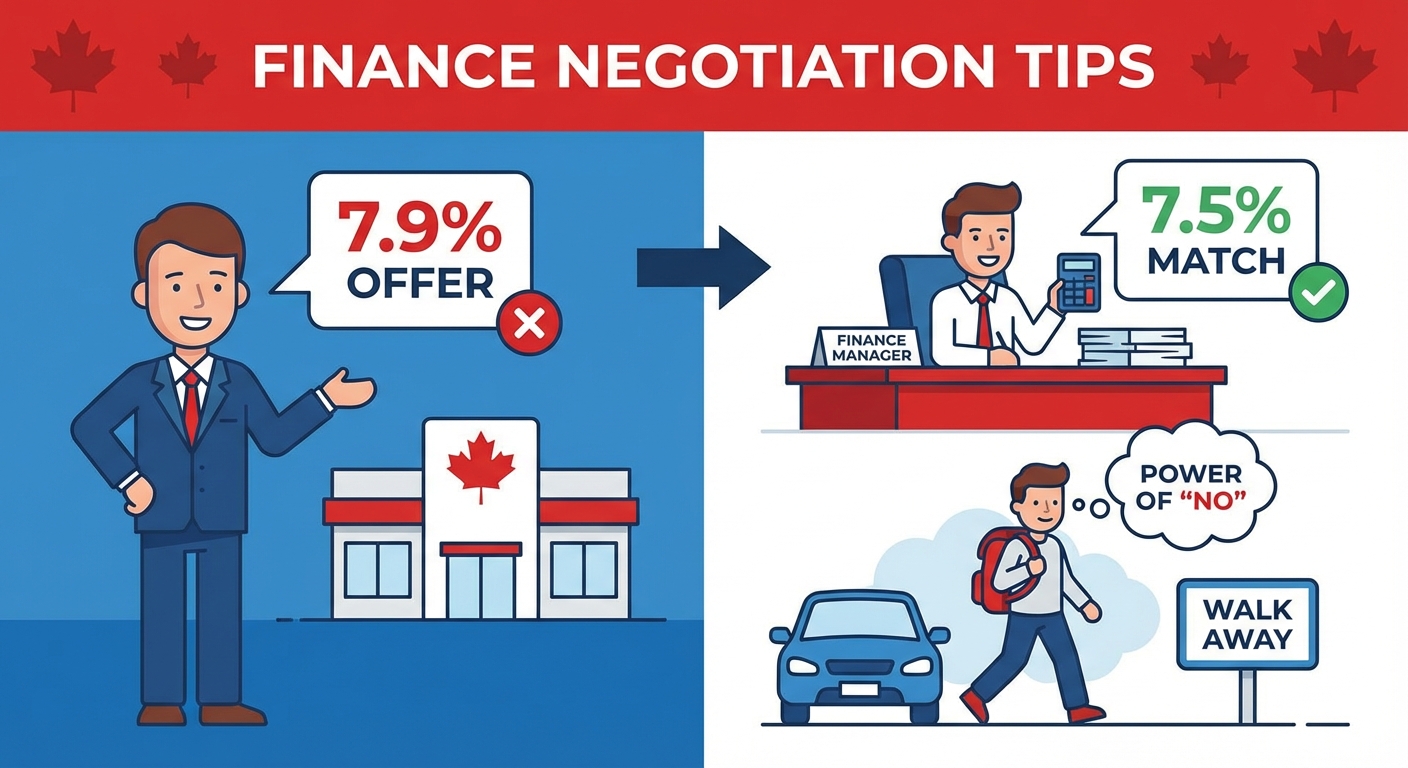
- Leverage Competing Offers: If you have multiple pre-approvals, use them. For example, if a credit union in London offered you 7.5%, and a bank in Vaughan offered 7.9%, you can ask the dealership's finance manager to beat or match the 7.5%.
- Be Prepared to Walk Away: Your greatest power in negotiation is the ability to say "no." If the offers aren't satisfactory, be willing to explore other options.
| Loan Offer Comparison Example (2026 EV Loan of $50,000 over 60 months) | Lender A (Bank) | Lender B (Credit Union) | Lender C (Dealership) |
|---|---|---|---|
| Advertised Interest Rate | 7.29% | 6.99% | 7.79% |
| Administrative Fees | $0 | $50 | $399 |
| Calculated APR | 7.29% | 7.08% | 8.05% |
| Estimated Monthly Payment | $1,008 | $1,000 | $1,025 |
| Total Interest Paid | $10,480 | $9,997 | $11,500 |
| Prepayment Penalty? | No | No | Yes (small fee for early payout) |
This table clearly shows that Lender B, despite a small fee, offers the lowest APR and total cost over the loan term.
Pro Tip: Don't Just Compare Rates – Compare the Entire Loan Package
The interest rate is crucial, but it's only one piece of the puzzle. Scrutinize the entire loan package. Look for administrative fees, origination fees, and any prepayment penalties if you plan to pay off your loan early. Understand the loan term (e.g., 60 months, 72 months) and how it impacts your monthly payment and total interest. A slightly higher rate with no fees and more flexible terms might be a better choice than a marginally lower rate with hidden costs or restrictive clauses. Ensure the chosen loan aligns with your long-term financial goals and cash flow.
Pro Tip: Don't Just Compare Rates – Compare the Entire Loan Package
The interest rate is crucial, but it's only one piece of the puzzle. Scrutinize the entire loan package. Look for administrative fees, origination fees, and any prepayment penalties if you plan to pay off your loan early. Understand the loan term (e.g., 60 months, 72 months) and how it impacts your monthly payment and total interest. A slightly higher rate with no fees and more flexible terms might be a better choice than a marginally lower rate with hidden costs or restrictive clauses. Ensure the chosen loan aligns with your long-term financial goals and cash flow.
Your EV, Your Business: Strategic Vehicle Selection and Usage for Self-Employed Professionals
Choosing the right EV for your self-employed venture goes beyond personal preference; it's a strategic business decision. Once you've secured financing, optimizing your vehicle choice and understanding its tax implications can significantly enhance your operational efficiency and bottom line.
Matching the Machine to Your Mission: EVs for Every Self-Employed Need
The EV market has matured significantly, offering a diverse range of vehicles to suit almost any self-employed need:
- Sedans (e.g., Tesla Model 3, Hyundai IONIQ 6): Ideal for consultants, sales professionals, or real estate agents in Kingston who require range, a professional image, and efficient highway cruising. Their sleek design and advanced tech features often leave a lasting impression.
- SUVs (e.g., Tesla Model Y, Hyundai IONIQ 5, Ford Mustang Mach-E): Perfect for professionals needing more cargo space, passenger capacity, or all-weather capability. Great for small business owners, family services, or those commuting in varied Ontario conditions.
- Trucks & Vans (e.g., Ford F-150 Lightning, Rivian R1T, commercial EV vans): Essential for contractors in Hamilton, tradespeople, or delivery services. These offer substantial towing capacity, cargo volume, and the ruggedness required for demanding jobs, all while providing the operational savings of electric power.
Consider factors like real-world range (especially in colder Ontario winters), charging speed, cargo capacity, and the vehicle's price point relative to your budget and business needs. A higher-priced EV might offer more features and range, but ensure it aligns with your financial projections for low-interest financing.
Tax Implications and Deductions: Leveraging Your EV for Business Write-Offs
One of the most attractive aspects of owning an EV as a self-employed individual in Canada is the potential for significant tax deductions. The Canadian government provides enhanced incentives for businesses acquiring Zero-Emission Vehicles (ZEVs).
- Capital Cost Allowance (CCA): ZEVs (both new and used, if certain conditions are met) acquired after March 18, 2019, are eligible for a 100% CCA deduction in the first year under Class 54 for passenger vehicles or Class 55 for other ZEVs. There are limits: for passenger vehicles, the maximum capital cost for CCA purposes is $61,000 (plus sales tax) for vehicles acquired in 2023 and onwards. This means you can write off the full eligible cost of your EV against your business income in the year of purchase, significantly reducing your taxable income.
- Interest on Loans: The interest paid on your EV loan can be deducted as a business expense, proportional to the business use of the vehicle.
- Insurance & Maintenance: Premiums and maintenance costs (including charging expenses) are also deductible based on the percentage of business use.
- Mileage Deductions: If you use your personal EV for business, you can claim mileage at a prescribed rate, or track actual expenses. Keeping a detailed logbook of all business-related kilometres is crucial.
It's vital to maintain meticulous records, including purchase invoices, loan agreements, charging logs, and mileage records, to substantiate your claims to the CRA. Clearly distinguishing between personal and business use is also paramount.
Pro Tip: Consult a Tax Professional for Maximum EV Business Benefits
While the tax benefits of an EV for self-employed individuals are substantial, the rules can be complex, especially concerning CCA limits, personal vs. business use allocation, and specific provincial nuances. Before making a purchase, consult with a qualified tax professional or accountant. They can help you navigate the intricacies of Canadian tax law, optimize your deductions, and ensure you're leveraging every possible advantage related to your EV ownership for your self-employed business.
Pro Tip: Consult a Tax Professional for Maximum EV Business Benefits
While the tax benefits of an EV for self-employed individuals are substantial, the rules can be complex, especially concerning CCA limits, personal vs. business use allocation, and specific provincial nuances. Before making a purchase, consult with a qualified tax professional or accountant. They can help you navigate the intricacies of Canadian tax law, optimize your deductions, and ensure you're leveraging every possible advantage related to your EV ownership for your self-employed business.
The Road Ahead: Future-Proofing Your EV Investment in Ontario
Investing in an EV is a long-term decision, and understanding the future landscape of battery technology, infrastructure, and the resale market is key to protecting your asset and maximizing its value in Ontario.
Battery Health and Resale Value: Protecting Your Asset
The battery is the heart of an EV, and its health is often a primary concern for owners. Battery degradation, a gradual loss of capacity over time, is a natural process. Factors influencing it include extreme temperatures, frequent DC fast charging, and consistently charging to 100% or discharging to 0%.
- Battery Warranties: Most EV manufacturers offer extensive battery warranties, typically 8 years or 160,000 kilometres (whichever comes first), guaranteeing a certain percentage of original capacity (e.g., 70%). This provides significant peace of mind.
- Maintenance Tips: To maximize battery life, aim to keep your charge between 20% and 80% for daily driving, use Level 2 charging primarily, and avoid prolonged exposure to extreme heat or cold when parked.
- Resale Market: The used EV market in Ontario is growing rapidly. While early models faced uncertainty, newer EVs with robust warranties and proven battery longevity are retaining strong resale values. Factors like battery health reports, range, and overall vehicle condition will be key determinants of future value.
Evolving Infrastructure: What to Expect for Charging and Servicing in Ontario
Ontario's EV ecosystem is in a continuous state of expansion and improvement, making long-term EV ownership increasingly convenient.
- Charging Network Expansion: Expect to see a continued surge in public charging stations across Ontario, driven by both government initiatives (like the EV Charger and Hydrogen Station Program) and private investment. More Level 2 and DC fast chargers will appear in urban centres, along highways, and in workplaces, reducing range anxiety for even the longest trips.
- Specialized Service Centers: As the number of EVs on the road grows, so too will the availability of specialized EV service centres. Dealerships are investing in training technicians and equipping facilities to handle EV-specific maintenance and repairs. Independent garages are also starting to offer EV servicing, increasing options for owners.
- Technological Advancements: Look forward to continuous improvements in battery technology (longer ranges, faster charging), charging speeds (even quicker DC fast charging), and vehicle-to-grid (V2G) capabilities, which could allow your EV to power your home or even sell electricity back to the grid during peak hours.
These advancements mean that your EV investment in 2026 will likely feel even more integrated and convenient within Ontario's evolving green landscape in the years to come.
Your Next Steps to Driving Electric with Confidence in Ontario
Embarking on your EV journey as a self-employed professional in Ontario doesn't have to be daunting. By following a clear, actionable roadmap, you can confidently navigate the financing process and secure a low-rate loan that propels your business forward.
- Assess Your Financial Health: Start by getting your financial house in order. Gather all necessary documentation: T1 Generals, NOAs, business financial statements, and bank statements for the past 2-3 years. Understand your average monthly income and expenses.
- Check and Improve Your Credit Score: Obtain your credit report from Equifax and TransUnion. Identify any errors and take steps to improve your score if needed. A higher score translates directly to lower interest rates.
- Research EV Models and Incentives: Determine which EV best suits your business needs and budget. Understand all applicable federal incentives (iZEV) and any potential provincial or municipal programs to calculate your net cost.
- Get Pre-Approved by Multiple Lenders: Don't wait until you're at the dealership. Apply for pre-approval with 2-3 different financial institutions – banks, credit unions, and reputable online lenders. This arms you with negotiating power.
- Compare Loan Offers Thoroughly: Look beyond just the interest rate. Compare the APR, loan terms, fees, and any prepayment penalties. Choose the loan package that best aligns with your long-term financial strategy.
- Consult a Tax Professional: Before finalizing your purchase, discuss the tax implications and deductions for your self-employed business with an accountant to maximize your benefits.
- Finalize Your Purchase: With your financing secured and a clear understanding of your EV's total cost and benefits, you can confidently make your purchase, knowing you've achieved the best possible rates and terms.
Ready to electrify your business? With SkipCarDealer.com, navigating self-employed EV financing in Ontario is simpler than you think. Let us connect you with lenders who understand your unique financial position.