Splitting Assets? Car Loan Options After Marriage Separation
Table of Contents
- Key Takeaways: Your Quick-Reference Guide
- The Immediate Crisis: Who's Responsible for This Month's Car Payment?
- Understanding Joint and Several Liability: Why the Bank Sees You as One Entity
- Creating a Temporary Payment Agreement: A Crucial Stop-Gap Measure
- The Joint Loan Dilemma: Untangling Your Financial Ties Without Damaging Your Credit
- Scenario 1: Selling the Vehicle
- Scenario 2: Refinancing into One Name
- Scenario 3: Loan Assumption
- Deep Dive: The Legal Decree vs. The Lender's Contract
- Why Lenders Aren't Bound by Your Family Court Agreement
- How to Use Your Separation Agreement to Your Advantage
- What Happens When an Ex-Spouse Defies the Agreement and Stops Paying?
- From 'We' to 'Me': Assessing Your Solo Car-Buying Power
- Calculating Your New Debt-to-Income (DTI) Ratio
- The Impact of Alimony and Child Support
- Pulling Your Credit Report
- Securing Your New Ride: A Strategic Approach to Getting Approved
- Bank vs. Dealership Financing: Which is better for a post-separation situation?
- The Power of Pre-Approval
- Down Payment Strategies
- The 2026 Outlook: How Economic Shifts and New Lending Rules Could Impact Your Post-Separation Car Loan
- Interest Rate Forecasts
- The Rise of Alternative Data
- Digital Loan Verification
- Your Post-Separation Auto Finance Roadmap: A 3-Step Action Plan
- Frequently Asked Questions (FAQ)
Separating from a spouse is one of life’s most stressful events. Amid the emotional upheaval, a mountain of practical and financial decisions demand immediate attention. One of the most common and complex issues is the shared car loan. It’s a tangible, high-value asset tied to a significant debt, and untangling it incorrectly can have devastating consequences for your credit and financial future. Who keeps the car? Who makes the payments? And how do you protect yourself from your ex-partner’s financial missteps?
This guide is your roadmap. We're not just going to give you vague advice; we're going to break down the specific car loan options after marriage separation, explain the legal realities versus the lender's contract, and give you a clear, step-by-step plan to navigate this challenge and get back in the driver's seat of your own financial life. Whether you need to get rid of a joint loan or secure a new one on your own, we have the answers.
Key Takeaways: Your Quick-Reference Guide
- Joint Loan Liability: A legal separation or divorce decree does not automatically remove you from a joint car loan. You and your ex-spouse are both 100% responsible for the debt until it's paid off or refinanced.
- Credit Score at Risk: Missed payments on a joint loan will negatively impact both individuals' credit scores, regardless of who was designated to pay in the separation agreement.
- Three Primary Paths: The main options for a joint car loan are: 1) Sell the vehicle and pay off the loan, 2) One person refinances the loan into their name only, or 3) One person formally assumes the loan (rarely offered by lenders).
- Solo Buying Power: Your ability to get a new car loan will be based solely on your individual income, credit history, and debt-to-income (DTI) ratio, excluding your ex-spouse's finances.
- Act Proactively: Do not wait for the separation to be finalized. Start conversations with your lender and your ex-partner about the car loan immediately to prevent financial damage.
The Immediate Crisis: Who's Responsible for This Month's Car Payment?
The most effective way to handle a joint car loan after separation is for one person to refinance the loan into their own name, or to sell the vehicle to pay off the loan entirely. This legally severs the financial tie and protects both parties' credit scores from future missed payments.
Navigating the emotional turmoil of a separation is tough, but financial obligations don't pause. The bank doesn't care about your changing living situation; they care about the contract you both signed. This section addresses the urgent first question: who pays the car note right now, and what happens if no one does?
Understanding Joint and Several Liability: Why the Bank Sees You as One Entity
When you signed that car loan together, you entered into a contract with "joint and several liability." This is a critical legal term that means the lender can pursue either one of you for the entire amount of the debt. It doesn't mean you're each 50% responsible. It means you are both 100% responsible.
If a payment is missed, the lender will report it to the credit bureaus (Equifax and TransUnion in Canada) on both of your credit files. They don't care whose "turn" it was to pay; to them, you are a single borrowing unit that has defaulted.
Creating a Temporary Payment Agreement: A Crucial Stop-Gap Measure
While you work out the long-term solution (selling, refinancing), you must have a clear, written agreement about who is making the payments in the interim. This can be a simple email or text message, but it needs to be explicit.
- Decide who will make the payment.
- Agree on the date the payment will be made.
- The other person should have access to the online loan portal to verify the payment has been made each month.
This isn't a permanent fix, but it's a vital measure to protect both your credit scores while you negotiate the final details.
Pro Tip: Even if your ex-spouse agrees to make the payments, continue to monitor the loan account monthly. Set a calendar reminder a few days before the due date. A single missed payment can drop your credit score by over 50-100 points, and the damage can take years to repair.
The Joint Loan Dilemma: Untangling Your Financial Ties Without Damaging Your Credit
This is the core challenge. Simply deciding who gets the car is only half the battle. The real goal is to remove your name from the associated debt. Here, we break down the practical, step-by-step solutions for the car you financed together.
Scenario 1: Selling the Vehicle
This is often the cleanest break. Selling the car and using the proceeds to pay off the loan eliminates the debt for both of you simultaneously. The key here is understanding your equity position.
- Step 1: Get the Loan Payoff Amount. Call your lender or check your online portal for the exact amount required to close the loan today. This is different from your statement balance, as it includes accrued interest.
- Step 2: Determine the Car's Market Value. Use resources like Canadian Black Book or check listings for similar models (year, make, model, kilometres) on autoTRADER.ca to get a realistic private sale value and trade-in value.
- Step 3: Analyze Your Equity.
- Positive Equity: If the car is worth more than the loan balance (e.g., valued at $20,000 with a $15,000 loan balance), you can sell it, pay off the loan, and split the remaining $5,000 profit as per your separation agreement.
- Negative Equity (Underwater): This is more complicated. If the car is worth less than the loan balance (e.g., valued at $20,000 with a $23,000 loan balance), you are "underwater." To sell it, you and your ex-spouse must come up with the $3,000 difference out-of-pocket to pay the lender and clear the title for the new owner.
Scenario 2: Refinancing into One Name
This is the most common solution when one person wants to keep the vehicle. The person keeping the car applies for a brand new loan, in their name only, for the amount needed to pay off the existing joint loan. If approved, the new loan pays off the old one, and the joint debt is officially closed.
The Approval Criteria: The lender for the new loan will assess the applicant based solely on their individual circumstances:
- Individual Income: Is their sole income sufficient to support the payment?
- Individual Credit Score: What is their personal credit history and score?
- Debt-to-Income (DTI) Ratio: How does this new car payment fit in with their other debts (rent/mortgage, credit cards, etc.)?
A potential roadblock here is a change in financial circumstances. A spouse who was a secondary earner may now struggle to show enough income to qualify for the loan on their own.
Scenario 3: Loan Assumption
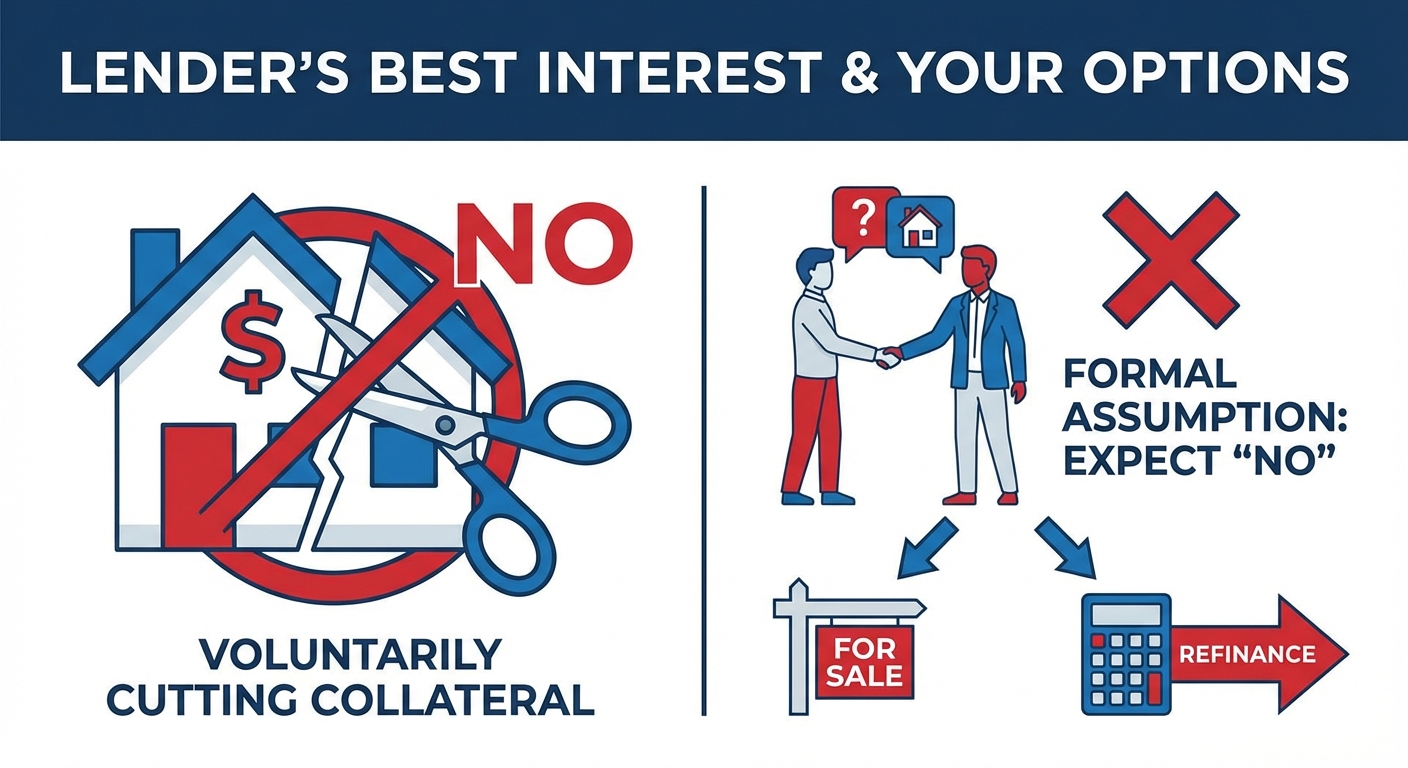
A loan assumption is when the lender agrees to remove one person from the existing loan, leaving the other solely responsible. This is extremely rare in Canada for auto loans.
Most lenders are unwilling to do this because it increases their risk. They approved the loan based on two incomes and two credit profiles. Voluntarily cutting that collateral in half is not in their best interest. While you can always ask your lender if they offer a formal assumption process, you should expect the answer to be no and be prepared to pursue selling or refinancing instead.
Deep Dive: The Legal Decree vs. The Lender's Contract
This is a critical distinction that trips up many people, leading to financial disaster. A judge can order your ex-spouse to be responsible for the car payments in your divorce decree, but that court order does not change the contract you have with the bank.
Why Lenders Aren't Bound by Your Family Court Agreement
Your loan agreement is a private contract between you, your ex-spouse, and the financial institution. The family court is not a party to that contract and cannot unilaterally alter its terms. The principle of "joint and several liability" remains in full effect until the loan is paid in full. If your ex is ordered to pay but stops, the lender will come after you for the money and report the delinquency on your credit file. Your only recourse would be to take your ex back to court for contempt, but by then, the credit damage is already done.
How to Use Your Separation Agreement to Your Advantage
While the agreement can't force the bank's hand, it can force your ex-partner's. Work with your legal counsel to include specific, action-oriented language. For example:
"John Doe, who will be retaining the 2022 Honda CR-V, must make all reasonable efforts to refinance the associated vehicle loan (Acct# 12345) into his sole name within ninety (90) days of the signing of this agreement. Should he fail to secure refinancing, the vehicle will be listed for private sale, with both parties cooperating fully."
This creates a legal obligation with a timeline, giving you a stronger position if they fail to act.
What Happens When an Ex-Spouse Defies the Agreement and Stops Paying?
This is the nightmare scenario. You get a call from the lender about a 30-day late payment you knew nothing about. Your credit score has already taken a significant hit.
- Pay Immediately: Make the payment yourself to stop further damage.
- Communicate: Contact your ex-spouse to find out what happened.
- Enforce: If they refuse to pay or it becomes a pattern, contact your lawyer to enforce the separation agreement. This may ultimately force the sale of the vehicle.
Pro Tip: Provide your lender with a copy of the finalized separation agreement. While it doesn't release you from liability, it provides context for your situation. In our experience, some lenders may be more willing to discuss hardship options or communication strategies if they understand the legal arrangement between the two parties.
From 'We' to 'Me': Assessing Your Solo Car-Buying Power
Before you can even think about refinancing the old car or getting a new one, you need a crystal-clear picture of your new financial reality. Lenders will now view you as a single applicant. This section is your self-audit guide.
Calculating Your New Debt-to-Income (DTI) Ratio
Your DTI ratio is one of the most important metrics lenders use. It's the percentage of your gross monthly income that goes toward paying your monthly debt obligations. Most lenders in Canada prefer a DTI below 40-43%.
Here’s a simple worksheet:
- Calculate Gross Monthly Income: Your pre-tax salary/wages + any guaranteed bonuses, alimony, or child support received.
- Calculate Total Monthly Debt Payments: Your new rent/mortgage + minimum credit card payments + student loans + lines of credit + any child/spousal support you pay out.
- The Formula: (Total Monthly Debt Payments / Gross Monthly Income) x 100 = DTI Ratio %
Losing a second income can dramatically increase your DTI, making it harder to qualify for new credit. Understanding this number is the first step to planning your next move.
The Impact of Alimony and Child Support
This is a two-way street for lenders.
- If you receive support: Most lenders will consider court-ordered alimony or child support as qualifying income, provided you can show a history of consistent payments (usually 3-6 months of bank statements).
- If you pay support: These court-ordered payments are treated as a monthly debt obligation and are included in your DTI calculation, which can limit how much you can borrow.
Pulling Your Credit Report
Now is the time for a financial health check-up. You are entitled to a free copy of your credit report from both Equifax and TransUnion each year. Check it for:
- Accuracy: Ensure all information is correct.
- Joint Account Status: Verify how the joint car loan is reporting. Are there any late payments you were unaware of?
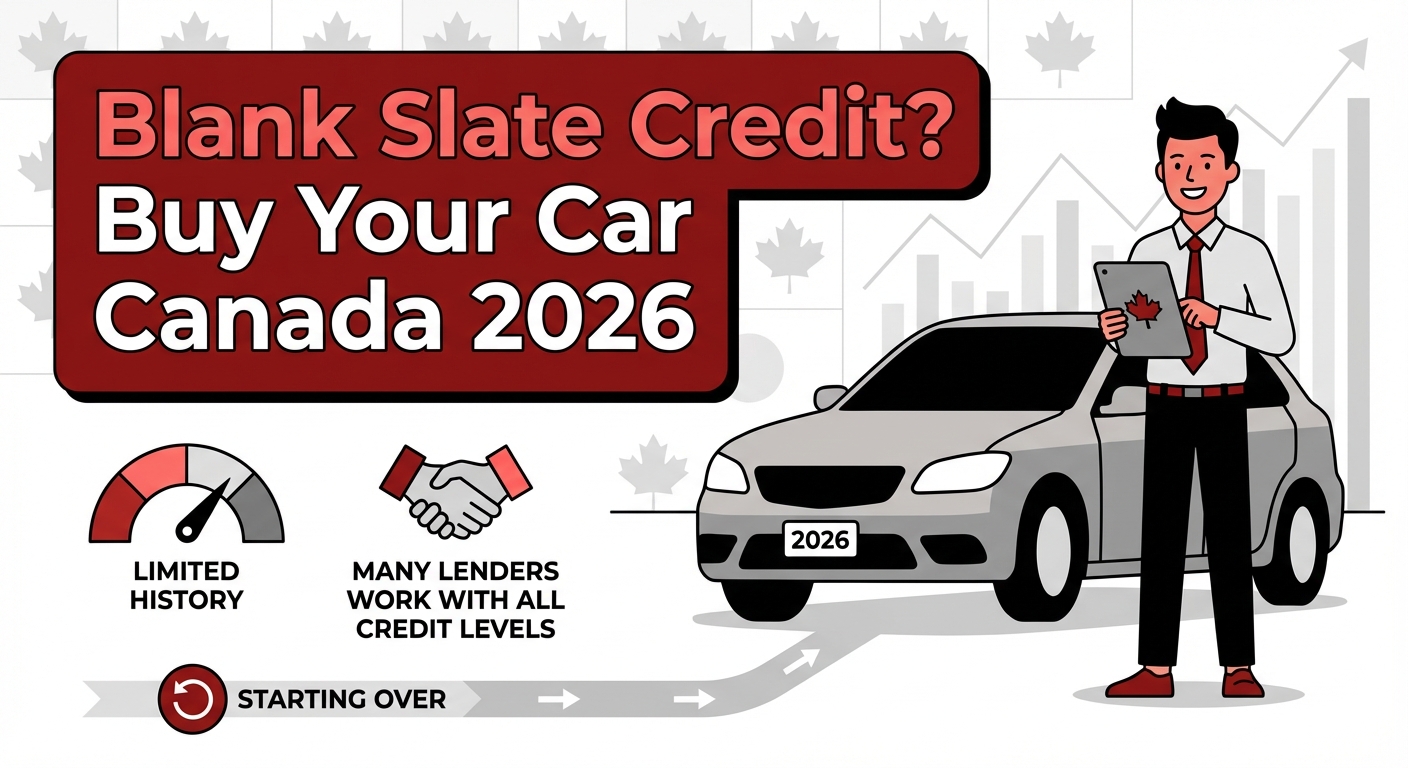
- Overall Score: Get a baseline of where you stand. A score above 660 is generally considered good, but many lenders work with all credit levels.
If you're starting over with limited credit history on your own, it's not a dead end. For more information, explore our guide on how to Blank Slate Credit? Buy Your Car Canada 2026.
Securing Your New Ride: A Strategic Approach to Getting Approved
You've handled the old loan, and now it's time for a fresh start. Whether you're refinancing or buying a different vehicle, the approach is the same. This section focuses on the practical steps of applying for and securing a new loan in your name only.
Bank vs. Dealership Financing: Which is better for a post-separation situation?
Both have their pros and cons, and the right choice depends on your specific financial profile.
| Financing Source | Pros | Cons |
|---|---|---|
| Major Banks / Credit Unions |
|
|
| Dealership Financing (like SkipCarDealer.com) |
|
|
The Power of Pre-Approval
Knowledge is power. Before you set foot on a car lot, get pre-approved for a loan. A pre-approval from a service like SkipTheCarDealer tells you exactly how much you can afford to spend and what your interest rate will be. This turns you into a "cash buyer" in the eyes of the dealership, allowing you to focus solely on negotiating the price of the vehicle, not the financing terms.
Down Payment Strategies
A significant down payment is your best friend in a post-separation car purchase. It does several things:
- Reduces Lender Risk: The less money they have to lend you, the lower their risk, increasing your approval chances.
- Lowers Your Monthly Payment: A smaller loan amount means a more manageable payment for your new budget.
- May Improve Your Interest Rate: Some lenders offer better rates for loans with a lower loan-to-value (LTV) ratio.
Even a past loan rejection can be a learning experience that helps you prepare a better down payment strategy. Learn how to turn that around with insights from our article: Toronto: Your Rejection Letter? It's Your New Down Payment.
Pro Tip: If your income has decreased, consider more affordable and reliable used vehicle brands known for their low cost of ownership, like Honda, Toyota, or Mazda. This demonstrates financial prudence to lenders and shows you are making responsible choices based on your new financial reality.
The 2026 Outlook: How Economic Shifts and New Lending Rules Could Impact Your Post-Separation Car Loan
Looking ahead helps you make smarter decisions today. The auto finance landscape is constantly evolving, and understanding these trends can give you an edge.
Interest Rate Forecasts
While we can't predict the future with certainty, auto loan interest rates are heavily influenced by the Bank of Canada's overnight rate. In a fluctuating economic climate, rates can change. Locking in a fixed-rate loan provides stability and predictable payments, which is especially valuable when you are managing a new, single-income budget.
The Rise of Alternative Data
Lenders are increasingly looking beyond traditional credit scores. They may start using "alternative data" to assess your creditworthiness. This could include your history of paying rent, utilities, and even phone bills on time. For someone rebuilding their credit file after a separation, this trend can be beneficial, as it allows you to demonstrate financial responsibility in other areas of your life.
Digital Loan Verification
The loan application process is becoming faster and more digital. Lenders can now often verify your income and employment electronically. This streamlines approvals but also means you need to have your digital financial house in order. Ensure you have easy online access to your bank statements, pay stubs, and any legal agreements. Having your documents in order is key, especially if you're in a new job. You can learn more about what you'll need in our guide, Your 2026 Contract: New Job Car Loan Proof, Ontario.
Your Post-Separation Auto Finance Roadmap: A 3-Step Action Plan
Feeling overwhelmed? Let's boil it down to three clear, actionable steps to take control of the situation and move forward with confidence.
- Step 1: Communicate & Investigate. This needs to happen today. Talk to your ex-partner about a plan for the joint loan. Simultaneously, call your current lender to get the exact loan payoff amount. Then, research your vehicle's current market value to understand your equity position.
- Step 2: Choose Your Path & Execute. Based on the information you gathered, decide on the best path: selling, refinancing, or pursuing assumption (if available). Begin the chosen process immediately. If refinancing, start the application. If selling, get the car cleaned and listed. Don't wait.
- Step 3: Solidify Your Solo Finances. Pull your own credit reports from Equifax and TransUnion. Calculate your new solo DTI ratio. If you'll need a replacement vehicle, secure a pre-approval to know exactly where you stand. This is about taking back control of your financial future.